best hermes web ui is really a four-way contest, because there are four practical ways to drive Hermes: the raw terminal, the official Hermes Desktop app, Buzz as a chat front-end, and a browser dashboard you control yourself. Julian Goldie has pushed real daily workload through all four, and his verdict is clear — the Agent OS web dashboard beats the rest, because it puts every agent, job and memory behind one screen instead of scattering them across tabs.
📺 Watch: Hermes Agent OS Just Changed AI Agents Forever!
🔥 Get the Agent OS as a free bonus: AI Profit Boardroom members get the full Agent OS zip, prompt libraries, daily tutorials and weekly live coaching calls. → Get inside
This page is the head-to-head. A separate guide on this site explains what a Hermes web UI actually is and how to get one running. Here the job is different: rank the options, be fair about each, and call a winner.
How These Rankings Were Decided
None of this comes from a spec sheet. The order below follows Goldie Bench, Julian's own hands-on testing routine — the same real-workload trials he runs on every model and tool before it earns a place in his stack. It is a personal scorecard rather than an objective industry benchmark, and that is exactly why the verdict carries weight: every option here has been driven properly, on real jobs.
The criteria are practical:
- Day-to-day speed — how quickly can you fire off real work?
- Visibility — can you see what your agents are doing at a glance?
- Continuity — do memory, history and context carry over?
- Access — can your team, or your phone, reach the agents?
- Compounding — does the setup get more valuable the longer you run it?
Every Way to Drive Hermes, Ranked
| Option | Strengths | Weaknesses | Best for |
|---|---|---|---|
| 1. Agent OS web dashboard | Chat, voice, agent teams, Kanban, workspaces and memory on one browser screen; models are swappable; reachable from your phone | You have to build it — or use the ready-made version | Daily drivers who want one mission control |
| 2. Buzz | Free, very intuitive, Slack-like; the easiest way to give a whole team access to your agents | A chat front-end rather than a full cockpit; one more separate app | Teams and non-technical staff |
| 3. Hermes Desktop | The official app; faster now, with artifacts and sandboxed live previews since the Herald release | Still one more separate window, and it started out rough | Solo users who want the official route |
| 4. Terminal (TUI) | Full power, nothing between you and the agent | Messy to drive day to day; no visual overview | Power users and debugging |
Now the countdown, from fallback to winner.
📺 Watch: Hermes: Agent OS + Obsidian + FREE Apis + WebUI!
1. The Agent OS Web Dashboard — Mission Control in a Browser
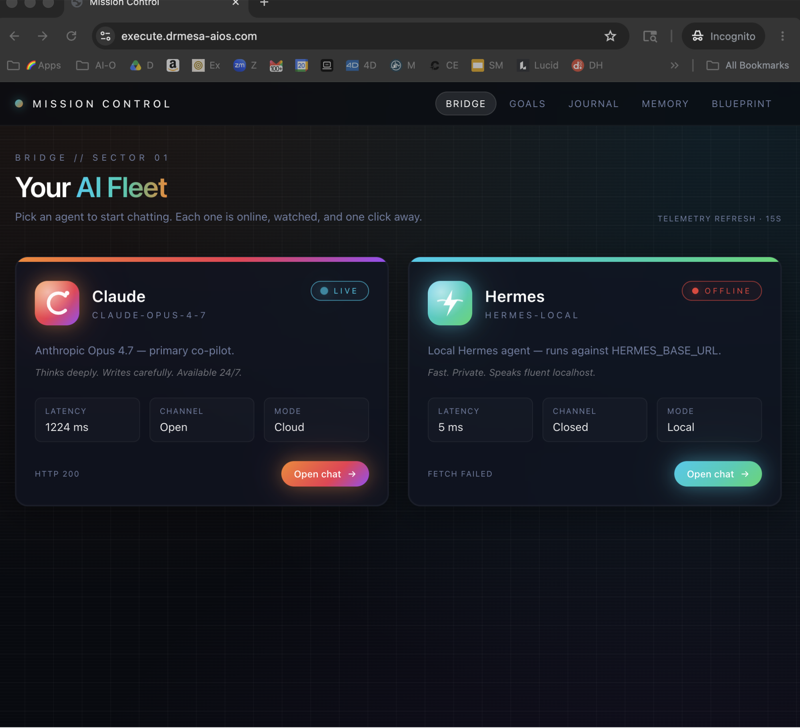
Julian's pick is the Agent OS web dashboard: a browser-based mission control running on localhost, with a button for every job he runs. One screen, everything on it:
- Chat with per-job profiles — each business task gets its own configured agent, one click away.
- Voice — Hermes Apollo speaks, listens, and controls the browser and the computer.
- Agent teams — multi-agent jobs run through Paperclip.
- A Kanban board — tasks get triaged visually instead of living in your head.
- Per-agent workspaces — every build an agent produces is saved somewhere you can find it.
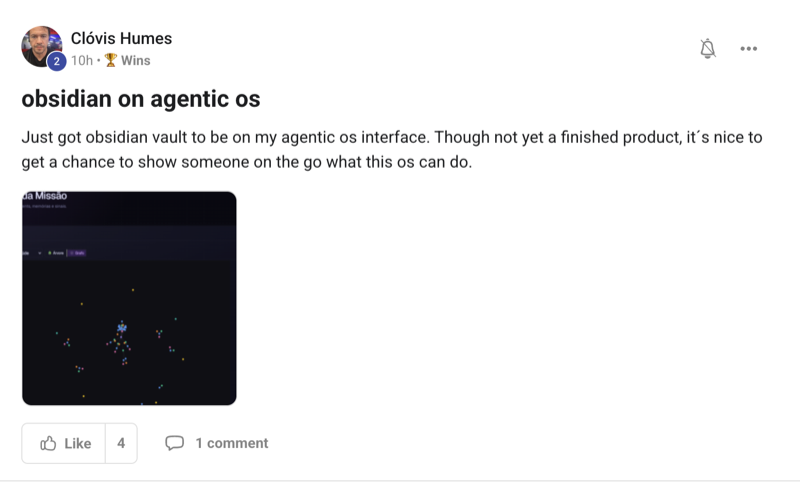
- The memory galaxy — his Obsidian memory visualised, so what the agents accumulate is something you can actually see.
He did not download this off a shelf. He asked Claude to build it, then kept improving it over a long time — which is the honest cost of this option: you either build and refine your own, or use the ready-made version that ships as a zip inside the AI Profit Boardroom.
2. Buzz — The Easiest Way to Give a Team Access
Buzz is Jack Dorsey's free, Slack-like chat app, and as a front-end for Hermes it is very intuitive: channels, messages, and your agents sitting in the sidebar like teammates. If you have ever used Slack, there is nothing new to learn.
Its superpower is people. If you want your VA, your editor or your whole team talking to your agents without anyone touching a terminal, Buzz is the easiest route on this list — the full Buzz integration walkthrough covers the wiring.
So why second place? Because a chat window is only one part of the job. Buzz will not show you a Kanban board of what is queued, a workspace of what got built, or what your agent remembers. And in Julian's experience it easily becomes one more tab in an already fragmented stack — Buzz here, Claude there, ChatGPT and Codex in two more tabs. Brilliant for the team; not the cockpit.
📺 Watch: NEW Hermes Agent Web UI is WILD!
3. Hermes Desktop — The Official App, Improving Fast
Hermes Desktop is the official way in, and credit where it is due: the app is improving quickly. It is faster than it used to be, it looks considerably better than it did at first, and since the Herald release it renders artifacts with sandboxed live previews — you can watch what the agent is building without leaving the window.
The trajectory matters here. Each release has genuinely moved it forward, and if that pace holds, it will keep climbing this ranking.
So why is it not the pick? Because it is still one more separate window in your stack. It handles conversations and artifacts well, but it is not trying to be mission control for every job, team, board and memory you run. On the criteria that decide this page — one place, visibility, compounding — it gives ground to the winner.
📺 Watch: NEW Hermes Agent Web UI is INSANE 🤯 (FREE!)
4. The Terminal — Powerful, But a Grind
The terminal is where Hermes actually lives, and everything above it on this list sits on top. Nothing is hidden from you here, which is why it remains the power-user fallback: when something breaks, or you want total control, you drop back to the TUI.
As a daily driver, though, it is a grind. Julian's line on it is blunt: "the terminal is fine, but a dashboard is way better." There is no board, no saved visual workspace, no glanceable state — just you, a prompt, and your own memory of what is running where.
Keep it installed. Do not live in it.
The Verdict: The Best Hermes Web UI Overall
Run through the same Goldie Bench lens as everything else in his stack, the dashboard wins on four counts — and each one is Julian's hands-on conclusion, not a spec-sheet claim:
- Everything lives in one place. The alternative is fragmentation — Buzz in one tab, Claude in another, ChatGPT and Codex in two more. That mess is precisely what the dashboard deletes.
- Models become swappable parts. In the dashboard, the model is a dropdown. Swap it, and the new model inherits your memory, your history and your jobs. The setup outlives any single model release.
- It compounds daily. Every profile refined, every task triaged, every build saved makes tomorrow faster than today. Chat apps reset; a dashboard accrues.
- Your phone can reach it. Over a private tailnet — phone access via Tailscale takes about ten minutes to set up — mission control stops being chained to your desk.
None of the other three delivers all four. That is the whole verdict.
If you want the best Hermes web UI making you money, check out the AI Profit Boardroom — the ready-made Agent OS dashboard ships inside as a zip, so you get mission control without months of building it yourself. → Get your ready-made dashboard
FAQ
Is the terminal ever the right choice?
Yes — as the fallback. It stays the power-user option for debugging and total control, and everything else on this list runs on top of it. It just should not be your daily driver when a dashboard can show you everything the terminal makes you hold in your head.
Is Hermes Desktop good enough on its own?
For a solo user who mostly chats and reviews artifacts, it is a solid start, and it is genuinely improving with each release — the Herald update added sandboxed live previews. The gap is scope: it is an app for conversations, not a cockpit for a whole operation.
Should I pick Buzz or a web dashboard?
They solve different problems, so it is not either-or. Buzz is the easiest way to invite humans in — a team talking to your agents inside a familiar chat app. The dashboard is for the operator running the whole show. If you have staff, there is nothing stopping you wiring up both and letting each do its job.
Do I have to build the dashboard myself?
No. Julian built his by asking Claude to build it and then improving it over a long time, but the finished version is packaged as a zip inside the AI Profit Boardroom, so you can run it without repeating the build phase.
Can I use the dashboard away from my desk?
Yes. It runs on localhost, and a private Tailscale tailnet extends it to your phone in around ten minutes — the same dashboard and the same agents, from wherever you are.
The Bottom Line
Four ways to drive Hermes, one honest ranking. The terminal is the powerful fallback. Hermes Desktop is the fast-improving official app. Buzz is the team-friendly chat layer. And the Agent OS web dashboard is the winner — the only option where chat, voice, agent teams, Kanban, workspaces and memory sit behind one screen that gets more valuable every single day.
"The terminal is fine, but a dashboard is way better." That was Julian's conclusion after running all four for real — and the longer the dashboard compounds, the harder it is to argue with.