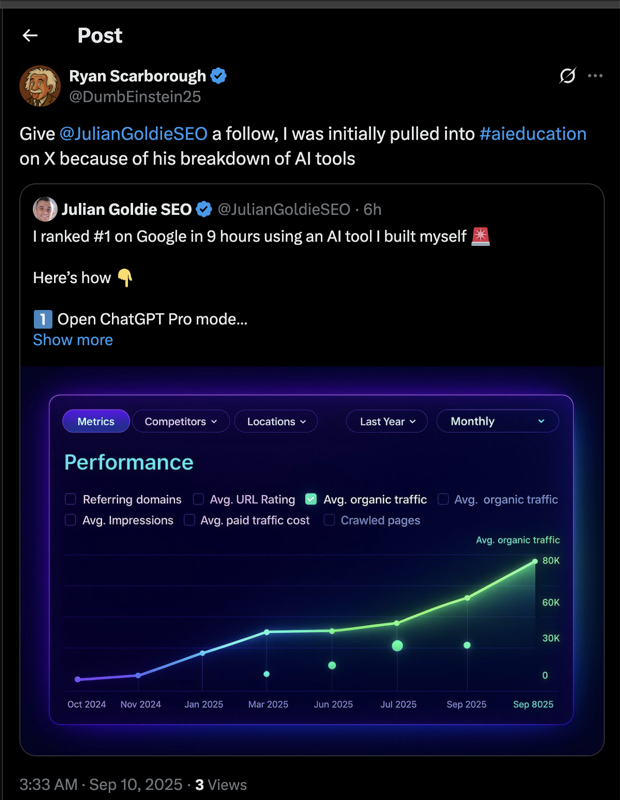
One claude ai seo skill now runs my entire content pipeline: I give it a single keyword, and it hands back five unique, published, verified and indexed articles across five sites.
📺 Watch: This Claude AI SEO Skill Ranks #1 FAST!
🔥 Get the Agent OS as a free bonus: AI Profit Boardroom members get the full Agent OS zip, prompt libraries, daily tutorials and weekly live coaching calls. → Get inside
No briefs. No editing. No uploading. No chasing Google to notice the pages.
In this post I will break down exactly what the skill automates end to end, the writing rules that make its pages rank, and the self-review loop that makes it sharper with every batch.
I have already covered using Claude Code as a general Claude Code SEO agent. This page is about the specific skill that agent runs — my blog post creator — and why packaging the whole playbook into one skill changed everything.
What Is the Claude AI SEO Skill?
A skill is a reusable instruction set that Claude loads automatically whenever it sees a matching job.
Mine carries every rule I have learned about ranking content — voice, titles, structure, schema, linking, indexing — so I never have to repeat any of it in a prompt.
Here is what happens when I hand it one keyword:
- It writes five completely unique articles for that keyword — different titles, openings, structures, examples and FAQs on each.
- It publishes one article to each of my five AI sites.
- It loads every live page and verifies it rendered correctly, embeds included.
- It submits every URL for indexing the same day.
- It updates my keyword tracker so I can see the whole batch at a glance.
- It reviews its own work and proposes improvements to its own rules.
One keyword in. Five ranking pages out.
That is the entire job description.
The Full Pipeline, Stage by Stage
| Stage | What the skill does |
|---|---|
| Transcript check | Confirms there is a real YouTube transcript for the keyword. No transcript, no article — it asks me for one before writing a word. |
| Writing | Five unique 2,000-3,000 word articles in my voice, written from the transcript, keyword in the first line, last line and headings. |
| Titles | Five different direct-response title formulas, one per site, each 50-60 characters. |
| Video embeds | Places the main video near the top, plus one or two older related videos woven into matching sections. |
| Conversion layer | Benefit-led opening claim, first CTA inside the first 30 percent, at least four personalised CTAs, styled callout boxes. |
| Technical SEO | Article and FAQ schema on every post, Review schema where relevant, author bio for E-E-A-T, comparison tables on vs and best posts. |
| Publishing | One unique article goes live on each of the five sites. |
| Verification | Opens every live URL and confirms the page and every video embed rendered correctly. |
| Linking | Same-site internal links, the cross-network block and the inbound link ladder — up to around 25 fresh contextual links per keyword. |
| Indexing | Submits every URL to an indexing service the same day, with sitemap and Search Console hygiene as a diagnostic checklist. |
| Tracking | Updates my keyword tracker with the new batch. |
| Self-review | Evaluates what worked and proposes specific changes to its own rules. |
If you want a Claude AI SEO skill ranking pages for you, check out the AI Profit Boardroom — it is where I share the exact systems, skills and training behind this pipeline so you can run the same play on your own sites. → Get the skill system working for your keywords
Why the Pages Rank: The Rules Inside the Skill
Transcripts Are the Source of Truth
Every article is written from the actual YouTube video transcript for that keyword.
Specific features, numbers and examples come straight from what I said on camera — never invented.
That one rule kills the biggest problem with AI content: confident nonsense.
If there is no transcript, the skill stops and asks for one before it writes anything.
Titles Written Like YouTube Headlines
Meta titles are treated like YouTube titles, because a search listing is basically a thumbnail without the picture.
The skill rotates five direct-response formulas across the five sites: number plus result plus timeframe, curiosity gap, a personal "How I" angle, bold claim with proof, and question plus payoff.
Each title runs 50-60 characters with a power word in it.
Generic "Guide to X" titles are banned outright.
My Voice, Not AI Voice
The writing rules are strict: first person, direct Alex Hormozi-style delivery with zero fluff, UK grammar, and every complete sentence on its own line.
Each article runs 2,000-3,000 words, puts the keyword in the first line, the last line and the headings, and ends with a proper FAQ section.
Five articles, one voice, zero filler.
Conversion Engineered Into Every Post
Ranking is pointless if the page does not convert.
So every article opens with a benefit-led claim, lands its first CTA inside the first 30 percent, and uses trust signals like member counts and specific results.
Each post carries at least four personalised CTAs in styled callout boxes.
And every URL is properly linked, because bare URLs kill conversion.
Technical SEO Baked In
Every post ships with Article and FAQ schema, plus Review schema where it fits.
An author bio block handles E-E-A-T, and vs or best posts get proper comparison tables.
None of it is optional, because it is written into the skill — it happens on every single post.
The Network Effect: Around 25 Links Per Keyword
This is the part most people miss.
Every article links two to four related posts on the same site.
Then an "Also On Our Network" block links to the same article on the other four sites — four backlinks per post, twenty per keyword.
Then the link ladder kicks in: the skill edits older related posts so they link into each new article.
Add it up and one keyword can generate up to around 25 fresh contextual links.
Cross-site links pass authority from my strongest site to the smaller ones, and they speed up indexing across the whole network.
📺 Watch: Claude Code AI SEO: How to Rank #1 with Claude Code
Same-Day Indexing, Every Time
Every URL is submitted to an indexing service via API on the day it goes live.
In my testing, same-day submission means dramatically faster ranking than waiting for Google to wander past on its own.
The skill also runs sitemap and Search Console hygiene as a diagnostic checklist, so no page sits invisible.
📺 Watch: Claude AI SEO System Ranks Me #1 on Google
The Skill That Improves Itself
This is my favourite part.
At the end of every batch, the skill evaluates what actually worked: which title formulas earned clicks, which CTAs converted.
Then it proposes specific changes to its own rules.
Most AI content workflows are static. This one compounds, because the playbook gets sharper with real data on every run.
The one decision left to me is which model runs it — and that is where Goldie Bench comes in. It is my own hands-on testing, not an objective leaderboard, but it tells me which Claude setup I trust with a job this long before I hand over a batch.
One Skill in a Bigger System
The blog post creator is one module in a larger machine.
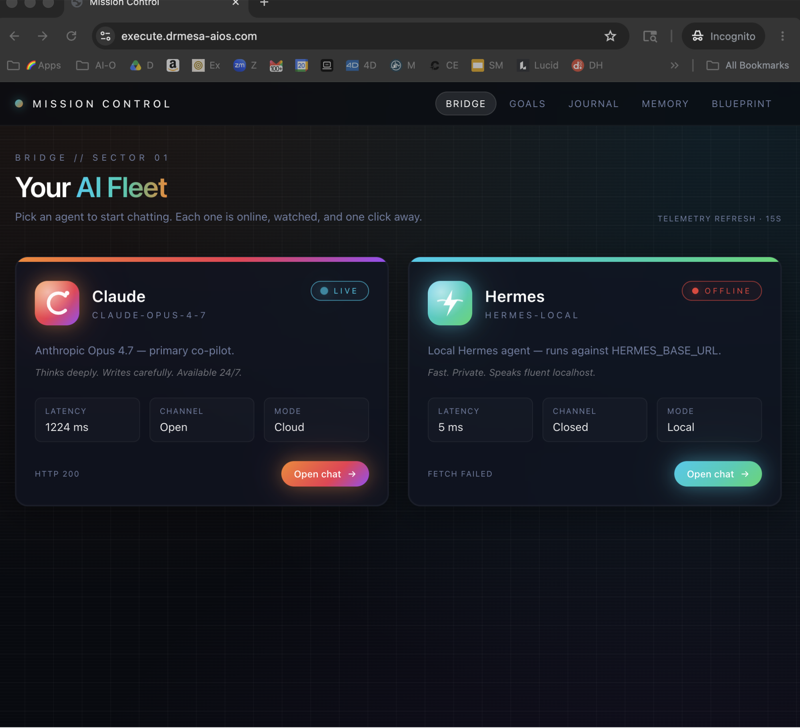
My Agent OS and Hermes run the same publish, verify, index and review play for my other channels, so the whole operation compounds in the same direction.
And this is exactly the kind of system I teach inside the AI Profit Boardroom: build the asset once, then let it work every week.
Claude AI SEO Skill FAQ
What is the claude ai seo skill exactly?
It is a reusable instruction set — my blog post creator — that Claude loads for content jobs. From one keyword it writes, publishes, verifies, links, indexes and tracks five unique articles, then reviews its own performance.
How is this different from a Claude Code SEO agent?
The agent is the worker. The skill is the playbook the worker follows. Without the skill I would re-explain my rules every session; with it, one keyword is the entire brief.
What happens if there is no transcript for a keyword?
The skill asks for one before writing anything. Transcripts are the source of truth, so no transcript means no article — that is what keeps the content specific instead of generic.
Do the five articles duplicate each other?
No. Each site gets different titles, openings, structures, examples and FAQs — five genuinely unique pages targeting the same keyword.
Can this work on a single website?
Yes. The transcript, title, voice, schema and indexing rules all apply to one site. You only lose the cross-network linking layer, which is where the extra authority comes from.
The Bottom Line
SEO used to be a to-do list. Now it is a loop.
One keyword goes in. Five unique articles come out, published across five sites, verified live, linked around 25 times, indexed the same day and logged in the tracker.
Then the skill studies its own results and rewrites its own rules for the next batch.
That is why I stopped writing blog posts manually — and why this claude ai seo skill is the highest-leverage asset in my entire content system.