Two agents, two completely different worlds. On one side you have OpenAI's terminal-based coding harness; on the other, Nous Research's open-source always-on agent — and the Hermes agent Codex pairing turns out to be a surprisingly clean way of making them colleagues rather than rivals. Both of them live inside my Agent OS, and after weeks of running them together I can tell you which routes are real, which are officially documented, and which are pure wishful thinking.
📺 Watch: New Codex Updates are INSANE!
🔥 Get the Agent OS as a free bonus: AI Profit Boardroom members get the full Agent OS zip, prompt libraries, daily tutorials and weekly live coaching calls. → Get inside
The question lands in my inbox constantly: do I have to pick a side, or can the two actually cooperate? Short answer: they cooperate, five different ways. Here is every genuine route I've found — no invented mechanics, and no pretending a duct-taped shell script counts as an integration.
What You're Actually Pairing
Codex in a Nutshell
Codex is OpenAI's coding agent — a terminal-based harness driven by your OpenAI subscription and OAuth login. It sits in the same weight class as Claude Code and Hermes as one of the big harnesses people genuinely run every day, and it's very good at the job it was built for: taking a coding ticket and grinding through it. Two details matter for this article. First, there are free routes to it — I've covered the whole "Codex is now free" angle on the channel. Second, it's routable: tools now exist that wire into the OAuth session you already have, which quietly unlocks every pairing below.
Hermes in a Nutshell
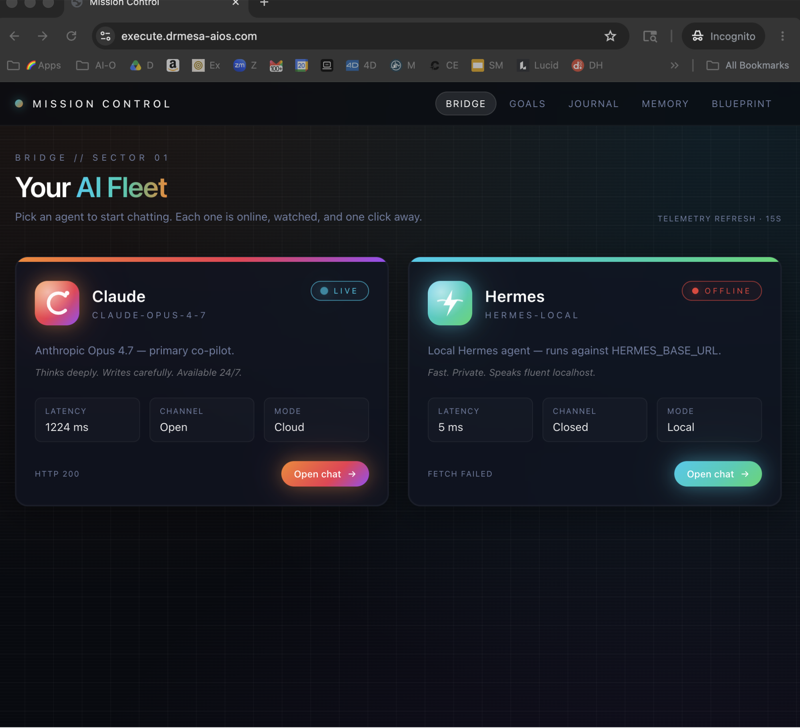
Hermes is Nous Research's open-source agent, and it plays a different game entirely. It ships with persistent memory, 80 skills, scheduled tasks and gateways out to the apps you already use — I run mine in bot mode so it's reachable from my phone all day. Crucially, it's provider-agnostic: Hermes doesn't care whose model or whose engine does the thinking. That neutrality is exactly why it pairs so well with a subscription-locked engine like Codex.
Hermes Agent Codex: The Five Routes That Actually Work
Route One: The Documented Codex App-Server Runtime
Start with the official one. Hermes's own documentation lists a Codex App-Server Runtime under its automation features — a first-party, documented integration point between the two. I'm deliberately not going to guess at the mechanics here; the Hermes docs are the source of truth for how it's configured and what it expects. The headline is simply that it exists at all: this pairing isn't a community hack, it's on the official feature list. If you only investigate one route, make it this one.
If you want your coding engines and your always-on agent working as one system, the AI Profit Boardroom ships the Agent OS where Hermes, Codex and Claude sit side by side. → Get the combined stack
Route Two: Kanban Worker Lanes
Hermes ships a documented multi-agent Kanban board, and it formalises the pattern I'd already been running by hand: one orchestrator triaging tickets, several coding workers implementing them. Hermes does the triage; the worker lanes do the building. It's the exact delegation shape I built in my Hermes OpenCode skill setup, except Codex can now be one of the worker engines pulling tickets off the board. Hermes never needs to be brilliant at code — it needs to be brilliant at deciding who codes.
Route Three: Side by Side in a Roster
Two roster tools put Codex directly on the team sheet. OpenMausBot lets you assign an engine per bot, and Codex is one of the options — so your existing Codex login drives one teammate while Claude and Grok drive the others. Paperclip goes further into org-chart territory: its adapters include Codex, so you can build a team where a Codex bot is simply the employee who takes the coding tickets. I covered that whole structure in my Hermes agent Paperclip piece. The idea is the same in both: Codex stops being "that terminal I open" and becomes a named colleague.
Route Four: The Router Angle
This is the route that makes the economics sing. 9Router wires into the OAuth logins you already have — Claude, Codex, Copilot, Cursor — so your agents can route work through the Codex access you're already paying for rather than a fresh API bill. I walked through the full setup in how to use 9Router. Once the router is in place, your Codex subscription becomes shared plumbing instead of a walled garden, and OmniRoute adds a pool of free providers around it so overflow work never even touches the paid lane.
Route Five: The Ecosystem Signal
The fifth route is less a cable and more a weather report. When DeepSeek shipped V4 Pro, it arrived with native OpenAI-response-API support and Codex integration on day one — I broke that down in my DeepSeek V4 Pro piece. Read the signal: Codex compatibility is becoming a standard target that other labs build towards from launch. For anyone running a mixed stack that's excellent news, because every new model that speaks Codex's language slots into the routes above without any fresh glue.
📺 Watch: Hermes Agent + Codex is INSANE!
How I Actually Split the Work
Here's my honest split after living with both. Codex is a strong coding engine with its own subscription economics — when it's on a ticket, it earns its keep. Hermes is the always-on layer: it remembers what we decided last Tuesday, runs the schedules, and triages what actually needs doing today. So the pairing that works for me is Hermes orchestrating — memory, schedules, triage — while coding engines, Codex among them, do implementation bursts. Hermes holds the diary; Codex turns up, smashes through a build, and clocks off.
Which engine takes which ticket is a side-by-side call, and that's precisely what Goldie Bench exists for — my own testing of the same task across engines before I hand out the work. The honest summary: this setup feels dramatically smoother than juggling terminals, because the thing with memory does the remembering and the things with horsepower do the lifting.
📺 Watch: NEW Codex + Hermes Agent MCP is Insane! (FREE!)
The Free and Cheap Access Angle
You don't need new spend to try any of this. There are free routes to Codex itself — my "Codex is now free" coverage walks through them — and 9Router's whole trick is reusing the OAuth sessions you already pay for, so the marginal cost of adding Codex to the roster is zero. OmniRoute then wraps a free-provider pool around the paid lanes, which is the same free-first thinking behind my free Grok bot alternative. Between those three, the entire Hermes and Codex stack in this article can run on subscriptions you already own plus a pool of engines that cost nothing.
Where Codex Sits Next to Claude Code and OpenCode
One honest paragraph for the comparison shoppers. Codex, Claude Code and OpenCode all fill the same slot: the coding harness that takes a ticket and implements it. I've paired Hermes with each of them — the Hermes agent Claude Code combination and the Hermes OpenCode integration both work beautifully — and my advice is deliberately unglamorous: pick the harness attached to the subscription you already pay for, then trust feel. Hermes complements all three rather than competing with any of them, which is the entire reason this pairing exists.
Every Route at a Glance
Here's the whole Hermes agent Codex menu in one place — the route, what it actually gives you, and how much effort it takes to stand up.
| Route | What it gives you | Effort |
|---|---|---|
| Codex App-Server Runtime | First-party, documented integration point — the mechanics live in the Hermes docs | Low to medium — follow the official docs |
| Kanban worker lanes | Hermes triages the board; Codex implements as a worker engine | Medium — board plus worker wiring |
| Roster tools (OpenMausBot, Paperclip) | Codex as a named teammate next to Claude and Grok, driven by your existing login | Low — assign the engine per bot |
| 9Router plus OmniRoute | Existing Codex OAuth becomes shared plumbing, with a free-provider pool for overflow | Low — one router configuration |
| Ecosystem compatibility | New models like DeepSeek V4 Pro target Codex support on day one | None — it compounds on its own |
FAQ: Hermes and Codex
Can Hermes work with Codex?
Yes. The strongest evidence is the documented Codex App-Server Runtime in Hermes's own automation docs, and around it sit the roster and router routes — OpenMausBot and Paperclip put Codex on the team, while 9Router shares out the access you already have. The Hermes agent Codex question stopped being "if" a while ago; it's now purely about which route suits your stack.
Does Hermes replace Codex?
No, and it isn't trying to. They're different layers: Codex is an implementation engine, Hermes is the always-on layer with memory, schedules and gateways. Swapping one for the other is like replacing your calendar with a power drill — both useful, neither does the other's job.
Can I use my Codex subscription in these setups?
Through OAuth-wrapping tools, yes — 9Router and OpenMausBot both drive the Codex login you already have. What you're not doing is bolting Codex in as Hermes's brain: Hermes keeps its own provider-agnostic model setup, and Codex plugs in beside it as an engine that takes tickets.
Is Codex free?
There are free routes to it — I've covered the "Codex is now free" angle in detail on the channel — and the free-access section above shows how the router layer stretches whatever access you've got even further. You can test every route in this article without adding a single new subscription.
Which should I learn first?
If you write code all day, learn Codex first — it pays for itself on the first big refactor. If you want an assistant that remembers, schedules and triages, start with Hermes. Either way you'll end up wanting the pairing, because each one is the missing half of the other.
My Verdict
The Hermes agent Codex pairing is the least dramatic integration story I've covered this year, and I mean that as a compliment. One documented runtime, a Kanban board that formalises delegation, two roster tools, a router that reuses the logins you already own, and an ecosystem drifting towards Codex compatibility by default. Hermes runs the diary; Codex takes the tickets. Two worlds, one org chart — and not a juggled terminal in sight.
If you want a stack where Hermes runs the diary and Codex smashes through the tickets, check out the AI Profit Boardroom — inside you get the Agent OS, the delegation playbooks, four weekly coaching calls, daily tutorials and 3,700+ business owners building the same systems. → Build your orchestrator-plus-engines stack