Hermes agent Omarchy support is now first-class: Nous Research announced on X on 9 September 2026 that you can install the Hermes desktop app straight from Omarchy's AI menu, set Hermes as your default terminal agent, and have your Omarchy theme colour the desktop app, the TUI and the CLI automatically. If you run DHH's agentic Linux distribution, Hermes is no longer something you bolt on afterwards — it is part of the operating system's furniture.
📺 Watch: Run Hermes Desktop With Ollama for FREE
🔥 Get the Agent OS as a free bonus: AI Profit Boardroom members get the full Agent OS zip, prompt libraries, daily tutorials and weekly live coaching calls. → Get inside
I have been tracking Hermes closely across its desktop, CLI, messaging and terminal surfaces, and this is the kind of integration I have been waiting for someone to ship. Not a plugin. Not a wrapper. An agent listed in the distro's own menu, coloured by the distro's own theme system. Below I break down what the announcement covers, what the community made of it on day one, and how I would set it up.
What Is Omarchy? DHH's Agentic Linux Distribution
Omarchy is an Arch-Linux-based distribution created by DHH — David Heinemeier Hansson, the creator of Ruby on Rails. Where most distros treat AI tooling as something you install after the fact, Omarchy is built around agentic workflows from the ground up: the working assumption is that you will be operating alongside agents all day, so the OS ships with the plumbing to make that normal. The official site is omarchy.org if you want the full picture.
That design philosophy is exactly why this integration fits so naturally. Omarchy wants agents to feel native; Hermes is an agent that already runs across CLI, desktop, messaging and terminal surfaces. Putting the two together was close to inevitable.
What Hermes Agent Omarchy Support Actually Includes
The announcement covers three concrete pieces, and I am going to be precise, because I am not in the business of inventing menu options that do not exist.
Install the Desktop App From the AI Menu
Omarchy now lists Hermes in its AI menu, which means you can install the Hermes desktop app directly from the distribution's own interface. No hunting for packages, no separate download step — the app sits alongside the rest of Omarchy's AI tooling, ready to go. If you are on another platform and need the manual route instead, my Hermes desktop installation guide walks through it step by step.
Set Hermes as Your Default Terminal Agent
The second piece: Omarchy lets you make Hermes your default terminal agent. On a distribution built around agentic workflows, the default terminal agent is prime real estate — it is the agent you reach for without thinking, in the surface where most real work happens. Hermes can now occupy that slot if you want it to.
Theme-Synced Colours Across the Desktop App, TUI and CLI
The third piece drew the most specific praise on the thread: your Omarchy theme sets the colours in the Hermes desktop app, the TUI and the CLI. Change your system theme and every Hermes surface follows suit. It sounds cosmetic, but it is precisely the detail that makes an agent feel like part of the operating system rather than a foreign window floating on top of it.
Integrations like this are exactly the kind of shift I turn into traffic and revenue for my own sites — if you want my full agentic SEO systems for doing the same, join me inside the AI Profit Boardroom. Prefer one-to-one help? Book a free SEO strategy session and I will map out your plan with you.
📺 Watch: Hermes3D Is INSANE: AI Agents Now Have a 3D Office
Why the Integration Matters: The Agent Becomes Part of the OS
The community reaction on the announcement thread told the story better than the announcement itself. One developer called having Hermes inside the AI menu "the bigger win — no install means people will just try it". Another put it more bluntly: "making the agent part of the OS matters way more than another benchmark win". Several users confirmed the integration installed and worked on day one, the theme-colour transposition drew specific praise as genuine polish rather than a token listing, and — inevitably — the joke landed: "I use Hermes on Arch, btw".
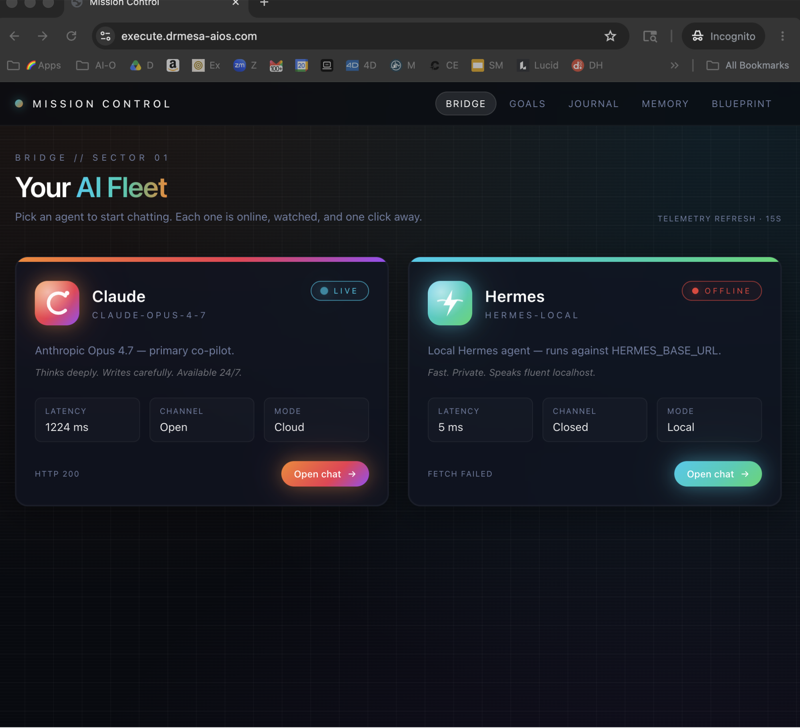
This is also my Agent OS thesis playing out in public. I have long argued that the endgame is not a better chatbot in a browser tab — it is the agent becoming part of the operating system itself: mission control for your work, agents as infrastructure rather than apps you remember to open. Omarchy shipping Hermes in its AI menu, themed by the system and installable in one step, is the clearest example yet of a distro treating an agent as a first-class citizen. The friction of trying Hermes has just dropped to effectively zero for every Omarchy user, and zero friction is how defaults get set.
Who Is This For — and Who Is Unaffected?
If you already run Omarchy, you now get zero-friction Hermes: install from the AI menu, optionally set it as your default terminal agent, and your theme handles the rest. If you are not on Arch, nothing is taken away from you. Hermes itself is cross-distro and cross-platform — one user on the thread noted they run Hermes happily on Fedora, and that remains true. Omarchy does not gate anything; it simply makes Hermes native to one particular distribution.
In other words, Omarchy users gain convenience while everyone else carries on as before. Wherever you run it, my Hermes agent best practices apply regardless of your operating system.
📺 Watch: Hermes AI Agents Just Went Portable
Pairing Omarchy With Local Models
Here is where the integration gets genuinely interesting for the self-hosting crowd. Hermes Desktop already ships one-click local model setup with NVIDIA backing on Windows and Linux — I covered the whole flow in my Hermes Desktop local model guide. An Omarchy machine with an RTX card is exactly the target profile: an Arch-based distro built for agentic workflows, an agent installed from the system menu, and a model running on your own GPU with no API bill attached.
That combination — native install plus local inference — is about as close to a fully self-contained agentic workstation as you can currently get. And if you prefer routing local models through Ollama instead, my Hermes agent Ollama setup covers that route in detail.
Honest Notes: Open Questions and Mixed Feedback
Two things from the thread are worth flagging honestly. First, an open question: whether computer use works inside Omarchy. The announcement does not address it, and at the time of writing I have not seen a definitive answer on the thread — so treat computer use as unconfirmed here until Nous Research or the Omarchy side says otherwise.
Second, the feedback was not uniformly glowing. At least one long-time user praised the underlying refactor but criticised the desktop app's UX maturity and open bugs. That reads to me as mixed feedback on desktop app polish rather than on the integration itself, which day-one users confirmed working. Check the official Omarchy site and Nous Research's channels for the current state before you commit a production machine to it.
The Momentum Behind the Move
This integration did not arrive in a vacuum. Hermes has been on a run — the v0.21 Pantheon release set the recent pace, and the pattern is consistent: ship the model, then ship the surfaces that make the model usable everywhere. CLI, desktop, messaging, terminal, and now a Linux distribution's own AI menu. I test each of these releases against my own real workload rather than leaderboard puzzles — Goldie Bench is where I explain how I benchmark agents on actual work — and the cadence of practical integrations matters more to my results than any single score.
Hermes Agent Omarchy at a Glance
| Integration piece | What the announcement says |
|---|---|
| Desktop app install | Available directly from Omarchy's AI menu |
| Terminal | Hermes can be set as your default terminal agent |
| Theming | Your Omarchy theme sets the colours in the desktop app, the TUI and the CLI |
| Source and date | Announced by Nous Research on X, 9 September 2026 |
| Official site | omarchy.org |
Frequently Asked Questions
What is Hermes agent Omarchy support?
It is the first-class integration Nous Research announced on X on 9 September 2026: the Hermes desktop app installs straight from Omarchy's AI menu, Hermes can be set as the distribution's default terminal agent, and your Omarchy theme automatically colours the desktop app, the TUI and the CLI.
What is Omarchy?
Omarchy is an Arch-Linux-based distribution created by DHH, the creator of Ruby on Rails, built around agentic workflows — an operating system designed on the assumption that you work alongside AI agents.
Do I need Omarchy to run Hermes?
No. Hermes is cross-platform and cross-distro — it runs in CLI, desktop, messaging and terminal surfaces on other systems, and one user on the announcement thread confirmed running it happily on Fedora. Omarchy simply makes Hermes native rather than exclusive.
Does the Omarchy theme really recolour everything?
Per the announcement, yes — your theme sets the colours across the desktop app, the TUI and the CLI, and that transposition drew specific praise from users on day one.
Where do I get Hermes on Omarchy?
From Omarchy's AI menu, per the announcement — that is the stated install path for the desktop app, with omarchy.org as the official site for the distribution itself.
My Verdict
The hermes agent omarchy integration is a small announcement with a large signal. Three modest features — menu install, default terminal agent, theme-synced colours — add up to the thing I keep banging on about: agents becoming part of the operating system instead of apps perched on top of it. There are honest caveats on desktop polish and an open question on computer use, but the direction is unmistakable, and DHH's distro just made Hermes the easiest agent for its users to try. That is how adoption actually happens.
If you want to ride shifts like this before your competitors have even heard of them, join the AI Profit Boardroom and get my complete agent-driven SEO playbook — or book a free SEO strategy session with me and we will build it around your business.