Hermes vs OpenCode is one of the questions I get asked most, and it makes sense: both are free, open-source AI agents, both can run free models, and both have blown up over the last few months. But here is the thing most comparisons miss — they are built for completely different jobs.
📺 Watch: Hermes Agent V0.19 Just Changed AI Agents Forever!
🔥 Get the Agent OS as a free bonus: AI Profit Boardroom members get the full Agent OS zip, prompt libraries, daily tutorials and weekly live coaching calls. → Get inside
I run both of them every single day inside my Agent OS. OpenCode is my free coding engine, and Hermes is the business agent that runs pretty much everything else. So rather than guessing, I put them through my own Goldie Bench testing — the same hands-on benchmark I use for every AI tool I cover — and this article breaks down exactly what I found.
Quick note before we start: everything here is based on my personal testing and daily use, not lab-grade benchmarks. Your results will vary depending on your machine, your models, and what you throw at them.
What OpenCode Actually Is
OpenCode is an open-source coding agent that lives in your terminal. If you have ever used Claude Code, it will feel instantly familiar: you describe what you want in plain English, and it runs an agent loop — writing code, running it, hitting errors, and fixing them until the job is done.
The difference that jumped out in my Goldie Bench testing is token efficiency. On the same coding jobs, OpenCode consistently used fewer tokens than Claude Code did in my runs. It is a similar experience, just leaner under the bonnet.
Why Token Efficiency Matters
Fewer tokens means two very practical things. If you are on a paid API, your bill drops. And if you are running free models, you hit rate limits far less often — which is the difference between a smooth coding session and one that stalls halfway through.
The 100 Percent Free Coding Stack
OpenCode ships with built-in free model options, like Big Pickle. The catch is that free models can get rate-limited when demand spikes, and Big Pickle is no exception.
That is why I pair OpenCode with OmniRoute, a free router that connects 290 providers — around 90 of them free — giving you access to more than 500 models with automatic fallbacks. When one free model gets rate-limited, OmniRoute quietly switches to another, and OpenCode just keeps coding. Together they form a genuinely 100 percent free coding stack, which is a big part of why I recommend the combination so often.
What Hermes Actually Is
Hermes is an open-source AI agent that lives on your computer and talks to any model you point it at. Coding is just one thing it can do — the real story is everything else.
Out of the box, Hermes gives you:
- Skills — reusable playbooks the agent loads for specific jobs, from SEO to publishing
- Shared memory — an Obsidian-based "memory galaxy" that every agent can read and write, so context compounds over time
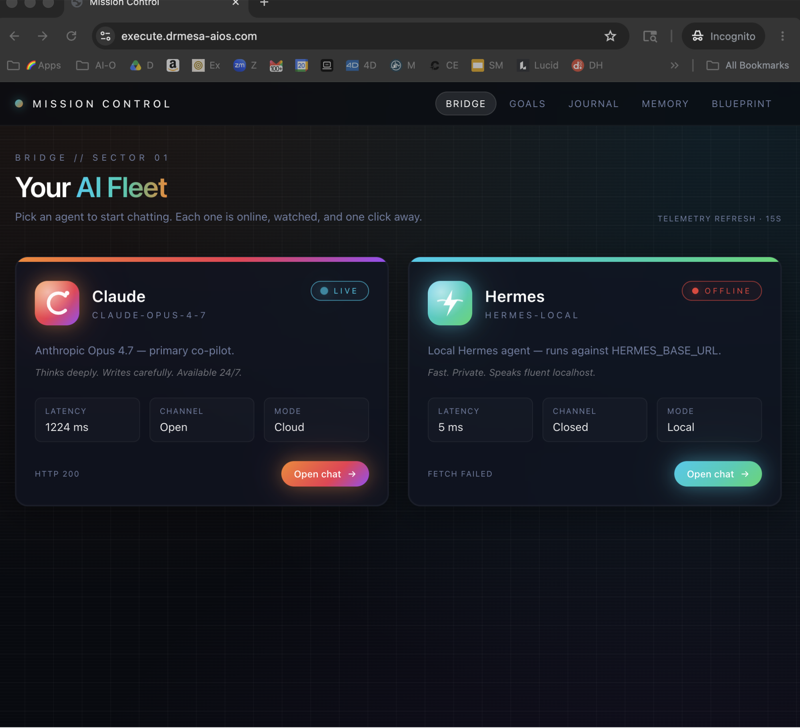
- A mission-control dashboard — one screen to watch everything your agents are doing
- Specialist agents — Hermes Apollo for voice, Hermes Oracle for news, and Hermes Astros for competitor tracking
- Autonomous background work — scheduled jobs that run while you sleep
- Gateway platforms — Telegram and Buzz support, so you can message your agent from anywhere
The Quicksilver Release Changed the Game
The V0.19 Quicksilver release pushed Hermes noticeably further ahead in my day-to-day use. Replies are roughly 80 percent faster, and fleet routing lets one gateway serve many agent profiles — each with its own model, its own memory, and its own skills.
Add smart approvals and new free models like HY3 and Laguna S 2.1, and you have what I would honestly call the most powerful and customisable agent I have used — and that includes every paid agent I have run through Goldie Bench.
Hermes vs OpenCode: The Head-to-Head Comparison
Here is how the two stack up across the categories that matter most, based on my own testing and daily use:
| Category | Hermes | OpenCode |
|---|---|---|
| Purpose | Whole-business AI agent — content, research, publishing, voice, always-on jobs | Dedicated coding agent for building and fixing software |
| Interface | Runs on your computer with a mission-control dashboard, plus Telegram and Buzz gateways | Lives in your terminal |
| Models | Talks to any model you point it at; free options include HY3 and Laguna S 2.1 | Built-in free models like Big Pickle; pairs with OmniRoute for 500+ models and automatic fallbacks |
| Memory | Obsidian-based shared memory galaxy across every agent profile | Project-level context focused on the code in front of it |
| Automation | Scheduled autonomous jobs, fleet routing, smart approvals | Agent loops that write, run, and fix code until the task is done |
| Token use | Depends entirely on the model and workload you give it | Noticeably token-efficient in my Goldie Bench runs — cheaper on paid APIs, fewer rate limits on free ones |
| Best for | Automating an entire business | Free, efficient coding |
One thing the table hides: these two barely compete. They overlap on coding and diverge almost everywhere else, which is exactly why the either-or framing falls apart the moment you use them.
📺 Watch: Omniroute + OpenCode: 100% FREE AI Coding Setup!
Which One Should You Pick?
If you genuinely only want to run one of them, here is the honest breakdown from my testing.
Pick OpenCode If...
- You mainly want an AI that writes and fixes code for you
- You like the terminal and want a Claude Code-style workflow without the token burn
- You want a completely free coding setup by pairing it with OmniRoute
- Token efficiency matters because you are paying per API call
Pick Hermes If...
- You want one agent handling your content, SEO, research, and publishing
- You want memory that persists and compounds across every conversation
- You want voice, news, and competitor agents working alongside the main one
- You want scheduled jobs running autonomously in the background
- You want to message your agent from Telegram while you are away from the desk
But honestly, treating this as either-or is the mistake I see most people make. Both tools are free, so the real question is not which one to install — it is which job to give each of them.
📺 Watch: Hermes Agent + Buzz is INSANE!
Why I Run Both Inside My Agent OS
In my Agent OS, OpenCode and Hermes are not rivals. They are colleagues with very different job descriptions.
OpenCode sits in its own tab as the free coding engine, wired up to OmniRoute. When something needs building — a landing page, a script, an automation — that is where the job goes, because coding eats tokens fast and OpenCode burns the fewest of any coding agent I have tested.
Hermes is the main business agent. It handles content, SEO, research, publishing, and voice, remembers everything through the shared memory galaxy, and keeps scheduled jobs ticking over in the background whether I am at the desk or not.
The combined effect is bigger than either tool on its own. Hermes decides what the business needs; OpenCode builds whatever software that requires. Both free, both open source, both running free models — and each one doing the job it is genuinely best at.
If you want Hermes and OpenCode making you money together, check out the AI Profit Boardroom — you get my complete Agent OS with both tools already wired in, plus the exact workflows I use to turn them into income. → Get the Agent OS with Hermes and OpenCode inside
Frequently Asked Questions
Is Hermes better than OpenCode?
It is the wrong question, because they do different jobs. In my Goldie Bench testing, OpenCode wins on token-efficient coding, while Hermes wins on everything beyond coding: memory, automation, voice, gateways, and business workflows. Neither result makes the other tool worse.
Are Hermes and OpenCode really free?
Yes. Both are free and open source, and both can run free models. OpenCode pairs with the free OmniRoute router for automatic fallbacks, and Hermes ships with free options like HY3 and Laguna S 2.1. The only cost comes if you choose to plug in a paid API model.
Can OpenCode replace Claude Code?
For a lot of jobs, in my experience, yes. It works the same way — describe the task, let the agent loop run — and in my testing it used fewer tokens doing it. If you are paying per token, that difference compounds quickly.
Can Hermes write code too?
It can — point it at a capable model and it will happily build things. But in my setup, coding goes to OpenCode because it is more token-efficient at that specific job, which frees Hermes to stay focused on running the business.
Do I need both to get started?
No — start with whichever matches your immediate need. But once you run them together, with OpenCode building and Hermes operating, it is very hard to go back. That combination is the closest thing I have found to a free AI employee stack.
The Bottom Line
Hermes vs OpenCode is not a fight with a single winner. OpenCode is the best free, token-efficient coding agent I have put through Goldie Bench. Hermes is the most powerful and customisable all-round agent I have used, paid tools included.
Pick OpenCode if your world is code. Pick Hermes if your world is a business. And if you want the setup I actually run every day, put both inside an Agent OS and let each one do what it does best — together, and completely free.