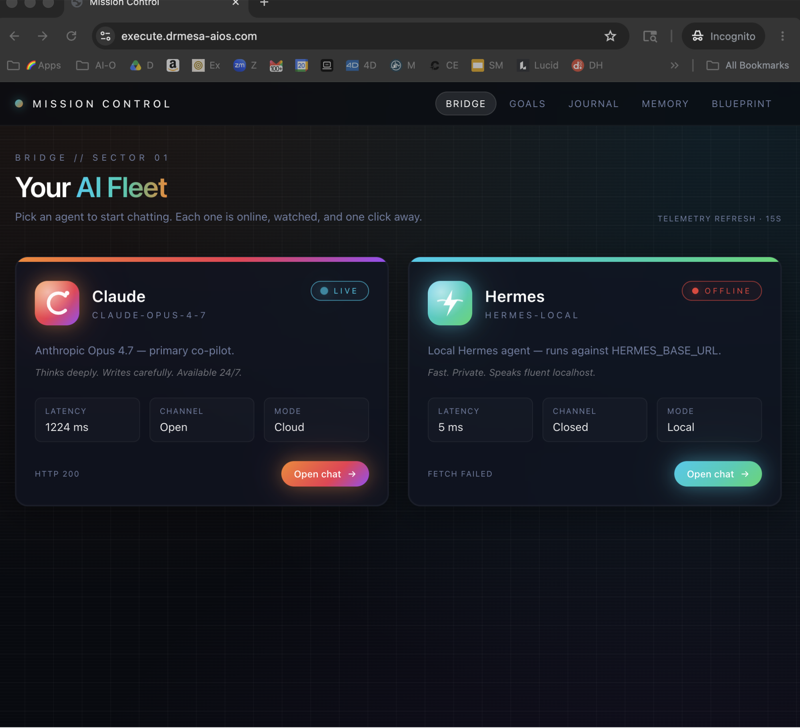
If your Hermes agent feels slow or laggy, the good news is that how to speed up Hermes usually comes down to a few simple changes — the model you run, where you run it, and how much context you hand it. Here's exactly what makes Hermes slow and the practical fixes that make it fast.
📺 Watch: speed up Hermes by running it in the cloud
Want the fastest Hermes setup, done for you? It is built into the Agent OS inside the AI Profit Boardroom. → Join AIPB
Why Hermes Runs Slow
Hermes itself is lightweight — what slows it down is almost always one of four things. First, the model: a big local model (say a 70B+ running on modest hardware) is slow to respond and eats your computer's resources. Second, where it runs: heavy local models bog down your machine, and if your laptop is busy, so is Hermes. Third, context: a bloated conversation with a huge memory makes every reply slower. Fourth, mode: high-effort or mixture-of-agents modes think longer by design. Fix those and Hermes gets fast.
📺 Watch: Kimi K3 + Hermes AI Agent is INSANE!
How To Speed Up Hermes: The Fixes That Work
1. Switch to a faster model
The single biggest lever. Point Hermes at a faster model instead of a heavy one — a smaller or quantized local model, or a fast API model. For coding, fast composer-style models respond in a fraction of the time of a large thinking model. Match the model to the task: use a quick model for chat and a heavier one only when you genuinely need deep reasoning. See our best model for Hermes agent guide.
2. Run Hermes in the cloud
Local models are limited by your hardware. Running Hermes in the cloud offloads the work to dedicated servers, so responses are fast and consistent and your machine stays free. In testing, Hermes Cloud responds noticeably quicker than a lot of APIs, and it keeps running 24/7 even when your laptop is closed. If speed and uptime matter, this is the biggest upgrade you can make.
3. Trim the context and use a memory system
Every extra token in the conversation slows the next reply. Compact long conversations, start fresh chats for new tasks, and lean on a structured memory system so Hermes pulls only the context it needs instead of re-reading everything each time. A clean memory keeps it both smart and fast.
4. Right-size your local models
If you prefer to stay fully local, don't run the biggest model you can find — run the smallest one that's good enough for the job. A well-chosen small or quantized model on Ollama will feel far snappier than a giant model your hardware is struggling with, and you can always switch up for the rare task that needs more power.
5. Use OAuth or an API instead of a slow local model
If local is the bottleneck, connect Hermes to a fast model via OAuth or an API. With something like Grok via OAuth you can even do this for free with an existing subscription — fast responses, no heavy local compute, no API bill.
📺 Watch: Hermes Agent + Blender MCP is INSANE!
The Fastest Way To Speed Up Hermes
Put it together and the fastest Hermes is: a fast model, running in the cloud (or via OAuth/API), with a lean memory system feeding it context — all wired into one Agent OS so you can swap models in and out the moment something faster drops. That combination is exactly what I run, and it is built for you inside the AI Profit Boardroom.
Frequently Asked Questions
Why is my Hermes agent so slow?
Almost always the model or the hardware: a large local model on a busy machine is slow. Switch to a faster or smaller model, run it in the cloud or via an API, and trim your context, and it speeds up a lot.
What is the fastest way to run Hermes?
Run it in the cloud (or via a fast API/OAuth model) rather than a heavy local model, with a lean memory system. This offloads the compute off your machine and gives fast, consistent responses.
Does running Hermes locally make it slower?
It can — large local models use a lot of your computer's resources and slow both Hermes and your machine. A smaller local model, or moving to the cloud, is usually much faster.
The Bottom Line
How to speed up Hermes comes down to four moves: run a faster model, run it in the cloud (or via OAuth/API), trim your context with a good memory system, and right-size any local models. Do those and Hermes goes from laggy to instant — and you can get the whole fast setup done for you inside the AI Profit Boardroom.