Jev pricing is startlingly simple: TypeSafe charges $0.042 per million input tokens, and output tokens are free — "too cheap to meter", in their own words — and right now there is a second route, because Jev is completely free on Vercel's AI Gateway until 25 September 2026. That is the entire pricing model. No tiers. No seat licences. No output meter climbing while a model pads out an answer you never asked for. Below you get the official numbers from TypeSafe's 15 September 2026 launch, the free window and exactly how to claim it before it closes, and cents-level receipts from the builders Julian cites — so you can see what Jev actually costs before you wire it into anything that matters.
📺 Watch: How to Use Jev AI for FREE!
🔥 Get the Agent OS as a free bonus: AI Profit Boardroom members get the full Agent OS zip, prompt libraries, daily tutorials and weekly live coaching calls. → Get inside
Jev Pricing: The Official Numbers
Here is what TypeSafe published when Jev launched into early access on 15 September 2026, with signups running through the waitlist at console.typesafe.ai:
- Input tokens: $0.042 per million.
- Output tokens: free. TypeSafe's exact phrase is "too cheap to meter".
- Access: early access via the waitlist, or through Vercel's AI Gateway — which is currently the free route.
To put $0.042 per million tokens in context: feed Jev a full million tokens of input — roughly 750,000 words of emails, leads, or documents — and the bill lands around four cents. TypeSafe's homepage claims "193.6x faster, 444.6x cheaper", and to their credit they say themselves that this figure is the higher end of real-world gains. Their stated working range is 40 to 400 times cheaper than normal models, depending on the workload. Those multiples are the vendor's own numbers, not independent audits, and you should hold them that way until your own runs confirm them. If you want the full picture of what this model actually is before the pricing math, start with the Jev AI overview.
The reason output can be free is structural rather than promotional. Jev never writes text back to you. It returns decisions — picks and probabilities — and a probability is a few bytes, so there is nothing meaningful to meter on the way out. More on why that flips the economics further down.
The Free Window: Jev Costs Nothing on Vercel Until 25 September 2026
This is the time-sensitive part, so date-stamp it: Jev via TypeSafe AI is completely free on Vercel's AI Gateway until 25 September 2026. Julian covered the setup in his 20 September 2026 video "How to Use Jev AI for FREE!" — you grab an API key from Vercel's settings quick start, plug it into the AI SDK, and you are making Jev calls at zero cost for as long as the window stays open.
One honest note Julian flags in that video: Vercel required a card on file even though his usage stayed free. Nothing got charged, but do not be surprised when the card step appears. The click-by-click walkthrough is in how to use Jev, and if you are wiring it into code, the Jev AI API guide covers the calls themselves.
The adoption stat Julian pulls up from the gateway is the one worth remembering: on day one, TypeSafe reached 13% of teams on Vercel. Per the Vercel gateway stats shown in the video, that is twice GPT-5.6's day-one figure and six times Fable 5.1's. Free plus fast does that to adoption curves.
If you would rather test the free window alongside people already shipping with it, the AI Profit Boardroom is where 3,000+ members trade builds, prompts, and cost logs — several of the runs below came out of exactly that kind of shared testing culture.
What Jev Decisions Actually Cost in the Wild
Vendor multiples are one thing. Receipts are better. In his 19 September 2026 video "Jev AI: 10 INSANE Use Cases", Julian walks through runs from named builders. To be clear about sourcing: these are their runs and their numbers as Julian cites them, each one a single run rather than a controlled benchmark. With that caveat on the table, here is what real workloads cost, in cents:
| Builder (as Julian cites) | Workload | Time | Total cost |
|---|---|---|---|
| Riley Brown | 500 emails sorted into folders | Seconds | 3.5 cents |
| Hassan, developer | 1,000 research papers sorted into 24 categories | About a quarter-second per paper | 8 cents |
| Roman, builder | 700 leads scored, with message-mismatch flags | 40 seconds | 9 cents |
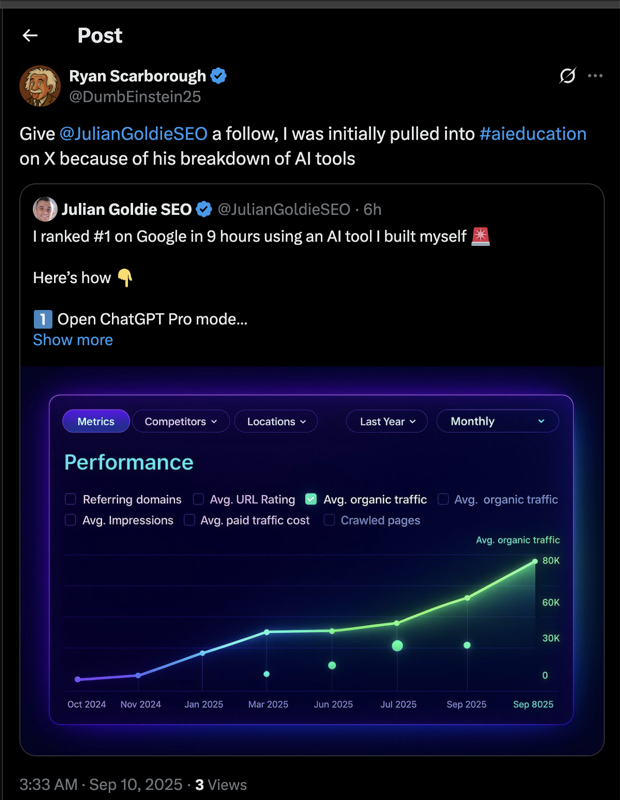
| SEO builder cited on X | 586-page site's internal link map rebuilt, 584 links placed | 45.1 seconds | 21 cents |
| Browser-agent team | Flight search completed by an agent | 7 seconds | Under half a cent |
The internal-linking run deserves one extra line. In the same 45.1 seconds it took Jev to rebuild the full 586-page link map and place 584 links, Claude Opus 5 had got through 21 pages. Same task, same clock, and the whole Jev run cost 21 cents. For the full breakdown of what these builds actually were — what counted as classification, what was scoring, what was routing — see Jev AI use cases.
And if you want a repeatable way to sanity-check numbers like these on your own workloads instead of taking screenshots on faith, that is exactly what Goldie Bench is for.
Julian's Own Cost Numbers
Julian's personal datapoint comes from his real-time outfit-mirror build — a camera app that decides, live, whether an outfit works. His claim from that build: Jev came out 95 to 99.5% cheaper than the writing models he tested it against, with each decision landing in roughly half a second. The range is wide because the comparison model matters, but take the worst case: even 95% cheaper turns a $200-a-month inference bill into $10.
That build runs inside his agent stack, and if you want the architecture it sits on, the Agent OS guide covers how the pieces fit together. If you would rather have someone run the cost math against your specific use case, book a free strategy session and bring your numbers.
Why Jev Is This Cheap: Decision Economics vs Writing Economics
The pricing only makes sense once you see what Jev refuses to do. A writing model charges you on the way in and on the way out — and the way out is where your money goes, because every token of the 400-word explanation you did not need still gets metered. Jev never generates text. It returns picks and probabilities, in parallel, and those are tiny. There is nothing to meter on the way out, so TypeSafe does not meter it.
Batching stacks on top of that. Ask Jev roughly ten questions about the same input and it costs about the same as asking one, because the input tokens — the only billable part, at $0.042 per million — are shared across the batch. That is why the per-decision cost in the table keeps landing in fractions of a cent. The structure of the model is doing the work here, not a promotional discount that quietly disappears later.
The Honest Caveats on Jev Pricing
Three things to hold onto before you re-plan a budget around these numbers:
- The big multiples are vendor claims. "193.6x faster, 444.6x cheaper" comes from TypeSafe's own homepage, and TypeSafe itself calls that the higher end. The working claim is 40-400x cheaper. Independent verification is thin this early, so run your own tests.
- The cents datapoints are single runs. Riley Brown's 3.5-cent email sort, Hassan's 8-cent paper run, Roman's 9-cent lead scoring — real builders as Julian cites them, one run each. Your workload, prompt design, and input size will move the numbers.
- The free window expires. 25 September 2026 is the date. If you are reading this after that, check the current terms on typesafe.ai and on Vercel before assuming anything in this section still holds.
Jev Pricing FAQ
Is Jev free?
Right now, effectively yes: through Vercel's AI Gateway, Jev is free until 25 September 2026, with a card on file required even while usage costs nothing, per Julian's setup video. Outside that window, official TypeSafe pricing applies — $0.042 per million input tokens, output free — with early access running through the waitlist at console.typesafe.ai.
What does Jev cost per decision?
Fractions of a cent in the attributed runs: 500 emails for 3.5 cents works out to 0.007 cents per email in Riley Brown's run, and 700 leads for 9 cents is about 0.013 cents per lead in Roman's. Because output is free and batched questions share the same input cost, per-decision spend stays in that territory across the cited builds.
What happens after 25 September?
The Vercel free window closes and standard TypeSafe pricing takes over: $0.042 per million input tokens, free output. Early-access terms can change between now and general availability, so check typesafe.ai for the current numbers before you commit a production workload.
Is Jev cheaper than GPT-5.6 or Claude for everything?
No, and TypeSafe does not claim it is. Jev only handles decisions — classify, score, pick, route — and the 40-400x cheaper range applies to those workloads. The moment you need generated text, you are back to writing models and writing-model economics.
Grab the Free Window While It Exists
The free window is the real story right now. $0.042 per million input tokens is already absurdly cheap, but until 25 September 2026 the number is zero, and zero is the correct price for finding out whether Jev fits your stack. Grab the Vercel key, rerun one of the workloads from the table on your own data, and look at what the cents column says.
Two ways to move faster. Join the AI Profit Boardroom at $69/mo locked in (normally $110) and compare cost logs with 3,000+ members already building on this. Or book a free strategy session and we will map Jev pricing against your actual workload, decision by decision.