Pull the Wi-Fi cable out of your laptop and almost every AI tool you own dies on the spot. The Magnitude AI agent is built so that party trick is the whole point — the model, the memory, the entire stack lives on your machine, and it keeps working with the internet gone. It landed on 8 August 2026, completely free, and I think it is one of the year's most important drops.
📺 Watch: Magnitude AI: FREE Local Agent Just Dropped
🔥 Get the Agent OS as a free bonus: AI Profit Boardroom members get the full Agent OS zip, prompt libraries, daily tutorials and weekly live coaching calls. → Get inside
What Is the Magnitude AI Agent and Why Did It Just Drop?
Magnitude is a free AI agent that runs 100% locally. No API keys, no token costs, no rate limits — and nothing you type ever leaves your machine. It shipped fully open source under the Apache 2.0 licence: free forever, including for business use.
It is built by Tom Greenwald and his team at Magnitude, who went through Y Combinator's Summer 2025 batch. Tom's launch line nails the problem: today's agents are local, but the model isn't — every prompt, file and secret gets sent straight to Anthropic and OpenAI. Magnitude flips that: the model itself lives on your laptop.
One honest caveat: I have not published my own hands-on test numbers for Magnitude yet. This is launch coverage, my framework, and what I would do this week.
The Zero Token Engine: My Framework for This
Every cloud AI runs on tokens. Every token either costs money or counts against a limit — hit one and it is "come back in 5 hours". Your entire workflow depends on someone else's meter.
A zero token engine has no meter. The model runs on hardware you already own. Ask it a thousand questions today, ten thousand tomorrow, run it all night — the cost is the same as leaving your laptop on. Zero tokens billed, zero keys, zero limits.
My one-sentence version: when AI stops costing you per use, you stop treating it like a vending machine and start treating it like an employee that never clocks out.
The Old Way vs the New Way of Local AI
Local AI has been possible for ages — and painful. The old way: install a separate tool to run models (Ollama, for example), guess which model your computer can handle, connect that model server to an agent tool, keep both running and hope they talk to each other. My Hermes local model setup guide exists because people kept getting stuck. Most gave up at step two.
The new way is one command: npm install magnitude. It looks at your hardware (chip, memory), tells you exactly which models will run well on your machine, and offers four simple choices: best quality, balanced, fastest, or lightweight. Then it downloads the model and sets everything up. My walkthrough on how to install a free AI model locally shows how many fiddly steps that one command replaces.
If you want new agents like this slotted into one system instead of another lonely install, the AI Profit Boardroom ships the Agent OS — built to plug in new agents like Magnitude as they drop. → Get the system
Why the Magnitude AI Agent Beats a DIY Ollama Stack
Three reasons. No separate inference server to configure — it is built in, spun up and down as you use it. Models are picked for your exact hardware rather than guessed at. And most important, the agent is built around local models and corrects their failures.
Small models make more mistakes than giant cloud models, so the team built the harness to catch and fix those slip-ups as it works. The harness props the model up — the difference between local AI being a toy and being useful. Same lesson as my best local model for a Hermes agent breakdown: the scaffolding matters as much as the model.
What You Can Actually Do With It
Out of the box, the Magnitude AI agent takes plain English and works your machine: read files, run routine jobs, tidy folders — no scripting knowledge needed. Skills take it further: they are like apps for the agent, one command adds one, and there is a whole directory at skills.sh.
Examples:
- An Excel skill that reads and builds spreadsheets
- A PowerPoint skill for slide decks
- Word documents and PDFs: read, fill, create
- A browser skill that can drive your logged-in browser
The real superpower is private data. Your numbers are the most sensitive thing in your business — client data you would never paste into a cloud agent. With Magnitude you can hand over that spreadsheet and ask it anything, because the data physically cannot leave your machine: no server on the other end, nothing to leak.
Same for private notes and journals (search, summarise and organise them locally) and messy file folders, where ten years of scattered documents get sorted. Boring work, but the kind of boring that saves hours every week.
Hardware Reality: What You Actually Need
When Tom was asked directly: ideally Apple silicon — any Mac from after 2020. No hard memory minimum, but about 32GB fits fairly capable smaller models; he mentioned smaller Qwen builds and the Gemma 4 models. My Qwen 3 8-27B breakdown covers what that family can do.
Not frontier level, but a working basic agent on the laptop you already own: no server rack, no gaming rig. It is Mac and Linux today, with Windows through WSL (a way to run Linux inside Windows).
I already run local Qwen and Gemma builds through my Goldie Bench side-by-sides, and that is exactly how I will judge which Magnitude model tier earns real work: same tasks, same scoring.
📺 Watch: Prime Agent: The Self-Improving AI Is Here
Under the Hood: The Bit That Sold Me
The inference engine — the part that actually runs the model — is Magnitude's own, written in the Rust programming language rather than borrowed. My furniture analogy from the video: loading a model is like moving furniture into a house. Most tools start shoving and hope. Magnitude's engine measures everything first, calculating exactly how much memory a model needs before loading it, so nothing crashes or jams.
It tunes itself to your hardware, multiple agents each keep their full conversation memory, you can switch models without breaking anything, and mid-task it stays responsive to new requests. It does not just run models — it runs them the way agents need them run.
The Honest Trade-Offs
Let me be straight, because most local AI coverage is not. A local model on a laptop is not as smart as Claude or GPT running in a data centre — not even close. Frontier models are miles ahead on hard reasoning, long complex projects and heavy coding.
But most daily AI tasks do not need the smartest model on Earth. Summarising, sorting files, drafting outlines, content drafts — a good small model handles all of it, especially with the harness correcting slip-ups — the same argument as my best open-source models guide: judge capability per task, not in the abstract.
The smart play is local AND cloud, not versus. Private, repetitive, always-on work goes local for free. The big thinking runs on a frontier model — Fable 5, GPT-5.6, whatever you use. That is exactly how my Agent OS is wired: match the tool to the job.
📺 Watch: NEW Qwen 3.8 Agent OS Update is INSANE! 🤯
Three Beliefs That Will Keep You Stuck
"I'm not technical." True a year ago. Not now. One install command, and Magnitude makes the technical choices for you. If you can install an app, you can run this.
"Free and local means weak." The small models of 2026 are better than the big cloud models of two years ago. Qwen and Gemma builds on a normal Mac read documents, build spreadsheets, draft and organise; my best free AI model rundown makes that case. "Weak" is outdated information, and outdated information is expensive.
"AI moves too fast — I'll wait until it settles." It will not settle. Magnitude shipped a requested feature same-day, and I saw the same pace covering Prime agent. The winners have a system for learning each tool as it lands. Waiting just widens the gap.
My Week-One Plan
- Got a post-2020 Mac? Install Magnitude. One command; let it profile your hardware and pick a model.
- Give it one boring, private job. Point it at your messiest folder and let it organise the lot, or hand it a spreadsheet you would never upload and ask away.
- If your machine cannot run it, do not force it. Learn the direction instead, because local, private, free agents are coming to every device.
- If you run a business, split your AI work into two buckets. Private and repetitive goes local. Heavy thinking goes to the cloud. The businesses that get the split right run more automation for less.
Local vs Cloud at a Glance
| Factor | Local (Magnitude) | Cloud (frontier models) |
|---|---|---|
| Privacy | Data never leaves your machine | Every prompt goes to a provider's servers |
| Cost per task | Effectively zero once installed | Every token billed or metered |
| Raw intelligence | Capable small models, harness-corrected | Frontier level, miles ahead on hard reasoning |
| Rate limits | None, run it all night | Caps, queues and "come back in 5 hours" |
| Best for | Private, repetitive, always-on work | Heavy coding, long projects, big thinking |
Magnitude AI Agent FAQ
Is Magnitude really free?
Yes. It is fully open source under the Apache 2.0 licence — free forever, including for business use, with no API keys and no token costs.
What computer do I need?
Tom Greenwald's own answer: ideally Apple silicon, meaning any Mac from after 2020. No hard memory minimum, but around 32GB comfortably fits fairly capable smaller models like the Qwen and Gemma 4 builds.
Is it as good as Claude?
No, and I will not pretend otherwise. Frontier models in a data centre are miles ahead on hard reasoning and heavy coding. But for summarising, sorting, drafting and organising, a harness-corrected small model does the job for free.
Does my data leave my machine?
No. The model itself runs on your laptop, so there is no server on the other end and nothing to leak. That is the entire point.
Does it work on Windows?
Mac and Linux are supported today. On Windows it runs through WSL, a way to run Linux inside Windows.
My Verdict
People are done sending private data to the cloud for every little task, and open-source local agents mean the price of AI labour on private work just went to zero. Once the model is on your machine, every extra task costs nothing — so you stop rationing and let it run all day. The Magnitude AI agent is the cleanest on-ramp to that future I have seen, and it has earned a place in my testing queue.
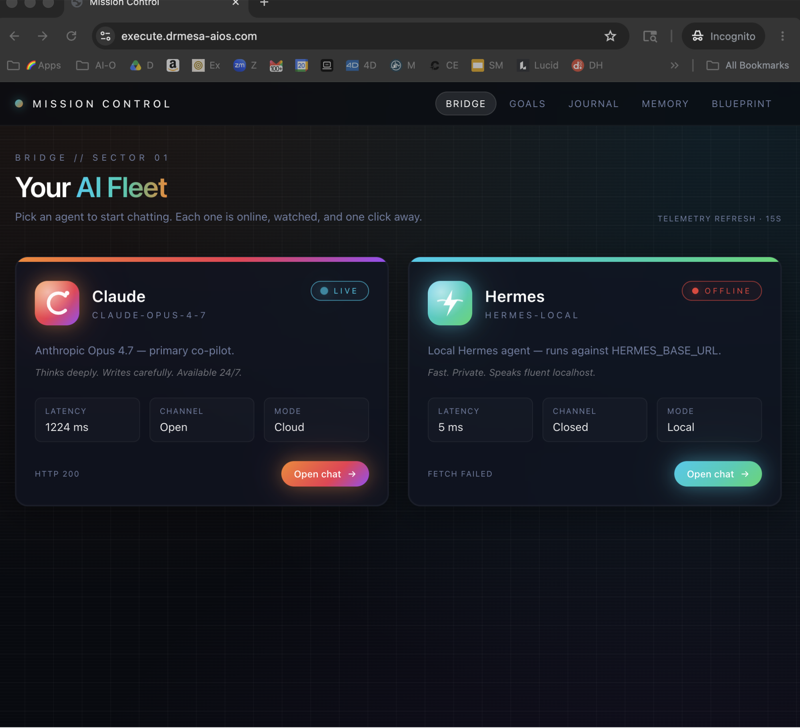
If you want an AI team that runs around the clock without a token bill, check out the AI Profit Boardroom — inside you get the Agent OS dashboard where Claude, Hermes, OpenClaw and new agents like Magnitude plug in together, the zip file with video tutorials, a 30-day roadmap, daily updates, four weekly coaching calls, and 3,800+ business owners inside. → Build your zero token engine