The Agentic OS local studio is where you run free, local AI models inside your Agent OS — a dedicated space to code and create with models on your own machine, with previews and a workspace to save everything. It's how you cut token costs to zero for the tasks that don't need a frontier model. Here's what it is and how to use it.
📺 Watch: building the Agent OS, including the local models studio
Want the local studio pre-built into your Agent OS? Get it inside the AI Profit Boardroom. → Join AIPB
What Is The Agentic OS Local Studio?
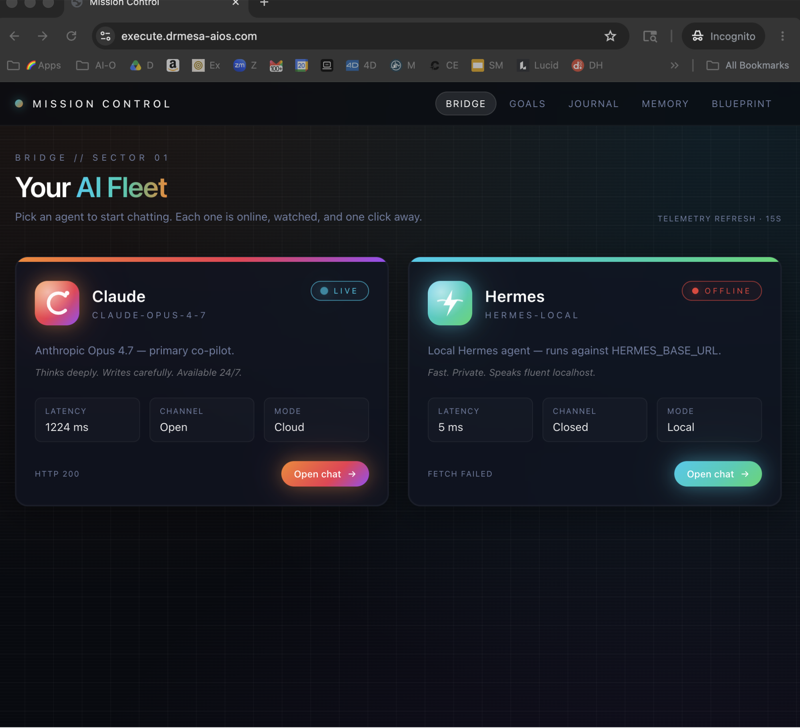
The local studio is a section of your agentic OS dashboard dedicated to local models. Instead of sending every task to a paid API, you run models on your own machine — via Ollama or LM Studio — right inside the studio, with a chat, a live preview, and a workspace of everything you've generated. It turns free local models into a first-class part of your Agent OS.
Why Use A Local Studio?
Two reasons: cost and control. Local models are free to run once installed and keep your data on your machine, so the local studio is perfect for the time-consuming tasks that don't need frontier-level effort. Offload those to a local model and save your paid tokens for the jobs that truly need them.
📺 Watch: LM Studio + Hermes Free Local AI Agents!
How To Set Up A Local Studio In Your Agent OS
You build it the same way you build any Agent OS feature — by asking your agent to add it. Prompt Codex or Claude to create a local section that connects to Ollama or LM Studio, with a chat, a preview and a saved workspace. Then pick your local model (Gemma 4, Qwen, or another) and start creating. See how to build an agentic OS.
📺 Watch: LIVE: Building Agentic Operating Systems with Claude
Best Local Models For The Studio
Gemma 4 is a great laptop-ready default; Qwen and Llama offer a range of sizes; and for heavier hardware you can run bigger open models. Match the model to your machine. See our best local model guide for picks.
Local Studio + Free APIs = Near-Zero Cost
Combine the local studio with free API routers and you can run a huge amount for nothing: local models for offline, private work, plus free APIs as backup when you want more power. That combination is how people run an Agent OS all day without burning through paid tokens.
Frequently Asked Questions
What is an agentic OS local studio?
It's a section of your Agent OS dashboard for running free local models (via Ollama or LM Studio) with a chat, preview and saved workspace — so you can create with local models in one place.
Why run models locally in the studio?
Local models are free once installed and keep your data private, which is ideal for time-consuming tasks that don't need a frontier model. It saves your paid tokens for the jobs that do.
How do I add a local studio to my Agent OS?
Ask your building agent (Codex or Claude) to add a local section that connects to Ollama or LM Studio with a chat, preview and workspace, then plug in a local model.
The Bottom Line
The agentic OS local studio makes free local models a first-class part of your Agent OS — run them on your machine, preview and save your work, and cut token costs to near zero. Build it yourself, or get it pre-wired in the Agent OS inside the AI Profit Boardroom.
Going Deeper: Building A Local Studio You Actually Use Every Day
The guide above covers what the local studio is and how to get one built. This section is the operating manual — what a complete setup includes, what hardware you realistically need, the honest version of the privacy and cost argument, a daily workflow that works, and how to scale from a laptop to a proper workstation.
What A Complete Local Studio Includes
A chat box connected to Ollama is a start, not a studio. The setups that get used daily tend to have five parts.
- A model runner and switcher. Ollama or LM Studio underneath, with a picker in your dashboard so you can jump between a small fast model and a larger careful one without leaving the page.
- Local media tools. Open image-generation and speech models run on the same hardware, so the studio can produce visuals and voiceovers as well as text — all offline.
- A live preview pane. When the model writes a page or a component, you want to see it rendered instantly. The preview is what turns generation into iteration.
- A saved workspace. Every draft, page and asset lands in a library you can reopen tomorrow. Without this, local work evaporates the moment you close the chat.
- Dashboard tiles. A place in your Agent OS showing which models are installed, what is running, and quick links into each tool — so the studio feels like a room, not a terminal command.
Hardware Tiers: What Your Machine Can Realistically Run
You do not need a monster machine to start, but it helps to know which tier you are in. These are broad strokes, not lab measurements.
| Tier | Typical machine | What runs well |
|---|---|---|
| Entry | Everyday laptop, modest memory | Small quantised models — drafting, summaries, simple chat |
| Mid | Recent laptop with generous memory, or Apple Silicon | Mid-size models comfortably — real daily studio work, light media |
| Heavy | Workstation with a strong GPU or high unified memory | Larger open models plus image and speech generation side by side |
The single most useful rule: memory matters more than raw speed. The model has to fit in memory with room left for context, so when you upgrade, buy memory first and clock speed second.
The Honest Case: Privacy And Cost
The privacy benefit is real and unqualified — prompts, files and outputs never leave your machine, which matters for client material and anything commercially sensitive. The cost benefit is real but needs stating honestly. Local is not free: you pay upfront in hardware and a little in electricity, and local models are weaker than frontier APIs on the hardest reasoning. The saving comes from routing — the high-volume, low-difficulty majority of your workload runs locally at no marginal cost, while paid tokens are reserved for the minority of jobs that genuinely need a frontier brain. Done that way, the studio pays for itself in avoided API spend; done as a total replacement for paid models, it will frustrate you.
A Realistic Daily Workflow
- Morning volume run. Queue the bulk work — outlines, first drafts, summaries, alt text — on your local model while you plan the day. Zero tokens spent.
- Midday review. Skim the workspace, keep what is good, mark what needs a stronger pass.
- Afternoon escalation. Send only the marked pieces to a paid model for polish or hard reasoning. This is the only point money leaves the building.
- Media pass. Generate supporting images or voiceover locally for anything shipping tomorrow.
- End-of-day save. Make sure everything worth keeping is in the workspace and noted in your Agent OS memory, so tomorrow starts warm.
Scaling From Laptop To Workstation
Upgrade when the queue tells you to, not before. The signs are concrete: you avoid running the model because it slows the machine, jobs queue behind each other, or the model tier you want simply will not load. When that day comes you have two sensible paths. Replace the laptop with a high-memory machine and keep everything in one place, or keep the laptop as your control desk and add a dedicated box — a workstation or a capable second-hand GPU machine — that sits on your network and serves models to your Agent OS. The second path is often the better value, and it means the studio keeps working even while your laptop is out of the house.
If you want to build and sell with AI without a monthly token bill eating the margin, check out the AI Profit Boardroom — the pre-wired Agent OS with the local studio, model picks and workflows is inside. → Get the local studio build here
More Local Studio Questions
Ollama or LM Studio — which should I choose?
Either works with the studio. Ollama suits people happy with a command-line install and scripted control; LM Studio gives you a friendlier visual app for browsing and testing models. Plenty of people run both.
Can the local studio work fully offline?
Yes — once models are downloaded, chat, preview and workspace all run without an internet connection. That is one of the strongest arguments for it: travel, outages and dodgy hotel Wi-Fi stop mattering.
How many models should I keep installed?
Two or three is the sweet spot: a small fast one for volume, a mid-size one for quality, and optionally a specialist for coding or media. More than that mostly eats disk space.
Will local models get better on the same hardware?
That has been the consistent pattern — each generation of open models does more with the same footprint. It is a genuine reason for optimism: the machine you buy today keeps gaining ability through software alone.
The Deeper Takeaway
A local studio earns its place when it is complete — models, media, preview, workspace, dashboard — and when you route work honestly: volume locally, hard jobs to paid models. Start on the machine you own, upgrade only when the queue demands it, and the studio becomes the cheapest employee in your business.