An agentic seo skill is a packaged capability an AI agent runs end to end without you babysitting a single step. It finds the keywords, writes the content, publishes it, checks the page actually rendered, submits it for indexing, and reports back when the job is done. Most people "using AI for SEO" have never seen one — they are still driving a chatbot by hand.
📺 Watch: This Claude AI SEO Skill Ranks #1 FAST!
🔥 Get the Agent OS as a free bonus: AI Profit Boardroom members get the full Agent OS zip, prompt libraries, daily tutorials and weekly live coaching calls. → Get inside
That distinction is the whole point of this page. A chatbot drafts. An agentic skill ships. Julian Goldie runs his content operation on the second model, and once you have watched SEO work this way, manual prompting feels like rowing a boat that has an engine.
This page defines the category: what makes a skill agentic, what one does in practice, why it compounds, and where the honest limits sit.
What Is an Agentic SEO Skill?
The definition is simple. An agentic SEO skill is a set of packaged instructions an AI agent executes as a complete job — not a prompt you feed it line by line.
"Complete job" carries four responsibilities:
- It finds the work. The skill pulls keyword opportunities from real data rather than waiting for you to suggest a topic.
- It does the work. It writes the article, builds the on-page elements, and publishes to the live site.
- It checks the work. It loads the live URL, confirms everything rendered, and submits the page for indexing.
- It reports and improves. It tells you what shipped, then refines its own rules based on what ranked and what earned clicks.
Remove any one of those and you are back to using AI for SEO the ordinary way: a fast writing assistant that still needs a human project manager. The agentic version removes the project manager. That is the category line.
The babysitting test
One test settles it. If you closed the laptop after giving the instruction, would a finished, live, indexed page exist an hour later?
If a human must still copy text from a chat window, paste it into a CMS, hit publish and remember to request indexing, it is not agentic. It is assisted. Useful, but a different species.
Chatbot SEO vs Agentic SEO
The table below is the clearest way to see the gap. Same goal, completely different operating model.
| Stage | Chatbot SEO | Agentic SEO |
|---|---|---|
| Keyword research | You brainstorm topics or paste in a list | The skill mines Search Console for gaps and picks targets |
| Writing | You prompt, review, re-prompt, edit | The skill writes from an approved source of truth under fixed rules |
| Publishing | You copy, paste, format and publish by hand | The skill deploys straight to the live site |
| Quality control | You eyeball the page, if you remember | The skill loads every live URL and verifies it rendered |
| Indexing | You wait, or request it manually | The skill submits every URL for indexing the same day |
| Learning | Lessons live in your head and fade | An end-of-batch review updates the skill's own rules |
| Your role | Operator on every single article | Editor of the rules, reviewer of the reports |
Notice the last row. In chatbot SEO your effort scales with output: fifty articles means fifty rounds of prompting. In agentic SEO your effort goes into the rules once, and output scales without you.
What an Agentic SEO Skill Does in Practice
Definitions are cheap, so here is what this looks like inside Julian's real stack, batch after batch.
Research from real data, not vibes
The skill pulls keyword gaps straight from Search Console data: queries where impressions exist but no dedicated page does. Every article starts from demonstrated demand rather than guesswork.
Writing with a source of truth
Articles are written from Julian's own video transcripts, and the transcripts are the source of truth — the skill is not allowed to invent facts beyond them. Titles follow CTR-first, direct-response formulas, and each post carries multiple relevant video embeds.
The technical layer, handled by default
Every page ships with JSON-LD schema and an author-bio E-E-A-T block. Internal links are added automatically, plus a cross-site network block, so each new post is backlinked from sister sites the moment it goes live. None of it depends on anyone remembering.
Shipping, verifying, indexing
Publishing is not the finish line. After every deploy the skill loads the live URL and verifies the page rendered correctly, then submits it for indexing via API the same day. A page nobody can find does not really exist, so indexing is part of the job.
The self-review
At the end of a batch, the skill reviews its own output and proposes rule changes based on what ranked and what got clicked. That one behaviour separates a workflow from a system.
📺 Watch: Claude Code AI SEO: How to Rank #1 with Claude Code
Where an Agentic SEO Skill Actually Lives
Two homes, in Julian's case. The first is a Claude skill — his Blog Post Creator — which packages the pipeline above into a capability the agent runs on command. For the walkthrough of that specific build, his Claude AI SEO skill has its own breakdown, so this page will not repeat it.
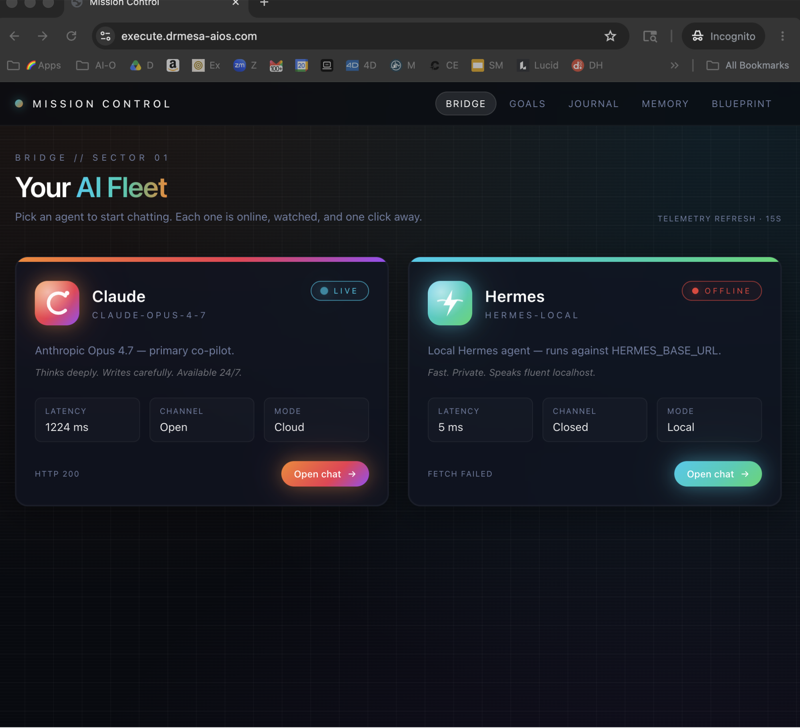
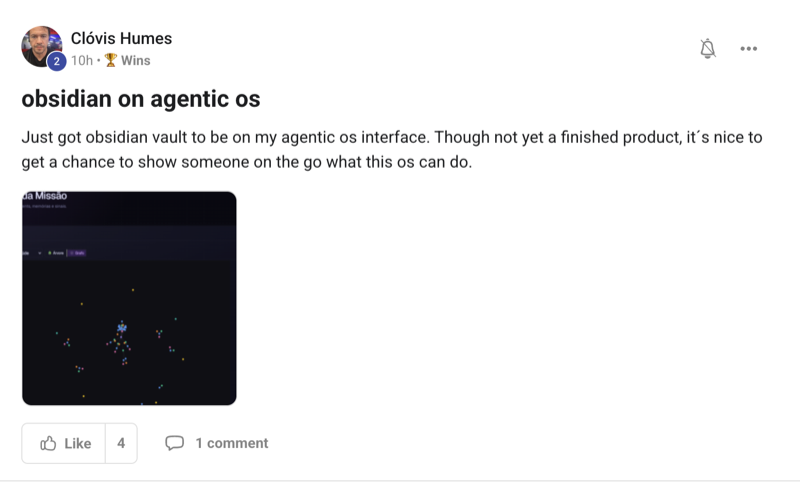
The second home is Agent OS, Julian's agent operating system, where SEO stops being a task you trigger and becomes a department that runs on schedules. Hermes executes the SEO workflows; Hermes Oracle pulls trending news and publishes on its own cadence; a Kanban board triages content tickets; and shared memory, kept in an Obsidian vault, keeps every agent on-brand without re-explaining the business each session.
The distinction matters. A skill on its own is a power tool. A skill inside an operating system is a member of staff.
📺 Watch: NEW AI SEO Agent is INSANE!
Why an Agentic SEO Skill Compounds
Here is the argument that matters.
A human-driven prompt workflow produces articles, and that is all it produces. Whatever you learned about titles or structure lives in your head and fades. Batch fifty is roughly as hard as batch one.
An agentic skill produces articles and better rules. Every batch teaches it which title formulas earn clicks and which calls to action convert, and those lessons are written back into the skill itself. Batch twenty runs on everything batches one to nineteen learned. The asset that appreciates is not the content — it is the skill.
The model underneath matters too, which is why Julian pressure-tests new models on Goldie Bench, his own hands-on benchmark, before trusting them with multi-step SEO jobs. It is his personal testing rather than an objective leaderboard, but it decides which model earns the right to run the pipeline — an agent that follows nineteen rules out of twenty ships quiet mistakes at scale.
The Honest Limits
Agentic does not mean judgement-free. Two things still sit firmly with the human.
Taste up front. The skill can find keyword gaps, but it cannot decide what your offer is or which keywords make money rather than vanity traffic. Julian points his skills at commercial terms because a human made that positioning call first. Aim the system wrong and it will efficiently produce traffic that buys nothing.
A verification habit. His skills verify every URL is live and every embed rendered before a job is called done, and the human still spot-checks the reports. Agentic SEO without verification is just automation you have not caught failing yet.
If you want an agentic SEO skill ranking pages while you sleep, check out the AI Profit Boardroom — the same Agent OS, SEO skills and daily tutorials Julian uses are inside. → Get the agentic SEO system working for you
Agentic SEO Skill FAQ
Is an agentic SEO skill just a fancy name for using ChatGPT?
No. A chatbot produces a draft you then carry through every remaining step by hand. An agentic skill owns the pipeline — research, writing, publishing, verification, indexing, reporting — and comes back when the work is live. The output of a chatbot is text. The output of an agentic skill is a live, indexed page.
Do I need to be a developer to use one?
Skills are written instructions the agent follows, so changing behaviour is closer to editing an operating procedure than writing software. Getting the rules sharp takes iteration, but the day-to-day is giving an instruction and reading a report.
Will Google penalise content published by an agent?
Google's public guidance targets unhelpful content, however it was produced. The real risk is not automation — it is automated slop. That is why the practices above exist: real transcripts as the source of truth, no invented facts, schema and author E-E-A-T blocks, and verification before anything counts as done.
How is this different from an AI SEO tool?
A tool automates one stage and waits for you to drive it. An agentic skill runs the whole loop, then rewrites its own rules from the results. A skill is better next month than it was this month.
The Bottom Line
An agentic SEO skill is not a better way to prompt. It is a different relationship with the work: you design the rules, the agent runs the pipeline — keywords, content, publishing, verification, indexing — and the results feed back into sharper rules while you do something else.
Chatbot SEO makes you faster. Agentic SEO makes you optional. Define the offer, pick keywords that pay, then hand the pipeline to something that never forgets a step. That is the category. That is the shift.