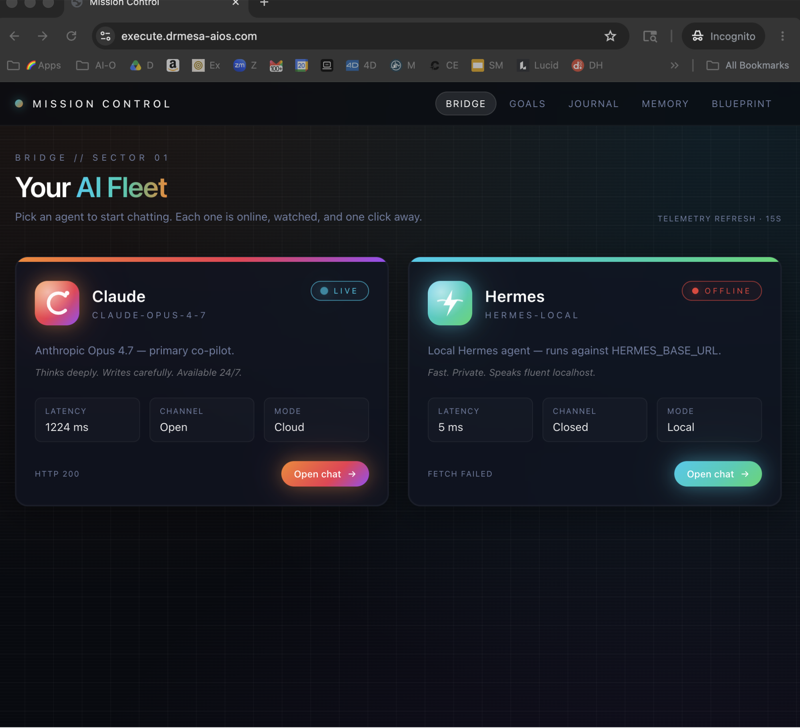
The best Hermes setup in 2026 stacks eight layers: Hermes Agent 0.21.4 or newer as the harness, a paid brain running on a subscription you already own, a free-model fallback lane so a rate limit never kills a build, a memory system your agents update themselves, voice, a cloud desktop for each agent, a small set of skills and plugins, and a quality loop that catches bad work before it ships. That is the complete answer. The rest of this page walks each layer with my pick, one line on why, and the link to the full deep-dive.
📺 Watch: This Claude + Hermes Setup is INSANE!
🔥 Get the Agent OS as a free bonus: AI Profit Boardroom members get the full Agent OS zip, prompt libraries, daily tutorials and weekly live coaching calls. → Get inside
One note on how to read this: I have published a full guide for nearly every layer, so this page is the hub that assembles them. The bigger philosophy — Hermes as an operating system for agents, not a chat window — lives in my Hermes Agent OS piece. This page is the shopping list and the build order.
The Eight Layers at a Glance
| Layer | My pick | Why |
|---|---|---|
| 1. Harness | Hermes Agent 0.21.4 or newer | The Claude plugin and newer features gate on it |
| 2. Paid brain | Claude Opus via the DirectSDK plugin | Rides the Claude Code subscription you already pay for |
| 3. Free lane | OmniRoute and 9Router | A rate-limited brain never stops a build |
| 4. Memory | Hermes memory plus an Obsidian second brain | Agents update it themselves; new models inherit it |
| 5. Voice | Voice Mode, the Apollo layer | Free push-to-talk by default, full duplex when you want it |
| 6. Agent desktop | Hermes Bot Screen | Each agent gets a cloud computer with saved logins |
| 7. Skills and plugins | /learn, Telegram business mode, memory-wiki | Teach workflows once, reuse them forever |
| 8. Quality loop | Gauntlet plus a Jev decisions layer | Builder versus critic on anything that ships |
Best Hermes Setup: Layer by Layer
Layer 1: The Harness — Hermes Agent 0.21.4 or Newer
Every pick on this page assumes a current harness, so updating Hermes is step one, not a chore to defer. Version 0.21.4 is the line: the official Claude plugin and several newer features gate on it, and on an older install half of what follows never even appears as an option. I have watched people spend an evening debugging a setup problem that was really a version problem. Update first, then build. My standing advice starts here too: if the update feels fiddly, ask Hermes itself to handle it — you are assembling a system whose whole job is work like this.
Layer 2: The Paid Brain — Claude on Your Claude Code Subscription
The single biggest upgrade in my Hermes setup is wiring Claude in as the paid brain through the official DirectSDK plugin, riding the Claude Code subscription I already pay for — no separate API bill. I run an Opus profile for heavy turns; the flow is one command, hermes profile create claude opus, and takes about three minutes. The full walkthrough is my guide to running Hermes on a Claude Code subscription. One caveat in one line: the plugin is experimental, so check Anthropic's current Terms before connecting — I keep the details current in the Hermes Claude auth guide. Why Opus? It keeps topping my Goldie Bench runs on real agent work, which is the only test I trust. If the subscription you already carry is ChatGPT instead, GPT-6 Astra is the alternative paid brain — I have covered that switch-over too.
Shortcut, before the remaining layers: the Agent OS zip inside AI Profit Boardroom is this entire setup pre-assembled, and I cover it honestly further down. Prefer to talk your situation through first? Book a free strategy session and I will map the layers with you.
Layer 3: The Free Lane — Two Routers, Not One
Every paid brain rate-limits, and the worst moment to hit a limit is mid-build. The free lane fixes that: OmniRoute and 9Router both installed, both in the model dropdown, so Hermes falls back the second the paid lane throttles. Two routers is deliberate redundancy — free lanes throttle, change terms, or die without warning, and the second one turns a stopped build into a non-event. I compared them head to head in 9Router vs OmniRoute; the real answer is both, not a winner.
Layer 4: Memory — An Obsidian Second Brain the Agents Keep Themselves
Memory is what turns a Hermes setup from a clever tool into a colleague. I run the built-in Hermes memory system paired with an Obsidian vault the agents update themselves — decisions, project state, and lessons get logged as they work, and I never write the notes. The payoff lands every time a new model drops: point it at the same memory and it inherits full context on day one instead of starting cold. Add the memory-wiki plugin and the vault becomes a browsable dashboard instead of a folder of files. The complete build is in my Hermes memory system guide.
Layer 5: Voice — The Apollo Layer
Voice is the layer I underestimated most in this Hermes setup. Voice Mode — the Apollo layer — switches on with /voice, Ctrl+B is push-to-talk, and the default Edge TTS voice costs nothing. Barge-in is supported, so you can cut the agent off mid-sentence the way you would a person. When I want zero buttons, the full-duplex desktop mode runs at $0.05 a minute and turns the desk into an open line. Those numbers are from the docs; my day-to-day notes are in the Hermes Apollo voice guide.
Layer 6: The Agent's Own Computer — Hermes Bot Screen
Hermes Bot Screen gives each agent its own computer: a cloud desktop with a real browser and saved logins, so web tasks run without borrowing your screen or your sessions. The setup is Docker-backed, and my advice is the same as for every fiddly config in this stack — do not hand-run the commands. Ask Hermes, or Opus 5.5 through the plugin from layer two, to build and test the container, then check the result. Owning agents and doing the setup manually is missing the point. Full notes are in the Hermes Bot Screen guide.
Layer 7: Skills and Plugins — Teach It Once
Skills are how a Hermes setup compounds instead of resetting every session. The /learn command teaches Hermes a reusable skill from one walkthrough — show it a workflow once and it is repeatable forever. Around it sits the command family — goal, loop, review and friends — which I keep a cheat sheet on because they turn one-off prompts into standing operations. Two plugins are worth naming. The Telegram business mode lets an agent run customer conversations with owner approval required before any reply goes out — the only way I would put an agent near customers. And memory-wiki, from the memory layer, keeps a permanent slot. Skip the plugin buffet; install what you will actually run.
Layer 8: The Quality Loop — Gauntlet, Jev, and Paperclip Above It All
The last layer separates demos from shipped work. Anything that leaves my Hermes setup goes through the gauntlet: one agent builds, a second plays critic, and nothing ships until it survives review. That builder-versus-critic pattern is documented in my gauntlet loop guide. On top sits a Jev decisions layer for routing and confidence-gated automation — high-confidence actions run themselves, low-confidence ones queue for a human — covered in Jev automation. And once you run more than a couple of agents, Paperclip is the org-chart layer above the whole stack, keeping the team coordinated instead of chaotic.
📺 Watch: Claude + Hermes Setup is WILD
The Assembly Order I Would Follow
You do not need all eight layers on day one, and trying to build them in one sitting is how setups stall. This order gets a working Hermes setup fastest:
- Update Hermes to 0.21.4 or newer — everything gates on this.
- Wire one paid brain — the Claude profile flow is about three minutes.
- Add the free lane — both routers, so a limit never stops you.
- Switch memory on — the sooner it starts accumulating, the more it is worth.
- Add voice, the Bot Screen desktop, and skills as the need actually appears.
The standing rule for the whole setup: ask your agent to do every fiddly config. Pasting a prompt beats hand-editing files every time, and it builds the delegation habit this stack exists for. If you want a second pair of eyes on the order for your workload, that is exactly what a free strategy session is for.
The Pre-Assembled Shortcut
Building this Hermes setup from scratch is a genuinely good afternoon of work, and some people should do exactly that — you learn the stack by assembling it. If you would rather start where the assembly ends, the Agentic OS inside AI Profit Boardroom is the pre-assembled version of this page: harness settings, the router lane, memory templates, skills, and the quality loop, packaged and kept current, alongside 3,000+ members running the same stack. It is $69 a month locked in while you stay — normally $110 — and the Agent OS guide shows the full system before you spend anything. The zip does nothing this page cannot; it just hands you the finished build instead of the parts list.
Best Hermes Setup FAQ
What's the best brain for Hermes?
Claude Opus through the official DirectSDK plugin, on a Claude Code subscription, is the best brain I have tested for Hermes — strongest output on heavy agent turns, no separate API bill. GPT-6 Astra on a ChatGPT subscription is the credible alternative if that is the subscription you already carry. Either way, keep the free router lane installed underneath it.
Can I run the best Hermes setup free?
Yes. The free lane covers the brain — OmniRoute and 9Router cost nothing — memory is local Obsidian files, and Edge TTS makes voice free by default. You lose the paid brain's quality on heavy reasoning turns, and ship-critical work will feel that gap, but the eight-layer structure itself runs at zero spend and upgrades cleanly later.
How long does this take?
An afternoon for the core: update Hermes, wire the Claude brain — the profile flow alone is about three minutes. Memory and voice add an evening each. My honest answer is a week of normal work, switching layers on as you need them, with the agent doing the fiddly parts.
Get This Setup Running
Two ways to move. If you want the finished build today, the Agentic OS zip inside AI Profit Boardroom is this whole page in one download, with the community there when a layer misbehaves. If you want a plan first, book a free strategy session and we will map the eight layers onto your business. Either way, start where I told you to start: update the harness, because nothing else in the best Hermes setup works on an old one.