The paperclip hermes agent stack is automation at its purest — you set a mission, a CEO agent plans the strategy, and a team of AI employees executes it on schedules with budgets they can't overrun.
No chat babysitting.
No lost context.
No surprise API bills.
Why automation used to be painful
I've been running multi-agent setups for over a year.
Claude Code for dev. OpenClaw for SEO. Hermes for local research. Codex for quick scripts.
The automation itself wasn't the problem — the management of all those agents was.
I'd lose track of what I told which agent.
Reboot, and half my context would evaporate.
Surprise API bills when an agent looped on itself.
No audit trail when something went wrong.
Paperclip kills all of it.
What the Paperclip Hermes agent actually does
It's a free, open-source GitHub tool.
Installs on localhost.
Gives you an org chart — every agent lives as a named role: CEO, CMO, Engineer, Writer, SEO Specialist, whatever.
Each agent has a title, a job description, a goal, an adapter (Claude / Hermes / OpenClaw / Codex / Cursor), a schedule, and a budget.
The whole chart aligns to a top-level company mission you set once.
That's the automation engine.
Set the mission → let the agents run.
Paperclip Hermes agent install — two ways
Option 1 — manual: clone the Paperclip repo from GitHub, run the setup script, it boots on localhost.
Option 2 — my way: tell Claude Code to install it for you.
I literally said: "Install Paperclip from GitHub into this folder and run it locally."
Claude Code handled the rest.
Pairs well with my Claude Code local setup if you want to run everything on your own machine.
Setting the mission — the part most people skip
The mission is the gravity of your AI company.
Every agent's decisions come back to it.
Mine is: "Grow the AI Profit Boardroom."
Yours should be a clear, outcome-focused sentence.
- Bad: "Build cool AI stuff"
- Good: "Rank my affiliate site for 50 high-intent keywords by June"
- Good: "Ship the v2 SaaS launch with $10k MRR in 90 days"
Specific, measurable, time-bound.
The CEO agent literally uses this mission to decide who to hire and what to assign them.
The CEO hiring flow — this is the magic
You add a CEO agent first.
Give it the mission.
The CEO reads it, thinks about it, then sends you inbox recommendations.
"To hit this mission, we need a content writer agent with this JD and this goal. Recommended adapter: Claude Opus 4.7. Recommended budget: $30/week."
You click approve.
Paperclip spins up the agent with the adapter plugged in.
New employee, onboarded, working.
You can approve hires from your phone.
Adapters — and why Hermes matters
Adapters are the brains.
Each agent picks one.
Options include:
- Claude — best for strategy and reasoning (CEO, CMO)
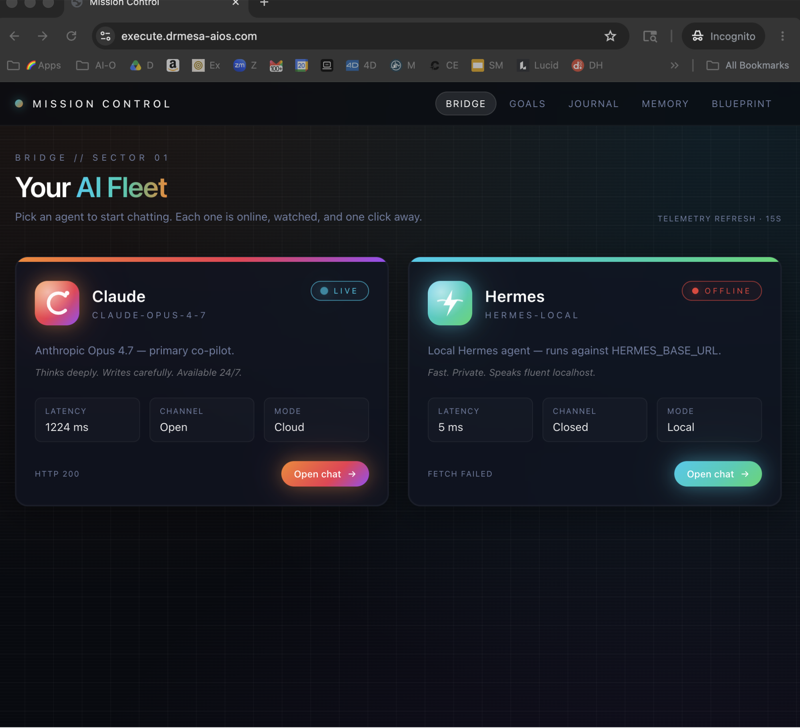
- Hermes — great for research, local tasks, and cost-free workloads (Hermes adapter is on the Paperclip GitHub)
- OpenClaw — best for SEO work (see my OpenClaw AI SEO breakdown)
- Codex — fast engineering tasks
- Cursor — complex dev / refactors
You mix them across roles.
My CEO runs on Claude.
My SEO agent runs on OpenClaw.
My research agent runs on Hermes locally (free).
My engineer agent runs on Codex.
Cross-adapter orchestration is the whole point.
Schedules — the automation heart
Every agent runs on a cadence.
Examples from my setup:
- Content Writer — Mon/Wed/Fri 8am
- SEO Agent — every Monday 6am
- Research Agent (Hermes) — daily 7am
- Engineer — on-demand when CEO assigns a ticket
- CEO — daily 9am strategy review
The agents wake up, do the work, report back, go dormant.
This is set-and-forget automation done right.
🔥 Want my full Paperclip automation blueprint? Inside the AI Profit Boardroom I've shared my full org chart, every agent's JD, the mission prompt, the schedules I run, and the exact adapter-per-role combo. Plus weekly coaching calls where I help you map your specific business onto Paperclip. → Get the automation blueprint here
Budgets — the thing that saves your bank account
Every agent gets a budget cap.
Hits it → auto-stops.
No more $400 surprise bills from a looped agent.
You can set:
- Per-task budgets
- Daily caps
- Weekly caps
- Monthly caps
The CEO also recommends budgets at hire time based on the job scope.
This alone is worth the install.
Projects, issues, and delegation
Paperclip has project management baked in.
Projects → Issues → Agent assignment.
The CEO can decompose a goal on its own:
- "Launch April content push" → CEO breaks into 12 issues → assigns 8 to Content Writer, 3 to SEO, 1 to Engineer → reports back when done.
Like ChatGPT workspace agents but with actual control and auditability.
Audit logs — the part most tools skip
Every decision every agent makes is logged.
Every task is a ticket.
You can scroll back and see:
- Why the SEO agent prioritised this keyword
- What data the CMO used to launch that campaign
- Which sub-agent got the final task
- What the output was
If an agent does something weird, you trace it and fix the prompt.
The mobile dashboard
Monitoring is mobile-friendly.
From my phone I can see:
- Active agents right now
- Open tickets
- Budget burn
- CEO recommendations waiting approval
- Recent decisions across the org
It's like Slack for AI employees.
Video notes + links to the tools 👉 https://www.skool.com/ai-profit-lab-7462/about
Paperclip vs Multion — I switched
I used to recommend Multion.
Paperclip beats it on:
- Control (per-agent budgets, adapters, schedules)
- Intuitiveness (the org-chart view)
- Stability (no sync bugs)
- Hiring flow (CEO recommendations + one-click approve)
If you're already on Multion, the migration is an afternoon.
Real Paperclip Hermes agent automation example
Mission: "Publish 20 SEO posts per month aligned to the AI Profit Boardroom."
Org chart:
- CEO (Claude Opus) — weekly strategy
- CMO (Claude Opus) — content calendar
- SEO Agent (OpenClaw) — keyword research
- Research Agent (Hermes local) — topic context pulls
- Content Writer (Claude Opus) — drafts
- Editor Agent (Claude) — polish + publish
Each on its own schedule, own budget, own adapter.
I approve hires and big calls.
The rest happens without me.
FAQ
What is the paperclip hermes agent automation stack?
Paperclip is the orchestration layer — an org chart for your AI agents. The Hermes adapter is one of the engines you can plug into specific agent roles. Together they let you automate a company with different models powering different roles.
Is Paperclip really free?
Yes — it's open-source on GitHub. You pay only for the model API calls each agent makes.
Can I run it fully local?
If you pair it with local adapters (Hermes, Ollama), yes — no cloud needed.
How does the CEO agent hire new agents?
It drops inbox recommendations with full JDs, suggested adapters, and budgets. You approve, Paperclip creates the agent.
How do I stop runaway spend?
Set budget caps per agent at hire time. They auto-stop at the cap.
Can I monitor Paperclip from my phone?
Yes — the dashboard is mobile-responsive, so you can approve hires and check agent activity from anywhere.
Related reading
- Claude Code local — run Paperclip + Claude Code together on your machine
- OpenClaw AI SEO — the SEO adapter I plug into my Paperclip org
- ChatGPT workspace agents — simpler alternative for single-agent workflows
Closing thought
Automation without orchestration is chaos.
Orchestration without adapters is a prison.
Paperclip gives you both.
Learn how I make these videos 👉 https://aiprofitboardroom.com/
Get a FREE AI Course + Community + 1,000 AI Agents 👉 https://www.skool.com/ai-seo-with-julian-goldie-1553/about
Run a zero-human company the right way — the paperclip hermes agent stack is the shortcut.