Hermes agent swarm vs single-agent — both have their place, but most people default to the wrong one for their task. After running both extensively, I've got a clear view of when each wins.
This post is the honest comparison. When swarms win, when single-agent wins, the actual time savings, and how to decide for each task.
Hermes Agent Swarm Vs Single — Quick Verdict
Single-agent wins for simple chat tasks, one-off questions, quick prototypes, and light daily use. Swarms win for multi-step tasks, quality-critical output, tasks where speed matters via parallelism, and large-scope missions.
For most production work, swarms are the upgrade. For testing and casual use, single-agent is fine.
What Each One Actually Is
Single-agent Hermes is one Hermes agent, one model, one conversation thread, sequential execution. That's the whole picture.
Hermes Swarm is multiple Hermes agents, each with its own role, model, mission, and memory. An Aurora orchestrator routes work between them and they execute in parallel.
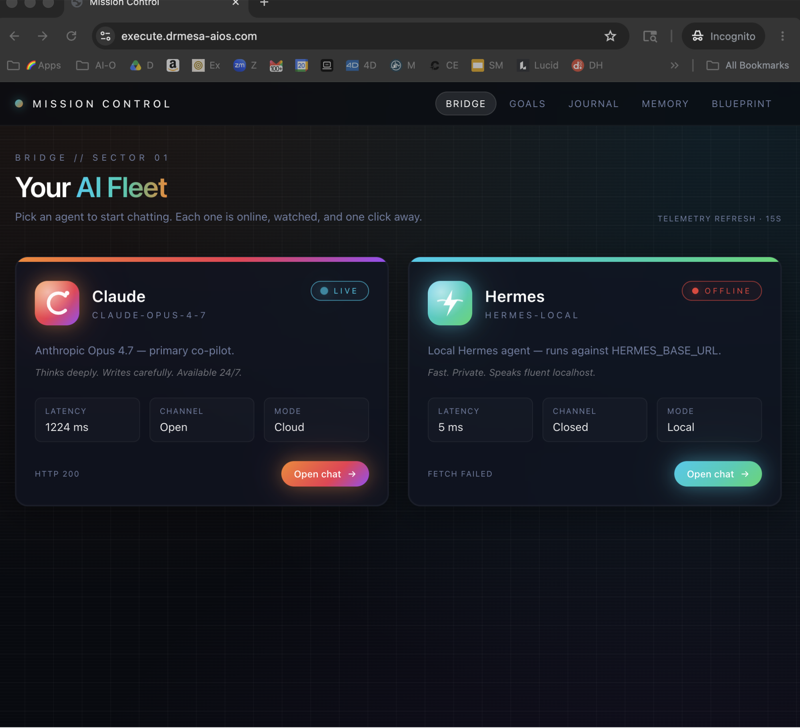
If you've used Hermes Agent Workspace, single-agent is what you're already using. Swarms add the team layer on top.
Speed Comparison
For a real example, building a 5-post blog content plan plays out very differently across the two patterns.
Single-agent runs sequentially — research keywords for 15 minutes, plan content calendar for 15 minutes, draft each post for 60 minutes total, plan internal links for 10 minutes, and build implementation checklist for 10 minutes. Total is roughly 110 minutes.
Swarm runs all 5 tasks in parallel via specialised agents with Aurora routing and coordinating. Total is roughly 10 minutes.
That's an 11x speedup on the same work.
Quality Comparison
Single-agent quality depends on the model you pick, your system prompt, and the agent's ability to handle multi-step reasoning.
Swarms quality depends on each specialist agent's role definition, Aurora's routing logic, and handoff clarity between agents.
In my experience, simple tasks produce comparable quality between the two. Complex tasks see swarms produce noticeably better output because each piece is handled by a specialist rather than a generalist.
Cost Comparison
Counterintuitively, swarms can cost less than single-agent for the same work.
Single-agent uses one (often expensive) model for everything. Swarms can route cheaper models to easier tasks while reserving expensive models for the hard ones.
If you put your researcher on DeepSeek (cheap) and your QA agent on a small model, you only pay for the heavy expensive model on the hard stuff.
🔥 Want my full swarm vs single-agent decision matrix? Inside the AI Profit Boardroom, I share my decision rules, swarm configs, and 30-day road map. Plus a 2-hour Hermes course and weekly live coaching. 3,000+ members. → Get the matrix
When Single-Agent Beats Swarms
Be honest about when not to use swarms.
The task is small. A 200-word email reply doesn't need a swarm.
You're prototyping. When you're still figuring out what you want, single-agent is faster to iterate.
The task is purely conversational. A back-and-forth chat doesn't benefit from parallelism.
You're on a low-spec machine. Multiple agents mean more RAM, so if you're tight on hardware, single-agent.
When A Hermes Agent Swarm Beats Single-Agent
Multi-stage workflows. Research, write, review, publish — each stage benefits from a specialist.
Time-sensitive output. Need 5 things done by tomorrow morning? Swarms parallelise.
Quality-critical work. Specialised agents produce better output than generalists.
Recurring scheduled tasks. If you're running daily or weekly automations, swarms scale better.
Setup Effort
Single-agent setup is trivial — Hermes is set up and you chat.
Swarms setup is more involved — install plugin, configure roles, test routing. Roughly 30 minutes extra setup, but it pays back fast.
Maintenance Burden
Single-agent maintenance is minimal.
Swarms maintenance is light. You'll occasionally need to tweak Aurora's routing rules, refine sub-agent prompts, and debug stuck agents. Roughly 10-20 minutes a week on average.
Common Decision Mistakes
Three mistakes worth avoiding.
Using swarms for everything. Even small tasks routed through Aurora is overkill — single-agent is fine for simple stuff.
Avoiding swarms because "they're complex". The complexity is upfront in the setup. Once running, daily use is simpler than juggling 5 single-agent sessions.
Putting every agent on the most expensive model. Match model to role and don't waste expensive models on QA tasks.
Real Decision Tree
For each task, ask a few questions in order.
Is the task multi-stage? Yes means swarms, no means single-agent.
Does quality matter more than speed? Yes means swarms because specialisation wins. No means single-agent because it's faster to start.
Will you run this weekly? Yes means swarms because they scale better. No means single-agent.
Will you trigger from your phone? Either works because both have phone access in Hermes Workspace.
Hybrid Hermes Agent Swarm Approach
I run both. Single-agent for daily chat, quick lookups, and one-off drafts. Swarms for weekly content batch generation, multi-source research projects, code review workflows, and customer ops automation.
Use the right tool for the job rather than picking one and forcing every task through it.
Real Hours Saved
Honest accounting from my own use. Weekly content batch was 12 hours single-agent and is now 1.5 hours via swarm — saves 10.5 hours. Multi-source research was 4 hours and is now 30 minutes — saves 3.5 hours. Code review workflow was 2 hours and is now 15 minutes — saves 1.75 hours.
Roughly 15 hours per week saved by switching specific tasks to swarms.
What Swarms Can't Do (Yet)
Be honest. Complex emotional tasks like sales conversations and complaint handling still need humans. Highly creative original work where true creativity matters needs humans. Extremely fast real-time chat — single-agent is faster on first response.
For these, augment rather than replace.
Daily Reality Of Running Both
What it looks like. At 8am I use single-agent for morning chat. At 9am I kick off a content swarm with the daily mission. At 10am the swarm runs in the background while I do other work. Throughout the day single-agent handles ad-hoc questions. In the evening I review the swarm outputs.
Swarms handle scheduled batch work. Single-agent handles real-time work.
🚀 Want my full Hermes single + swarm playbook? The AI Profit Boardroom has my full Hermes playbook covering single-agent and swarm workflows. 2-hour Hermes course, daily training, weekly live coaching. 3,000+ members. → Join here
FAQ — Hermes Swarm vs Single-Agent
Which is easier to use?
Single-agent — lower setup overhead.
Which produces better results?
Swarms for complex tasks. Single-agent for simple ones.
Which is cheaper?
Swarms can be cheaper if you mix model tiers per role.
Can I use both?
Yes — most people should.
Will single-agent become obsolete?
No — it's still ideal for many tasks.
How many sub-agents make a useful swarm?
Minimum 3 (planner plus builder plus reviewer). 5-6 is the sweet spot.
Can I convert a single-agent workflow to a swarm?
Yes — break it into stages and assign each to a specialist agent.
Related Reading
- Hermes Agent Swarm Overview — feature walkthrough.
- Hermes Workspace Setup — setup detail.
- Hermes Agent Workspace — broader Workspace overview.
📺 Video notes + links to the tools 👉
🎥 Learn how I make these videos 👉
🆓 Get a FREE AI Course + Community + 1,000 AI Agents 👉
The Hermes agent swarm vs single-agent decision is task-by-task — pick swarms for multi-stage production work and single-agent for everything else.