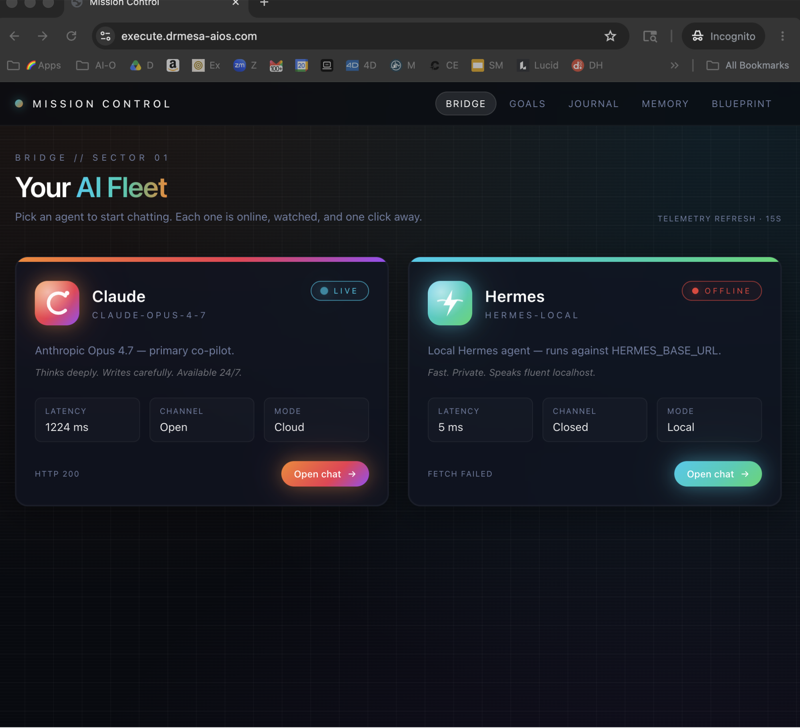
Hermes DeepSeek is the smoothest agent stack I've used — and the reliability gap vs alternatives matters more than people realise.
I'll define "smooth".
A smooth agent does what you ask without you babysitting it.
You say "schedule daily content research" — it actually runs daily without breaking.
You say "draft this email" — it drafts cleanly the first time.
You say "find competitor data" — it finds it without 14 retries.
OpenClaw is great.
OpenClaw is also 50/50 on whether it'll complete a task cleanly first try.
Hermes DeepSeek is more like 90/10.
That's the smooth agent gap.
Why Smoothness Matters More Than Capability
A capable but unreliable agent is worse than a less capable reliable one.
Real example.
You schedule a daily competitor analysis at 7am.
Unreliable agent: runs successfully 4 days a week. Other 3 days, fails silently or partially. You learn not to trust the output. Eventually you stop checking.
Smooth agent: runs successfully 6.5 days a week. The half-day a week of issues are caught and reported. You trust the output. You actually use it.
Same workflow.
10x more value from the smooth agent because trust compounds.
🔥 Want my Hermes DeepSeek smooth agent playbook? Inside the AI Profit Boardroom I've documented the configurations, fallback chains, and skill structures that make Hermes DeepSeek reliable enough to actually trust. Plus the failure-handling patterns. 3,000+ members already running smooth agents in production. Click below. → Get the smooth agent playbook
Why Hermes Is Smooth
Three architectural choices.
1. Self-improving skills. When a skill fails, Hermes updates the skill markdown to handle that failure mode. Next run is more reliable. Compound improvement.
2. Fallback model chains (v0.6+). Primary model down? Switch to backup automatically. Workflow continues.
3. Persistent memory of failures. Hermes remembers what's broken and what's worked. Doesn't repeat known-bad patterns.
Compare to OpenClaw which often re-makes the same mistakes day after day because the architecture doesn't have the same self-correction loop.
I covered the OpenClaw vs Hermes architectural comparison in my Hermes vs OpenClaw post — same theme, deeper dive.
Why DeepSeek V4 Flash Specifically Is Smooth
Three reasons it pairs well with Hermes:
1. Designed for agentic workflows. Not just trained for chat — trained specifically for tool use, planning, multi-step tasks.
2. Sub-second latency. Slow models cause timeouts in Hermes scheduled tasks. DeepSeek V4 Flash is fast enough that timeouts are rare.
3. Stable API. DeepSeek's API has had remarkable uptime in my testing. Months without an outage.
Compare to Claude — slightly higher quality but slower latency, and Anthropic has occasional 30-minute outages that disrupt workflows.
For consistent daily automation, the speed + reliability trade-off favours DeepSeek.
I covered the DeepSeek-specific characteristics in my DeepSeek V4 OpenClaw post — same model, applied across different harnesses.
The Failure Modes That Don't Break Hermes DeepSeek
Real failure modes I've hit in 6 months of daily use:
API rate limit hit → Hermes fallback chain switches to Claude, workflow continues.
Skill produces unexpected output → Hermes catches with success criteria check, retries with adjusted prompt.
Sub-agent dies mid-task → main Hermes spawns replacement, picks up where the dead one left off.
Network blip → Hermes retry logic absorbs.
Disk full on memory.md → Hermes alerts you with a Telegram message before things break.
These aren't theoretical — these are the actual breakages I've seen. Hermes handled all of them gracefully.
I'd estimate this kind of failure handling is 5x what I get from OpenClaw in the same scenarios.
If you want to see the OpenClaw side specifically, my DeepSeek V4 OpenClaw post covers the same workflows running through OpenClaw — pairs nicely with this comparison.
Smooth Skill Authoring Discipline
Smooth agents need smooth skills.
Three rules I follow when authoring Hermes skills:
1. Explicit success criteria. Every skill ends with "Success means: X. Failure means: Y. Retry conditions: Z."
2. Step-level error handling. Every step in a skill specifies what to do if it fails. Not just the end-state.
3. Idempotent operations. Skills should be safe to re-run on the same input. No "step 1 already completed, can't redo".
Skills following these rules are 10x more reliable than skills that don't.
The first month of using Hermes is largely about learning to write skills with this discipline.
For more skill authoring patterns, my hermes ai course skills module covers the production-grade skill structure.
🔥 Want my smooth-skill template library? Inside the AI Profit Boardroom I've put up 20+ production skill markdown files — each one structured for reliability, idempotency, error handling. Clone them into your Hermes installation and you're 80% of the way to smooth daily operations. Click below. → Get the smooth-skill templates
Smooth Scheduled Tasks
Cron jobs are where smoothness matters most.
A scheduled task that fails 2 days a week is useless.
Three patterns for smooth scheduled tasks:
1. Pre-flight checks. Before the main task, verify dependencies (API reachable, disk space available, required files present).
2. Bounded retries. If something fails, retry up to 3 times with exponential backoff. After that, alert and stop.
3. Status reporting. Every scheduled task ends with a Telegram message confirming success or describing failure. You always know what happened.
These patterns turn scheduled tasks from "fire and hope" into "fire and trust".
I covered the scheduled task patterns in my hermes ai course automations — pairs naturally with this smoothness theme.
When Hermes DeepSeek Isn't Smooth
Be honest about the limits.
First week: noisy. Hermes is learning your style and skills are immature. Smoothness takes time to build.
During major Hermes updates: sometimes regressions. Test before relying on a fresh update for production workflows.
With poorly-written skills: garbage in, garbage out. Smooth Hermes still depends on smooth skill authoring.
During DeepSeek outages: without a fallback chain, you're down. Configure fallbacks.
Hermes DeepSeek is smooth in the steady state.
The transition states require care.
Smooth Agent ROI
The reason smoothness is worth chasing:
Unreliable agent → 50% of the time it works, 50% you have to manually finish the task.
Smooth agent → 90% works, 10% requires intervention.
Looks like a 40% improvement.
Actually it's much bigger.
Because mental cost compounds.
With unreliable agents, you have to check every output. Trust degrades. Mental load stays high.
With smooth agents, you can trust the output by default. Mental load drops to near-zero. You scale.
That's why smoothness is the hidden ROI metric.
For my breakdown of the actual time savings from smooth automation, my hermes ai course post covers the daily numbers.
Hermes DeepSeek Smooth Agent FAQ
How long until Hermes DeepSeek feels smooth?
Honest answer: 2-4 weeks of daily use. Skills mature, memory builds, you stop fighting the tool.
Is OpenClaw less smooth than Hermes?
In my experience yes — different architectural choices. OpenClaw is more powerful in some ways, less reliable day-to-day.
Can I make ChatGPT smooth?
ChatGPT-as-agent is hit-or-miss. The smoothness is in the harness, not the model. ChatGPT lacks a real harness.
Does smoothness require expensive models?
No — DeepSeek V4 Flash (free) is more than smooth enough. The harness matters more than the model.
What if my agent is unreliable on my workflows specifically?
Audit your skills. Most "unreliable agent" issues trace to "vague skill markdown".
Can a smooth agent be too cautious?
Yes — over-defensive skills slow things down. Find the balance: pre-flight check, then commit.
Related Reading
- Hermes vs OpenClaw — reliability comparison
- DeepSeek V4 OpenClaw — alternative harness
- Hermes ai course — production daily automations
Final Take
Hermes DeepSeek smoothness is the under-discussed advantage.
Capability gets all the headlines.
Reliability is what makes you actually use the tool every day.
Hermes DeepSeek is the rare combo that's both capable AND reliable.
That's why this is my daily-driver stack.
🔥 Ready to run a smooth Hermes DeepSeek stack? Get a FREE AI Course + Community + 1,000 AI Agents 👉 join here. Or grab the smooth-agent playbook inside the AI Profit Boardroom.
Learn how I make these videos 👉 aiprofitboardroom.com
Video notes + links to the tools 👉 skool.com/ai-profit-lab-7462
Hermes deepseek is the smooth agent advantage — switch your daily-driver tonight.