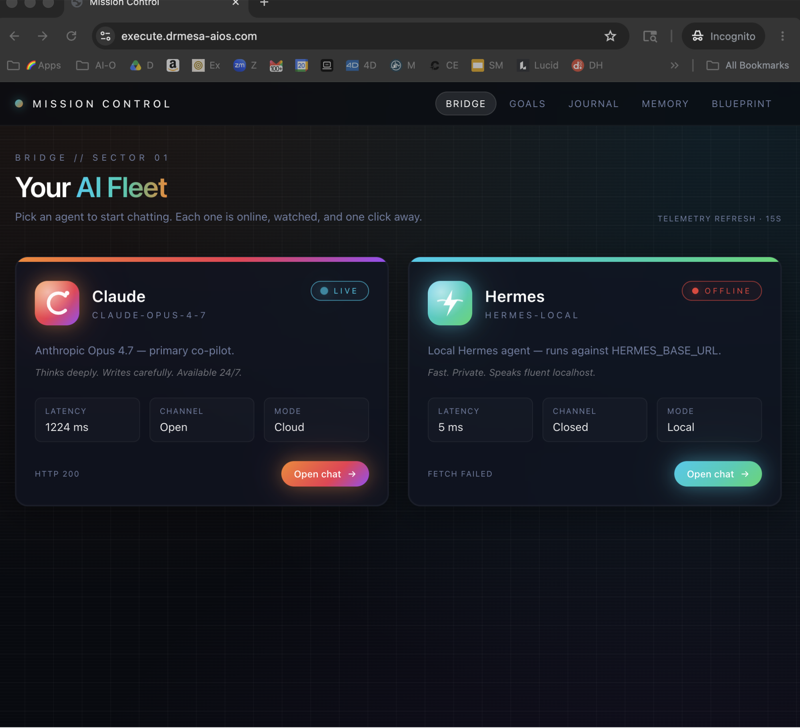
Hermes Open WebUI and the default Hermes dashboard look like they overlap.
They don't.
They do completely different jobs.
I run both — and after three months I can tell you exactly when to use which.
This is the comparison nobody else is doing properly.
What The Hermes Dashboard Is For
The default Hermes dashboard is what you get out of the box.
It's a web UI you can open in your browser.
What it does well:
- Schedule task management — see all your cron jobs, edit, pause, run on demand
- Skill browsing — see every skill installed, view skill.md files
- Session management — see active conversations, end them, restart
- Settings panel — switch models, configure providers, manage API keys
- Diagnostics —
hermes doctorresults, log viewing
What it doesn't do:
- Chat — there's no chat interface in the default dashboard
- File uploads
- Image generation/preview
- Voice input
- Knowledge bases
So if you only ever use Hermes for scheduled tasks (cron jobs, daily reports, automation runs), the default dashboard is enough.
For everyone else, it's only half the story.
🔥 Want my full Hermes UI setup — both dashboard + Open WebUI? Inside the AI Profit Boardroom I've put together the dual-UI playbook — when to use the dashboard, when to use Open WebUI, and the workflow that uses both. 3,000+ members already running this. Plus weekly coaching to walk through your setup. Click below. → Get the dual-UI playbook
What Hermes Open Web UI Is For
Open WebUI is the chat interface.
ChatGPT-style.
What it does well:
- Conversational chat — fast, clean, multi-tab
- Model switching — flip between Hermes, OpenClaw, DeepSeek, Claude with one click
- File uploads — drag and drop
- Code preview — render generated HTML/code inline
- Voice input + voice messages
- Knowledge bases — attach reference docs to specific workspaces
- Custom workspaces — different system prompts and tools per workspace
- Multi-user accounts — share with your team
What it doesn't do (well):
- Cron job management — possible but clunky vs the dashboard
- Skill browsing — you can ask Hermes "list skills" but it's not a UI for it
- Session diagnostics — nope
- Provider/API key config — nope
I went deeper on the Open WebUI capabilities in my Hermes vs OpenClaw post — same chat-UI principles applied across two agents.
When To Use Each
Here's the simple decision tree.
Use the Hermes dashboard when:
- You're managing scheduled tasks (cron jobs)
- You're reviewing or editing skills
- You're checking sessions or logs
- You're configuring providers or API keys
Use Open WebUI when:
- You're having a conversation with Hermes
- You're uploading files for analysis
- You're switching between multiple models
- You're using voice
- You're working with knowledge bases
- You're collaborating with a team
Use both at the same time when:
- You're running production Hermes (which is most of the time)
The two are complementary.
Not competitors.
The Workflow That Uses Both
Here's how I actually use them together.
Morning:
- Hermes dashboard — check overnight scheduled task results, fix any failures
- Open WebUI — pull up "Daily Brief" workspace, ask for the morning summary
During the day:
- Open WebUI — primary chat, drafting, research, coding
- Hermes dashboard — quick check when adding a new scheduled task
Evening:
- Hermes dashboard — review the day's task logs
- Open WebUI — ask Hermes to summarise the day's outputs
Two interfaces, one agent, complementary jobs.
For the underlying scheduled task patterns, my Hermes ai course post covers the cron architecture.
Performance — Which Runs Faster?
Both are lightweight.
Hermes dashboard runs as a small web server inside Hermes itself — no Docker, minimal RAM.
Open WebUI runs in Docker — slightly heavier but still under 1GB RAM idle.
In practice you won't notice the difference on any modern Mac or VPS.
If you're tight on resources, the Hermes dashboard alone is fine.
If you've got 4GB+ free RAM, run both.
Mobile — Hermes Open Web UI Wins
The Hermes dashboard is desktop-first.
Open WebUI works in any mobile browser cleanly.
If mobile matters to you, Open WebUI is the answer — or use Telegram (which I covered in my paperclip Hermes agent post for a third interface option).
Most people end up with three interfaces:
- Hermes dashboard for ops
- Open WebUI for chat (desktop)
- Telegram for chat (mobile)
All sharing the same Hermes brain.
🔥 Want my mobile + desktop Hermes interface stack? Inside the AI Profit Boardroom I've documented all three interfaces — dashboard, Open WebUI, Telegram — and the gateway config that makes them all share state. Plus the workflows for switching between them seamlessly. Click below. → Get the multi-interface stack
Customisation — Hermes Open Web UI Is Way Ahead
The Hermes dashboard is fixed.
You can use it.
You can't really customise it beyond settings panels.
Open WebUI is a customisation playground:
- Custom workspaces (different agents per workspace)
- Custom system prompts
- Custom knowledge bases
- Custom tools (MCP-compatible)
- Custom UI themes
- Custom model fine-tunes
If you're a power user, Open WebUI gives you control the dashboard never will.
Team Use — Open WebUI Wins By Default
Hermes dashboard is single-user.
Open WebUI has multi-user accounts built in.
If you're sharing your Hermes setup with a team or clients, Open WebUI is the answer.
Each user gets their own login, chat history, and workspace.
The Hermes brain is shared (same skills, same scheduled tasks) — but personal chat history stays private.
That's the right separation for team use.
The Honest Limits
Both UIs share Hermes's underlying limits.
Neither makes Hermes faster.
Neither adds new capabilities Hermes doesn't already have.
They're interfaces — not enhancements.
Don't expect installing Open WebUI to make Hermes do new things.
It just makes the things Hermes already does easier to use.
Hermes Open WebUI vs Dashboard FAQ
Can I disable the Hermes dashboard if I only use Open WebUI?
Yes — but I don't recommend it. The dashboard is useful for ops even if you chat in Open WebUI.
Do they share authentication?
No — Hermes dashboard uses Hermes auth, Open WebUI uses its own. Separate logins.
Can both run on the same VPS?
Yes — different ports, no conflicts.
Which is more secure?
The Hermes dashboard is bound to localhost by default — more secure for solo use. Open WebUI exposes a port — wrap in a reverse proxy with auth for production.
Will the Hermes dashboard get a chat feature eventually?
Maybe. Open WebUI fills the gap until then.
Can I use OpenClaw via Open WebUI instead of Hermes?
Yes — Open WebUI supports any compatible API. OpenClaw works.
Related Reading
- Hermes vs OpenClaw — chat UI comparison
- Hermes ai course — full Hermes deep dive
- Paperclip Hermes agent — Telegram interface
Final Take
Hermes Open WebUI vs the default Hermes dashboard isn't really a choice — it's a "use both" situation for serious users.
The dashboard owns ops.
Open WebUI owns chat.
Together they cover every interaction model you'll need.
Install both, configure your workspaces in Open WebUI, and stop choosing.
🔥 Ready to run the dual-UI Hermes setup? Get a FREE AI Course + Community + 1,000 AI Agents 👉 join here. Or grab the full multi-interface playbook inside the AI Profit Boardroom.
Learn how I make these videos 👉 aiprofitboardroom.com
Video notes + links to the tools 👉 skool.com/ai-profit-lab-7462
Hermes open web ui plus the dashboard is the dual-UI play — go and ship both this week.