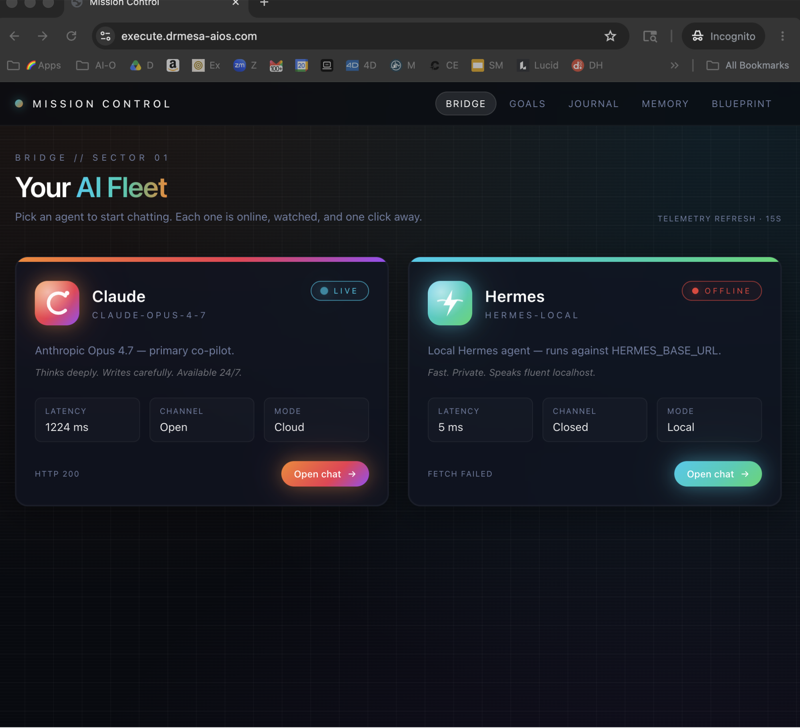
Hermes WebUI vs Open WebUI is a real question — both are great, but they solve different problems.
Both projects are open source.
Both give you a clean web chat interface for AI agents.
Both are free.
But Hermes WebUI is purpose-built for Hermes. Open WebUI is a general AI agent UI.
This post breaks down which fits which user.
The Short Answer
Use Hermes WebUI if:
- You only run Hermes
- You want tight Hermes integration
- You care about Hermes-specific features (skills, memory, schedules)
Use Open WebUI if:
- You run multiple AI agents (Hermes + OpenClaw + Claude + ...)
- You want one UI for everything
- You're willing to lose some Hermes-specific polish
Run both if you have time — they coexist on different ports.
🔥 Want my Hermes WebUI vs Open WebUI decision framework? Inside the AI Profit Boardroom I've documented when to reach for each, the dual-deploy pattern, and the workflows that play to each one's strengths. 3,000+ members already running optimised setups. Click below. → Get the decision framework
Round 1 — Setup
Hermes WebUI: clone repo, npm install, npm start. Localhost ready in 3-5 minutes.
Open WebUI: Docker run command. Localhost ready in 2 minutes.
Winner: Open WebUI by a hair on speed. Hermes WebUI by a hair on flexibility.
Round 2 — Hermes Integration
Hermes WebUI: native. Profiles, skills, schedules, memory all surfaced.
Open WebUI: chat works fine. Hermes-specific features harder to access.
Winner: Hermes WebUI.
Round 3 — Multi-Agent Support
Hermes WebUI: Hermes only.
Open WebUI: Hermes + OpenClaw + Claude Code + Ollama + many more.
Winner: Open WebUI.
For OpenClaw specifically, my deepseek openclaw post covers the harness comparison.
Round 4 — Mobile Responsive
Both work on mobile. Both responsive.
Winner: Tie.
Round 5 — Provider Switching
Hermes WebUI: dropdown for Anthropic, OpenRouter, Ollama, etc. Per-conversation switching.
Open WebUI: more providers configurable. Plugin marketplace for new ones.
Winner: Open WebUI by breadth.
Round 6 — Skill Management
Hermes WebUI: Skills tab. Install, edit, browse Hermes-specific skills.
Open WebUI: generic prompt template management.
Winner: Hermes WebUI.
For skill design specifically, my build your own openclaw post covers the architecture.
Round 7 — Memory Editing
Hermes WebUI: native memory tab. Edit Hermes memory directly.
Open WebUI: generic chat history. Doesn't expose Hermes memory cleanly.
Winner: Hermes WebUI.
Round 8 — Session Continuity
Hermes WebUI: sessions sync across CLI, Telegram, web. Single timeline.
Open WebUI: sessions are local to UI. Doesn't sync to Hermes terminal sessions.
Winner: Hermes WebUI.
Round 9 — Theme + Customisation
Hermes WebUI: dark/light. Limited theming.
Open WebUI: themes marketplace. Highly customisable.
Winner: Open WebUI.
Round 10 — Community
Hermes WebUI: smaller, Hermes-focused community.
Open WebUI: large general AI community. Many plugins.
Winner: Open WebUI.
Final Tally
Hermes WebUI: 4 wins Open WebUI: 4 wins Ties: 2
A draw on aggregate. The right choice depends on your context.
For the harness theory generally, my hermes ai course post covers the model + harness pattern.
My Setup — Hermes WebUI Primary
I run Hermes WebUI as primary because:
- 80% of my agent work is Hermes
- The Hermes-specific features matter to my workflow
- Skills, memory, profiles are key
I keep Open WebUI installed for:
- Multi-agent comparisons
- Testing new agents (Claude Code, OpenClaw)
- Plugin experiments
Both run on different ports. No conflict.
When To Switch Hermes WebUI As Primary
If you start running 3+ AI agents seriously, switch primary to Open WebUI.
The single-pane-of-glass for all agents matters more than Hermes-specific polish.
If you stay Hermes-only, stick with Hermes WebUI.
For multi-agent setup patterns, my hermes deepseek post covers the cross-agent flow.
🔥 Want my dual Hermes WebUI + Open WebUI deployment guide? Inside the AI Profit Boardroom I've documented the side-by-side install, the routing patterns, the keyboard shortcuts that bridge them. 3,000+ members already running this. Click below. → Get the dual deployment guide
Performance Comparison
Hermes WebUI: ~150MB RAM, fast load.
Open WebUI: ~250MB RAM (Docker overhead), similar load speed.
For low-memory systems, Hermes WebUI wins. For high-memory systems, no difference.
Hermes WebUI vs Open WebUI FAQ
Can I migrate between them?
Hermes config stays the same. Both UIs read the same Hermes daemon.
Are sessions shared?
No — sessions in each UI are separate.
Which has better mobile?
Both responsive. Slight edge to Open WebUI for touch UX.
Which gets updated more?
Open WebUI more frequent (larger team). Hermes WebUI more focused (Hermes team).
Can I use Open WebUI without Hermes?
Yes — Open WebUI works with any AI agent / LLM endpoint.
Cost?
Both free. Open WebUI has paid hosting tiers. Hermes WebUI is self-host only.
Related Reading
- Hermes AI course — base setup
- DeepSeek OpenClaw — alternative harness
- Hermes DeepSeek — model pairing
Final Take
Hermes WebUI vs Open WebUI is a draw on features.
Pick based on context:
- Hermes-only: Hermes WebUI
- Multi-agent: Open WebUI
- Both available: run both
Either way you get a free clean web interface for your AI agents.
🔥 Ready to pick your WebUI tonight? Get a FREE AI Course + Community + 1,000 AI Agents 👉 join here. Or grab the dual deployment guide inside the AI Profit Boardroom.
Learn how I make these videos 👉 aiprofitboardroom.com
Video notes + links to the tools 👉 skool.com/ai-profit-lab-7462
Hermes webui or open webui — both win, used right.