OMI Obsidian automation is what turns a passive wearable into a fully hands-free knowledge system, and after running it for months I'm convinced this is the cheapest second brain a knowledge worker can build in 2026. The wearable captures everything you say, the vault stores it, and the agent layer does the heavy lifting that used to eat hours of your week.
This post is the automation-focused view of the OMI Obsidian stack. I'll walk through what runs without you, how to wire it together, and what stays manual no matter how good your skills get.
🔥 Want my OMI Obsidian automation pack? AI Profit Boardroom has my automation skills plus scheduled tasks templates ready to drop in. → Get the pack
Why Automate OMI Obsidian
Manual cleanup of OMI captures is what kills the ROI of the entire system. If you have to touch every transcript, tag every note, and link every entry by hand, you'll quit by week two and the wearable will end up in a drawer.
Automation is what makes the system genuinely self-organising and worth wearing every day.
What Can Be Automated
There are six high-leverage things worth automating from day one.
1 — Inbox processing
Raw OMI dumps land in your inbox folder, and a scheduled skill tags them, links related notes, and sorts them into the right project folders. You go from a chaotic stream of transcripts to a properly organised vault without ever touching a file.
2 — Daily summaries
At the end of the day Hermes generates a summary of everything that was captured and drops it into your daily note. By the time you sit down for dinner, your day is already documented.
3 — Weekly reviews
Every Sunday morning Hermes generates a full week review and adds it to the weekly note, covering wins, lessons, and priorities for the week ahead.
4 — Project status updates
Once a week Hermes pulls every note tagged with a given project and rolls them up into a status doc you can share with collaborators or clients.
5 — Idea pipeline
Daily and weekly, Hermes extracts ideas from the captures and sorts them by theme, so the random thoughts you mumble into the wearable actually compound into something usable.
6 — Decision log
Real-time, captured decisions are auto-tagged and indexed, which means six months from now you can find any decision you made and the context around it.
That's the full automation surface. You orchestrate, Hermes executes, and the vault stays clean.
Watch The Workflow
For the agent side of the pipeline, this Hermes walkthrough covers the skills layer that actually does the processing.
These two videos together show you the full automation pipeline end to end.
The Automation Stack
There are three layers that need to work together for any of this to feel hands-free.
1 — Capture (OMI)
The capture layer is already automatic. The wearable runs all day, transcribes what you say, and pushes it to the OMI cloud without you doing anything.
2 — Storage (Obsidian + sync)
Auto-sync from the OMI cloud to your Obsidian vault is the bridge. A small cron job or Zapier flow pulls new transcripts every few minutes, so the vault is always fresh.
3 — Processing (Hermes scheduled tasks)
This is where the magic actually happens. Hermes runs scheduled skills on a clock — the inbox processor every hour, the daily summary at 6pm, the weekly review at 9am on Sunday. By the time you check the vault, everything is already organised.
Setting Up The Cron
Three scheduled tasks are enough to get the system fully self-running.
Task 1 — Inbox processor (hourly)
The inbox processor reads everything sitting in the 00-inbox folder, tags each note with the right topics, links related notes by ID, and moves processed entries into their final project folders. Run it hourly and your inbox never fills up.
Task 2 — Daily summary (6pm)
The daily summary skill reads everything from today, extracts decisions, todos, and key learnings, and writes them into the daily note. By 6:05pm your day is documented without you opening Obsidian once.
Task 3 — Weekly review (Sunday 9am)
The weekly review reads the entire week of notes and generates a structured review covering wins, lessons learned, focus areas, and priorities for the week ahead. It writes straight into the weekly note so Sunday planning takes ten minutes instead of an hour.
These three skills plus their scheduled tasks form the complete automation backbone.
Hermes Skills To Build
There are five high-ROI skills worth wiring up once the basic pipeline is running.
1 — Daily summary skill
Already covered above and the easiest place to start.
2 — Weekly review skill
Covered above and the second skill to build because it compounds with the daily summaries.
3 — Email triage skill
The email triage skill reads your inbox, sorts messages by priority, and drafts replies for the urgent ones. Pair it with Telegram AI Agent for mobile control and you can clear inbox from anywhere.
4 — Content drafter skill
The content drafter takes voice notes from OMI and turns them into blog drafts ready for review. Pair it with Claude Code SEO Agent for the full SEO automation chain.
5 — Research skill
The research skill takes a topic input and produces a structured research summary, but the trick is it reads your vault first for prior knowledge. That means it never re-researches something you've already explored.
What Stays Manual
Here's the honest list of things automation cannot and should not handle for you.
1 — Final decisions
You decide. Hermes informs the decision with summaries and context, but the call is yours.
2 — Strategic vision
Strategic vision cannot be automated and never will be. That's still your job as the operator.
3 — Relationship building
Calls, DMs, and in-person time are yours. Don't outsource that to an agent.
4 — Creative direction
Creative direction is yours. Agents execute the creative work, but the direction comes from you.
Everything else in the knowledge management stack can be automated to some degree.
Common Automation Mistakes
There are three mistakes I see people make repeatedly when wiring up OMI Obsidian automation.
1 — Over-automating too fast
Build one skill at a time and test it for a week before adding the next. Automating broken processes makes things worse, not better, and you'll burn yourself out chasing failures.
2 — Trusting AI output without review
Hermes outputs are usually 80% there, but always spot-check before acting on anything important. Especially for client-facing work, the last 20% is where reputation lives.
3 — Forgetting maintenance
Skills break occasionally as models update or vaults grow. Schedule a monthly skill audit reminder and spend twenty minutes confirming everything still works.
Cost Of Automation
The full stack costs less than most people expect. OMI is £79 as a one-off purchase, Obsidian is free, Hermes runs locally for free, and the sync layer is free if you use cron and a few scripts. Total all-in is £79 once and £0 per month thereafter.
If you want to use cloud LLMs for some of the heavier reasoning steps, expect £10-30/mo on top.
Compare that to Zapier plus Airtable plus Notion AI at £100+/mo, or hiring a VA to run a manual system at £400-1,000/mo, and OMI Obsidian automation is dramatically cheaper than every alternative.
Time Saved By Automation
Per week, the automation pipeline saves real hours. Inbox cleanup is roughly two hours, note tagging is three hours, the weekly review takes 1.5 hours off your plate, status updates save another two hours, and content drafting saves about four hours.
Total saved is 12+ hours per week, which is essentially a part-time hire — for free.
Trigger Patterns
There are three trigger types worth using, and the best system mixes all three.
1 — Time-based
Time-based triggers are cron jobs that run skills on a schedule. Daily and weekly skills sit here, and time-based is the most reliable trigger pattern by far.
2 — Event-based
Event-based triggers fire when something happens. A new file lands in the inbox and the processor runs, or a calendar event ends and a meeting summary skill triggers automatically.
3 — Manual
Manual triggers are when you ask Hermes for something via Telegram or terminal. They're the lowest-volume path but they're what you use for ad-hoc requests.
Mixing all three trigger types is what creates a system that feels genuinely intelligent rather than just scheduled.
Watch The Skills In Action
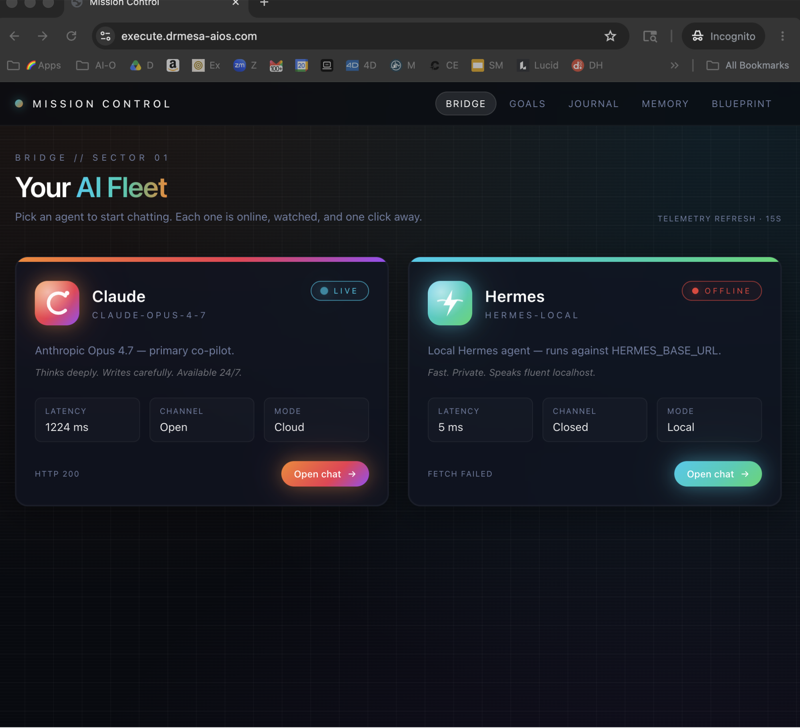
Hermes Workspace plus Mission Control gives you visibility into running automations so you can actually see what each skill is doing rather than guessing.
🚀 Want hands-on automation help? AI Profit Boardroom has weekly live coaching where I'll wire your OMI Obsidian automation on a screen-share. → Join here
Scaling Automations
Once the core automation is running cleanly, there are four phases worth working through over the next few months.
Phase 2 — Multi-agent
Add more agents that specialise — see Hermes Agent Swarm for the swarm pattern that makes this clean rather than chaotic.
Phase 3 — Cross-tool integration
Wire Hermes to your CRM, calendar, and email so the second brain feeds back into the rest of your tools.
Phase 4 — Team automation
Share automated outputs with your team, so what was a personal system becomes shared infrastructure.
Phase 5 — Client automation
Automated client briefs and status updates land in client inboxes without you writing them. By phase 5, you're running a genuinely AI-leveraged operation.
Daily Reality With Full Automation
What a typical day actually looks like once the system is running. At 6am Hermes drops a morning brief into your inbox. Throughout the day OMI captures everything passively and the inbox processor runs hourly to keep things tidy. At 6pm the daily summary writes itself, and on Sunday the weekly review appears without you lifting a finger.
You touch the system maybe 30 minutes a day. It runs the rest.
When OMI Obsidian Automation Breaks
There are three failure modes worth planning for.
1 — Sync glitches
OMI cloud to Obsidian sometimes lags behind. Check daily and fix weekly so a single bad day doesn't compound into a week of missing notes.
2 — Skill drift
LLM updates can change how skills output, sometimes dramatically. Review skill outputs monthly and adjust prompts when behaviour shifts.
3 — Vault chaos
Without periodic cleanup, even a well-tagged vault gets cluttered over time. Schedule a monthly vault tidy task and spend an hour pruning dead notes and consolidating folders.
FAQ — OMI Obsidian Automation
How long to set up automation?
Core automation takes a single weekend, and the full pipeline is realistic over 2-3 weeks of evening work.
Do I need coding skills?
Light scripting helps but isn't required — most of the work can be done with Hermes skills and GPT prompts.
What if I don't trust AI to auto-process?
Set everything to draft mode initially. Hermes proposes the changes and you approve them. Once you trust it, graduate to full automation.
Privacy with automation?
If you run Hermes locally with Ollama, all the processing stays on your machine. The only cloud touch is OMI's transcription itself.
Best automation to start with?
The daily summary skill is the highest ROI and the easiest skill to build. Start there and expand once it's stable.
Will automation break my workflow?
Only if you build incrementally without testing. Don't replace working systems overnight — layer the automation in alongside your current process and switch over once it's proven.
Worth the setup time?
For knowledge workers, the ROI is easily 10x within the first quarter.
Related Reading
- Hermes Second Brain — the recall layer that pairs with this stack.
- Telegram AI Agent — mobile control for the automations.
- Claude Code SEO Agent — the content automation pair.
📺 Video notes + links to the tools 👉
🎥 Learn how I make these videos 👉
🆓 Get a FREE AI Course + Community + 1,000 AI Agents 👉
OMI Obsidian automation is the system that keeps a second brain genuinely useful long-term — set up the three core skills this week and watch the compounding kick in by month two.