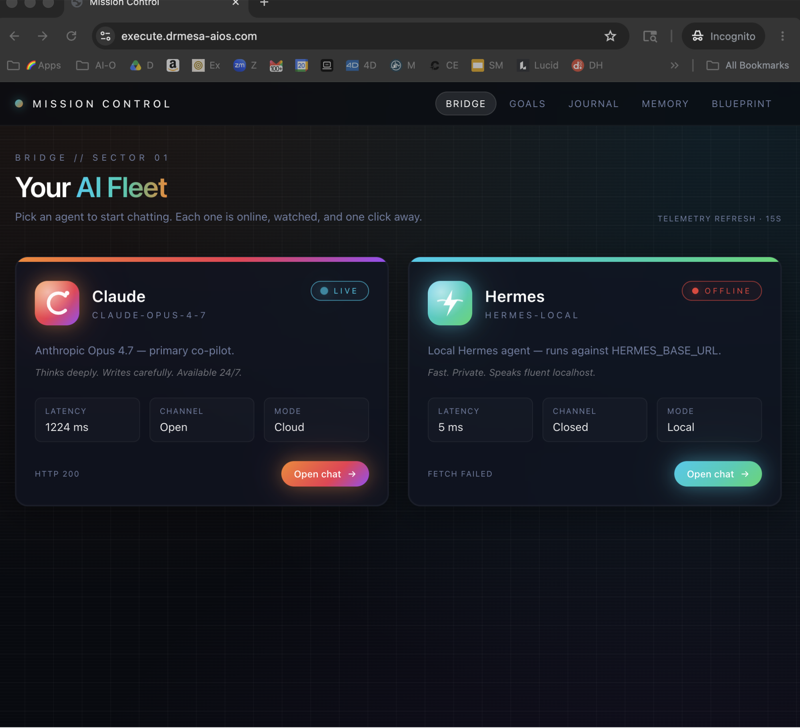
OpenClaw Mission Control isn't just one feature — it's a whole stack of agent management tools in one dashboard, and after running it for months it's become my central ops view for everything OpenClaw.
This post is the feature-by-feature deep dive. What each feature does, when you'd use it, and how features combine for real workflows.
OpenClaw Mission Control Features Overview
The major features are Sessions for seeing what's running, System Health for gateway, database, and errors at a glance, Agent Squad for adding and managing multiple agents, Task Board for Kanban-style AI work, Session Management for token tracking and analytics, Memory Browser for exploring agent knowledge, Scheduled Jobs for recurring task management, and Agent Spawn Control for manually spawning sub-agents.
Each one fills a different need.
Feature 1 — Sessions
Live view of what's running. Shows active OpenClaw sessions, which agents are connected, and what each session is doing.
Daily use is a morning check to see what worked overnight.
Feature 2 — System Health
Critical metrics at a glance — gateway status, database uptime and size, active sessions count, agents online count, tasks running count, errors in the last 24 hours, and backup pipeline status.
If something's broken, you see it here first.
Feature 3 — Agent Squad
This is one of the cooler features — you build and manage a team of AI agents.
For each agent you set the name (e.g. "Orchestrator", "Developer", "Content Creator", "Researcher"), recommended model (Haiku, Sonnet, Opus), system prompt, and skills.
It's like designing your own AI workforce.
🔥 Want my full Mission Control feature playbook? Inside the AI Profit Boardroom, I share my Mission Control setup, agent squad templates, task board workflows, and 30-day road map. Plus 6-hour OpenClaw course and weekly live coaching. 3,000+ members. → Get the playbook
Feature 4 — Task Board
Kanban-style task management for AI agents with columns for Backlog, To Do, In Progress, Review, and Done.
You can create tasks, assign them to specific agents, move between columns, and watch agents work through the tasks. Like Trello but for AI work.
For organising daily AI tasks, this is genuinely useful.
Feature 5 — Session Management
See all sessions with detail — models being used, token consumption per session, active versus idle sessions, sub-agents spawned, and scheduled tasks.
For cost tracking and optimisation, this matters.
Feature 6 — Memory Browser
Explore OpenClaw's knowledge files and memory structure. You can browse all skills folders, see all MD files, view memory structure, add new files directly, and see file count, directory count, and total size.
If you've got a complex OpenClaw setup, this is how you understand it.
Feature 7 — Scheduled Jobs
Manage recurring AI tasks. You can see all scheduled jobs, view job details, add new scheduled jobs, and modify existing schedules.
Pair with OpenClaw Byterover for advanced scheduling patterns.
Feature 8 — Agent Spawn Control
Manually spawn sub-agents and choose API per spawn from Haiku, Sonnet, Opus, DeepSeek, Grok, Gemini, and MiniMax.
Useful for one-off tasks where you want a specific model rather than your default.
Token Usage Dashboard
A specific subsection worth highlighting. Mission Control shows total tokens used, distribution by agent, and weekly plus monthly summaries.
For OpenClaw users worried about costs, this is real visibility.
How Features Combine For Workflows
Real patterns from my own setup.
Daily ops workflow
Sessions for the morning check. System Health to verify everything's up. Task Board to plan the day. Agent Spawn Control to kick off specific work.
Multi-agent coordination workflow
Agent Squad to define the team. Task Board to assign work to the team. Sessions to monitor parallel execution.
Cost optimisation workflow
Session Management to see token usage. Token Usage Dashboard to identify expensive agents. Agent Spawn Control to switch to cheaper models.
Memory management workflow
Memory Browser to explore knowledge. Add new files to extend agent context. Sessions to verify updated agents.
Each feature plays a role.
Which Features You'll Use Daily
From my own use.
Daily features include Sessions (morning check) and Task Board (planning).
Weekly features include Agent Squad (review setup) and Token Usage (cost review).
Occasional features include Memory Browser (skill management) and Agent Spawn Control (one-off tasks).
Common Feature Mistakes
Four mistakes worth avoiding.
Ignoring System Health. If something's broken, Mission Control tells you. Check it daily.
Not using Agent Squad. Single-agent OpenClaw is limiting. Build a team.
Skipping Token Usage tracking. Costs creep up if you don't watch them. Monthly review at minimum.
Memory Browser ignored. Better memory means better agents. Worth a few minutes weekly.
Pairing With Other Tools
Mission Control plus other OpenClaw tools form a complete stack.
The common stack is Mission Control for monitoring and management, ClawX OpenClaw for daily chat with agents, OpenClaw computer use for desktop automation, and Auto Research Claw for research workflows.
Each tool layers on the OpenClaw foundation.
What OpenClaw Mission Control Doesn't Do
Be honest. It doesn't run agents itself. Mobile UI is limited. There's no native multi-tenancy for teams.
For most solo operators, the wins outweigh the limits.
Daily Reality
What it looks like. At 8am I open Mission Control, check Sessions and System Health, review the Task Board, add new tasks for today, approve overnight outputs, and check Token Usage weekly.
Used to be no visibility. Now full ops dashboard.
🚀 Want my full Mission Control feature setup? The AI Profit Boardroom has my Mission Control feature configs, OpenClaw 6-hour course, daily training, weekly live coaching. 3,000+ members. → Join here
FAQ — OpenClaw Mission Control Features
Which feature is most useful?
Sessions and System Health for daily. Task Board for ongoing work.
Do I need Agent Squad if I'm solo?
Even solo operators benefit from multi-agent. Yes.
Can I customise the dashboard layout?
Limited customisation. Most features are fixed in their panels.
Does Memory Browser show all my knowledge?
Yes — full file structure.
Can I delete scheduled jobs from Mission Control?
Yes — manage them from the Scheduled Jobs section.
Will Token Usage tracking impact performance?
Minimal — runs alongside normal operation.
Can I export task data?
Limited export functionality. For full export, use OpenClaw direct.
Related Reading
- OpenClaw Mission Control Overview — what it is.
- ClawX OpenClaw — alternative front-end.
- OpenClaw Aion UI — multi-CLI dashboard.
📺 Video notes + links to the tools 👉
🎥 Learn how I make these videos 👉
🆓 Get a FREE AI Course + Community + 1,000 AI Agents 👉
OpenClaw Mission Control features are what make this the most complete OpenClaw dashboard available — explore them all to get full visibility into your AI agents.