OpenClaw memory persistence is the invisible upgrade that turns a generic AI agent into a personal one, and most users haven't grasped why this matters yet. After running it for months I'm convinced this is the unlock that defines what AI does for you long-term.
This post is the strategic case. Why memory persistence matters more than feature upgrades, what it changes about how you work with AI, and why now is the time to solve it.
OpenClaw Memory Persistence — Quick Take
Most AI users re-explain context every session, get generic answers, and train themselves to work around AI's amnesia.
Memory persistence changes that. AI remembers your projects, knows your preferences, and applies your specific knowledge.
This isn't a small upgrade. It's a fundamental shift in what AI can do for you.
The Hidden Tax Of No Memory
Most people don't notice it, but every AI session has overhead — re-explaining what you're working on, re-clarifying your preferences, re-pasting context from previous discussions.
Multiply across hundreds of sessions per year and that's hours wasted on redundant context-setting. That's the hidden tax.
What OpenClaw Memory Persistence Eliminates
When you solve it (e.g. with OMI plus Obsidian plus OpenClaw — see OpenClaw Memory Persistence), there's no more re-explaining, no more "as I mentioned last week...", and no more starting from scratch.
AI just knows. That's the upgrade.
Why This Is A Strategic Shift
Three implications matter.
1 — Solo operators get serious leverage
If your AI knows everything you know, it can act in alignment with your strategy, recall past decisions, and pick up where you left off. Effectively a junior partner that never forgets.
2 — AI quality compounds
Every conversation adds to the memory. The longer you use the system, the better outputs become. This is unlike most software where value is constant — AI with persistent memory has compounding value.
3 — Personal AI becomes possible
Generic AI is good. Personal AI is much more useful. Memory persistence is what makes AI personal.
🔥 Want to be ahead on AI memory? Inside the AI Profit Boardroom, I share my OMI + Obsidian + OpenClaw memory stack, and prep workflows for solo operators. Plus 6-hour OpenClaw course and weekly live coaching. 3,000+ members. → Get the playbook
Why Most People Haven't Solved It
Three reasons.
1 — Setup friction
Memory persistence requires a capture tool (OMI), a knowledge layer (Obsidian), and an integration (MCP to OpenClaw). For non-technical users, that's intimidating.
2 — Privacy concerns
Capturing your daily activity feels invasive. Many users avoid for privacy reasons.
3 — "AI doesn't need memory"
Many people think AI is good enough without persistence. They're underestimating how much better personal AI is.
The Karpathy LLM Wiki Concept
Andrej Karpathy (former Tesla AI lead, OpenAI founding member) talks about this. His knowledge approach isn't "read and remember" — it's build dense, structured, interconnected notes, compound them over time, like a Wikipedia but written entirely by you.
Every idea links to another. Every concept has context. The result is a living document that gets smarter every day.
OMI plus Obsidian plus OpenClaw automates this pattern.
What Compounds Over Time
With OpenClaw memory persistence in place, the value curves up.
Week 1
Limited memory. AI feels similar to before.
Month 1
Notable improvement. AI starts referencing past discussions.
Month 3
Clear differentiation. AI gives genuinely contextual answers.
Month 6
Major leverage. AI behaves like a partner who knows your work.
Year 1
Compounded knowledge. AI is essential to your operation.
The earlier you start, the more this compounds.
What This Means For Solo Operators
If you run alone the difference is night and day.
Before memory persistence, AI helps with tasks but you provide context and each session is fresh.
After memory persistence, AI knows your business, applies your context automatically, and each session builds on the last.
For solo operators, this is the closest thing to having a partner.
What This Means For SMBs
For small teams, team-wide memory becomes possible if you configure carefully for privacy. Onboarding AI to new employees becomes easier. Institutional knowledge is captured by AI.
For SMBs that lose people, memory persistence retains knowledge.
The Privacy Trade-Off
Be honest. Memory persistence requires capturing data, which raises privacy considerations around what gets captured, where it's stored (local vs cloud), and who can access it.
OMI is local-first and you control everything. For most users, the privacy trade-off is acceptable. For privacy-critical work, configure carefully or skip.
What Solo Operators Should Do This Week
Three actions to set up the foundation.
1 — Install OMI
If you have a Mac, install OMI. 5-10 minutes.
2 — Connect to Obsidian
Set up the knowledge sync. 15 minutes.
3 — Plug into OpenClaw
MCP integration. 15-20 minutes.
I cover the setup detail in OpenClaw Memory Persistence Setup.
What Could Go Wrong
Be honest about the risks.
1 — Privacy mishap
If OMI captures something it shouldn't, your AI might surface it inappropriately. Configure exclusions carefully.
2 — Data loss
Local storage means local risk. Back up your Obsidian vault.
3 — Over-reliance
If your AI knows everything, you might forget how to operate without it. Maintain core skills.
These are real concerns. Mitigate with care.
What This Doesn't Solve
Be honest. It doesn't make AI smarter (model-dependent quality). It doesn't replace strategic judgment. It doesn't perfectly capture nuance from conversations.
For 80% of memory persistence needs, OMI plus Obsidian plus OpenClaw covers it.
The Bigger Picture
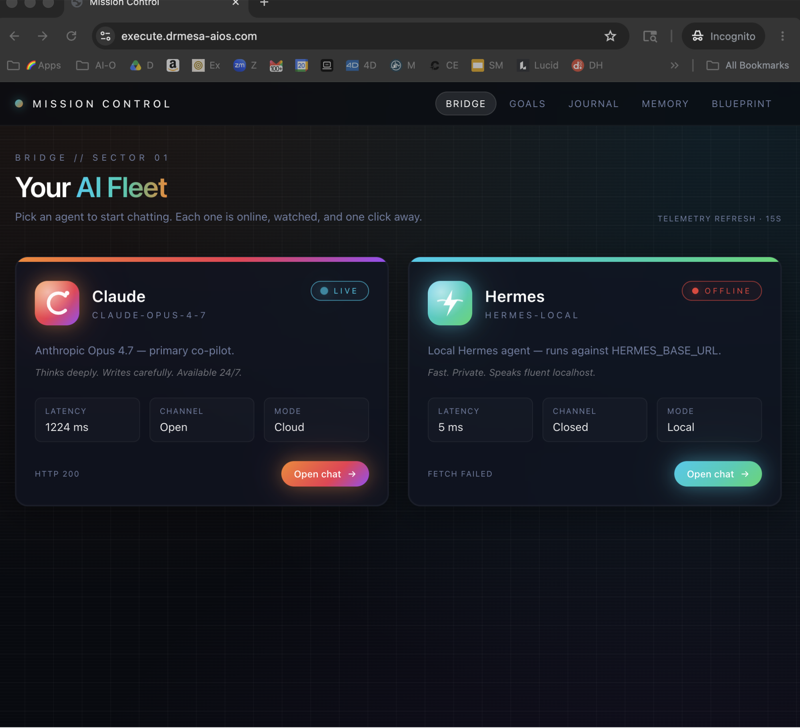
Memory persistence is one piece. Combined with Hermes Agent Swarm for multi-agent execution, OpenClaw Mission Control for visibility, Manus Cloud Computer for always-on automation, and Claude Code Remotion for video creation, you get a personal AI operating system.
Memory persistence is the layer that makes it personal.
Predictions
Where I think this goes.
Persistent memory becomes a default expectation within 12-18 months — AI without memory will feel old.
More tools build native memory layers. OMI is one approach and others will follow.
Memory becomes a competitive moat. Operators with deep AI memory have insights others don't.
Privacy concerns surface regulation. Likely regulation around always-on capture tools, so plan accordingly.
Why Now
The window is open. Tools are mature enough, setup is achievable, and compounding hasn't happened for most operators yet.
If you start in the next month, you're 6-12 months ahead of the curve when this becomes mainstream.
🚀 Want my full OMI + OpenClaw memory stack? The AI Profit Boardroom has my OMI + Obsidian + OpenClaw setup, OpenClaw 6-hour course, daily training, weekly live coaching. 3,000+ members. → Join here
FAQ — Why OpenClaw Memory Persistence Matters
Is memory persistence really that big a deal?
Yes — it's the difference between generic AI and personal AI.
Will I notice the difference immediately?
No — value compounds over weeks and months.
Can I solve this without OMI?
OMI is the easiest path. Alternatives exist but require more setup.
Will memory persistence work with Claude or ChatGPT?
OMI's MCP can serve any compatible AI.
Is there a privacy risk?
Yes — manage carefully.
Will this become standard?
Within 12-18 months, expect it to be common.
Should I wait for tools to mature?
No — early adopters compound faster.
Related Reading
- OpenClaw Memory Persistence Overview — what this solves.
- OpenClaw Memory Persistence Setup — install walkthrough.
- OpenClaw Mission Control — agent management.
📺 Video notes + links to the tools 👉
🎥 Learn how I make these videos 👉
🆓 Get a FREE AI Course + Community + 1,000 AI Agents 👉
OpenClaw memory persistence is one of those features that's hard to grasp until you have it — install OMI now and your AI agent finally knows you.