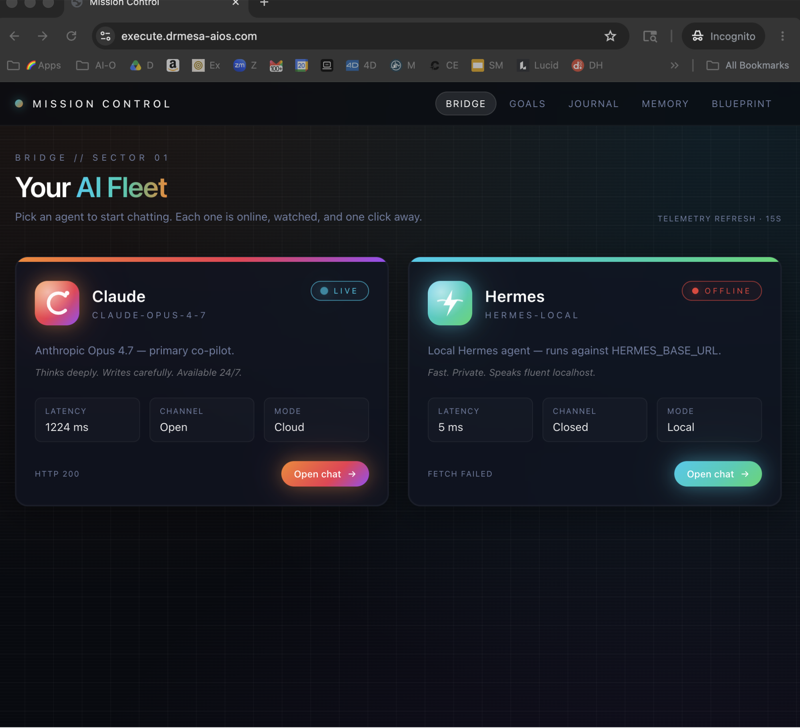
The Hermes agent HUD UI changes the automation experience for anyone running scheduled or multi-agent Hermes workflows by giving you a real browser dashboard for managing what was previously buried in terminal sessions. After running it alongside my own automation pipeline for the last few weeks, I'm convinced this is the missing operational layer that most Hermes automation builders have been working around with custom scripts.
This post is the automation-focused take on HUD UI. I'll cover what it actually unlocks for scheduled and multi-agent workflows, how the scheduled tasks panel changes the cron-job equation, and where it fits alongside the broader Hermes automation stack.
🔥 Want my Hermes automation playbook? AI Profit Boardroom has automation templates, scheduled task patterns, and weekly live coaching for serious agent builders. → Get the playbook
Why Hermes Agent HUD UI Automation Matters
The previous Hermes automation experience was solid technically but rough operationally. You'd write skills, set up scheduled tasks via cron or Hermes config, and then check on them by tailing terminal output or grepping log files. It worked, but it required more attention than it should have.
HUD UI turns that into a proper dashboard. Scheduled tasks become a UI you can edit. Live agents become a panel you can scan in five seconds. Broken pipelines become a health diagnostics screen that flags issues before you notice. For automation builders, that operational layer is the difference between automation that runs reliably and automation that silently breaks for a week before you spot it.
Hermes Agent HUD UI Automation — Two-Minute Install
Install is a Hermes plugin, so it follows the standard Hermes plugin pattern with two routes.
The first route is to copy the install command from the HUD UI repo and paste it into your terminal. Standard plugin install. The second is the lazier route: ask Hermes itself to "install this and sync it with Hermes" with the install command pasted in. Hermes handles the install and confirms when ready in the browser.
Either way, two to three minutes from start to a running dashboard.
Watch The Walkthrough
For the broader Hermes automation context, this walkthrough covers the agent foundation HUD UI runs on top of.
The Scheduled Tasks Panel
The scheduled tasks panel is the headline feature for automation builders.
You create a new task by giving it a name, the prompt the agent should run on each fire, and the interval. The UI handles the cron-style scheduling so you don't have to remember exact syntax. Edits and deletes are clean GUI operations rather than file edits and Hermes restarts.
For automation that fires daily, weekly, or on any recurring interval, this panel removes most of the friction that previously made setting up new automations annoying. Friction was the difference between automations existing and not existing — and reducing friction means more automations get built.
For loops that need to run until a goal is met rather than just on a schedule, pair this with Hermes Agent Goals which is the autonomous-loop feature that fires until completion is verified.
The Live Agents Panel
The agents panel shows every live agent on your machine in real time. In normal use I had 25+ agents visible at once including Hermes agents, Claude agents, and Codex agents all running concurrently across different projects.
For automation builders running multi-agent pipelines, this is the visibility layer you've been missing. You can see at a glance which agents are working, which are idle, which have errored, and which are mid-task. That visibility lets you intervene early when something drifts off track instead of finding out later that a pipeline silently failed.
Health Diagnostics For Automation Reliability
The health diagnostics panel runs continuous checks across your Hermes setup and surfaces broken pieces. Expired API keys, misconfigured providers, dead gateways, missing environment variables — all flagged automatically.
For automation that runs unattended, this is genuinely critical. The most common failure mode for unattended pipelines is "API key expired three days ago, every run since then has silently failed." HUD UI catches that on the dashboard before it becomes a crisis.
If you've ever debugged a pipeline that stopped working only to discover a key needed renewing, you'll appreciate this panel.
The Model Swap Feature
The models panel exposes the default model selector as a dropdown. You can switch between Claude, Sonnet 4.8, Kimi K2.5, MiniMax M2.5, GPT-5.4, or whatever your providers support without restarting Hermes or editing config files.
For automation builders, this matters more than it sounds. Different scheduled tasks benefit from different models — research tasks might want long-context Gemini, code tasks want Sonnet 4.8, high-volume triage wants Haiku. Being able to swap defaults from a dropdown rather than rewriting config means you actually do tune model choice per use case instead of leaving everything on whatever you started with.
Pairing HUD UI With Hermes Agent Goals
The combination of HUD UI's scheduled tasks plus Hermes Agent Goals is genuinely powerful for autonomous automation.
Scheduled tasks fire on intervals — every hour, daily, weekly. Goals fire and run until a judge model confirms completion. Together they give you both time-based and outcome-based automation in the same stack.
A real example from my setup: a scheduled task fires every morning at 7am to kick off a research goal. The research goal then runs autonomously until the judge model confirms the topic has been thoroughly researched and the summary is complete. The HUD UI dashboard shows me both the schedule and the active goal status in one place.
Pairing With Sonnet 4.8 As Default
For most automation work, Sonnet 4.8 is the right default model in HUD UI's dropdown. The reasoning quality and tool-use reliability mean fewer broken automation runs and less time spent debugging output.
For high-volume cheap automation where each run only needs basic intelligence, drop down to Kimi K2.5 or MiniMax M2.5. For privacy-sensitive work, switch to a local Ollama model — same UI, same scheduling, just a different model underneath.
Real Automation Workflows On HUD UI
Five workflows worth setting up via HUD UI's scheduled tasks panel.
A daily content drafting agent that fires each morning and produces first-draft blog posts or social content based on trending topics. A daily research agent that pulls developments in your niche and summarises them for review. A weekly customer FAQ scan agent that monitors common questions and updates your FAQ documentation. A daily lead enrichment agent that takes new leads and adds context from web data. A daily content repurposing agent that turns existing content into multiple formats.
All five run cleanly via the schedule panel and surface in the agents view for monitoring.
HUD UI Vs Custom Cron Setup
Before HUD UI, automation builders had a few options for scheduling: native Hermes scheduling, system cron with shell scripts wrapping Hermes calls, or n8n workflows with Hermes API calls. HUD UI changes the calculus.
For workflows that live entirely inside Hermes and don't need to integrate with external systems, HUD UI's scheduled tasks panel is now the easiest path. For workflows that need to integrate with email, Slack, CRMs, or other tools, n8n still wins. Cron with shell scripts is mostly obsolete for new builds.
The right rule of thumb: if it's all-Hermes, use HUD UI's scheduler. If it crosses tool boundaries, n8n.
HUD UI Vs Hermes Workspace For Automation
Both are free open-source web UIs and both have automation features.
Hermes Workspace has the Swarms feature that HUD UI doesn't ship with natively, which matters for multi-agent orchestration. HUD UI has denser feature coverage and the diagnostics panel that Workspace doesn't expose as cleanly. For pure automation work, both have schedulers — Workspace's is slightly cleaner UI, HUD UI's is more feature-dense.
I run both and use HUD UI for diagnostics-heavy days and Workspace for swarm-heavy work. For most automation builders, pick one to start and add the other if a gap emerges.
For the multi-agent side, Hermes Agent Swarm covers the patterns regardless of which UI you're using.
Cost Structure
HUD UI is free open-source. The only cost is whatever your model providers charge per token.
For local Ollama-based automation, all-in cost is £0 per month for unlimited runs. For cloud-model automation with Sonnet 4.8 or similar, expect £20 to £200 per month depending on volume. For light automation builders, total stack cost lands around £20-£50 per month.
Common Automation Mistakes
Three mistakes I've seen automation builders make with HUD UI.
The first is treating the scheduled tasks panel as a replacement for proper monitoring. Scheduling a task is not the same as knowing it ran successfully — you still need to check the agents panel and health diagnostics regularly.
The second is over-relying on the model dropdown without thinking through model fit per task. Just because you can swap models easily doesn't mean every workflow benefits from a frontier model. Match the model to the task complexity.
The third is skipping retry logic. Automation that runs unattended will hit API failures eventually. Build retry into your skills rather than hoping the underlying providers stay up forever.
Reliability At Scale
For automation that needs to run reliably at scale, four habits matter.
First, check HUD UI's health diagnostics daily — even a 30-second scan catches most issues before they bite. Second, build retry-on-failure into your skills so transient API errors don't kill runs. Third, monitor the agents panel for stuck or zombie agents that need manual clearing. Fourth, keep a fallback model configured so when your primary provider has issues, automation degrades to backup rather than dying entirely.
🚀 Want hands-on automation help? AI Profit Boardroom has weekly live coaching for serious automation builders running Hermes-based stacks. → Join here
Privacy For Sensitive Automation
HUD UI runs entirely locally on your machine — the dashboard, the scheduling, the diagnostics. The only network calls are to whichever model providers you've configured.
For automation involving sensitive client data, you can pair HUD UI with local-only Ollama models for full privacy. The scheduling, monitoring, and diagnostics all work the same regardless of whether the underlying model is cloud or local.
Daily Automation Routine
Here's what a typical day looks like running HUD UI as the automation control plane.
At 6am scheduled tasks start firing for content, research, lead enrichment, and customer FAQ work. At 7am I open HUD UI for a 5-minute scan: agents panel for any failures overnight, health diagnostics for expired keys or down providers, scheduled tasks panel to confirm everything fired as expected. Mid-morning I review what's been produced — drafts, summaries, enriched leads — and ship what's ready. The rest of the day I glance at HUD UI 2-3 times to monitor progress, but most automation runs unattended.
Total time spent on automation ops: maybe 30 minutes a day. Output across content, research, leads, and FAQ work is multiples of what I'd produce without the agent stack.
What HUD UI Won't Do For Automation
Be realistic about the limits.
HUD UI doesn't include native multi-agent swarm orchestration the way Workspace does, so heavy swarm automation builders may want both UIs. It also doesn't replace the agent skills themselves — those are still your code. And it won't fix automation built on top of unreliable providers, so model and provider choice still matters more than UI quality.
FAQ — Hermes Agent HUD UI Automation
Best automation use case for HUD UI?
Daily or weekly scheduled agent tasks where you want a real UI for management instead of cron and shell scripts.
Cost to run?
Free for HUD UI itself. Token costs depend on your model provider.
Better than n8n for Hermes automation?
For all-Hermes workflows, yes — HUD UI is more native. For cross-tool automation, n8n still wins.
Pair with Hermes Agent Goals?
Yes, ideal pairing — schedule fires the goal, the goal runs to completion. Both surface in the dashboard.
Best paired model for automation?
Sonnet 4.8 for most work. Cheaper models like Kimi K2.5 for high-volume triage tasks.
Does it scale to many concurrent agents?
Yes — the agents panel comfortably shows 25+ agents in real time without performance issues.
Worth Boardroom upgrade for automation training?
For serious automation builders, yes — the playbook plus weekly coaching saves weeks of trial-and-error.
Latest Updates
- Hermes Agent Goals (NEW Persistent Update FREE) — autonomous loops that pair perfectly with HUD UI's scheduled tasks panel.
- Sonnet 4.8 Review — the model I default to inside HUD UI for automation work.
- 🌐 Read on bestaiagentcommunity.com — sister-site take on the same topic.
Also On Our Network
- 🌐 Read on bestaiagentcommunity.com
- 🌐 Read on aiprofitboardroom.com
- 🌐 Read on aisuccesslabjuliangoldie.com
- 🌐 Read on aimoneylabjuliangoldie.com
Related Reading
- Hermes Agent Goals — autonomous loops that pair with HUD UI's scheduled tasks.
- Hermes Agent Swarm — multi-agent orchestration patterns.
- Sonnet 4.8 Review — best model to default to in the HUD UI dropdown.
📺 Video notes + links to the tools 👉
🎥 Learn how I make these videos 👉
🆓 Get a FREE AI Course + Community + 1,000 AI Agents 👉
For automation builders, the Hermes agent HUD UI is the operational layer that turns scattered terminal pipelines into a single visual mission control — install it this week and your automation reliability will lift inside the first month.