The Hermes AI agent framework 2026 has 4 different ways to run it, ranging from full technical control via manual install through to one-click hosted setup for non-technical users. After running all four paths myself, here's the honest comparison covering which one fits which user.
This post covers the 4 setup paths for Hermes, which one fits your situation, the pros and cons of each, and how to switch between them later if you change your mind.
🔥 Want my Hermes setup guide? AI Profit Boardroom has my 2-hour Hermes course covering all 4 setup paths + weekly live coaching. → Get the guide
Hermes AI Agent Framework 2026 — Quick Decision Tree
If you want the fastest one-click free path, the Ollama install is your answer. If you don't want any technical setup at all, Max Hermes (paid) skips the terminal entirely. If you want maximum control plus free pricing, the manual GitHub install is the right call. If you have a powerful Mac or Linux box and want a local-cloud blend, manual plus Ollama gives you the deepest setup.
For most users in 2026, the Ollama one-click is the right starting point and you can graduate to manual later if you outgrow it.
Path 1 — Manual GitHub Install
This is the traditional way and still the right choice for serious power users.
Steps
You head to the Hermes GitHub repo, copy the install command from the quick-start section, paste it into your terminal, and wait roughly 5 minutes for the install to complete. Once installed, you configure your providers — either cloud APIs or local Ollama — and you're ready to use.
Pros
You get maximum control over every config option, the install is fully free, and the setup is deeply customisable for any workflow you want to build on top of it.
Cons
You need basic terminal comfort to navigate the install cleanly, some debugging is realistic if anything fails on first try, and updates are manual rather than handled by an installer.
Best for
Developers who live in the terminal anyway, power users who want full control over their stack, and long-term builders who plan to customise Hermes heavily.
Path 2 — Claude Code Install (Non-Technical)
This is the terminal-skip option that bypasses the manual setup entirely.
Steps
Open Claude Code or Codex, paste the Hermes GitHub URL into the chat, type "install this for me" as the prompt, approve the actions Claude proposes, and wait for the install to complete on its own.
Pros
You don't type any terminal commands yourself, the install works for non-technical users who'd otherwise be stuck, and any errors that come up get auto-fixed by Claude as part of the install flow.
Cons
You need a Claude Code subscription or Codex access to run this path, and you have slightly less control than the manual install gives you.
Best for
Non-technical users who want Hermes without the terminal pain, people who hate dealing with the command line, and anyone who wants a quick setup without learning the install internals.
I cover this trick in detail in How To Setup Hermes Agent.
Path 3 — Ollama One-Click
This is Hermes' newer one-click setup that bundles everything cleanly.
Steps
Install Ollama from ollama.com, run ollama launch hermes in your terminal, pick the model you want to use, and the setup completes itself.
Pros
It's a single terminal command rather than a multi-step install, you get free local plus cloud models out of the box, switching between models is dead simple, and it's the newest and simplest install option Hermes ships.
Cons
You need Ollama installed as a dependency, and local models need decent hardware to run smoothly.
Best for
Most users in 2026, free local AI fans who want zero ongoing API costs, and anyone who wants a quick setup without giving up the option to customise later.
Path 4 — Max Hermes (Hosted)
This is the zero-setup option for users who don't want to install anything locally.
Steps
Head to agent.mminia.io, click "Start Now", and you're inside the agent within 30 seconds.
Pros
There's literally zero install required, multimodal capabilities (image and video generation) are built in via MiniMax, and the experience is friendly for non-technical users from the first click.
Cons
It's paid only with no free tier, you can't link to Telegram or other apps that the self-hosted Hermes integrates with, customisation is limited compared to manual installs, and you can't upload your own files for processing.
Best for
Pure non-technical users who want something that just works, quick demos for clients or team members, and casual use where the limitations don't matter.
Watch The Setup Comparison
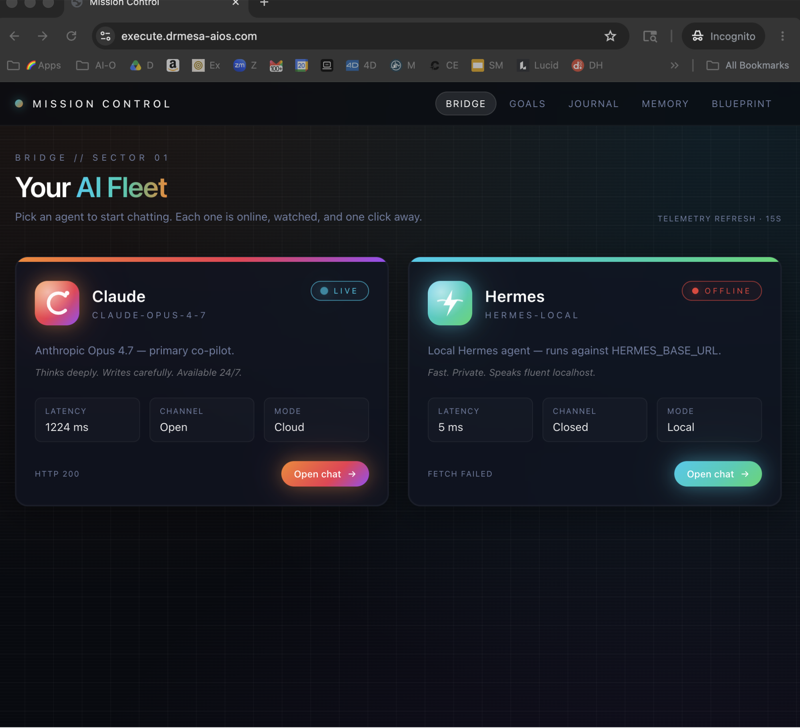
For broader Hermes context including the Workspace and multi-agent setups, this walkthrough covers the mission control plus workspace experience.
Hermes AI Agent Framework 2026 Comparison Table
| Path | Time | Cost | Technical Level | Best For |
|---|---|---|---|---|
| Manual GitHub | 5-15 min | Free | High | Developers |
| Claude Code | 2-5 min | Subscription | Low | Non-technical |
| Ollama One-Click | 5-10 min | Free | Low-Med | Most users |
| Max Hermes | 30 sec | Paid | None | Beginners |
For most users in 2026, the Ollama one-click is the right starting point because it balances setup ease against long-term flexibility.
Switching Between Paths
You're not locked into one path forever, though some transitions are easier than others.
Manual to Claude Code
Don't bother switching — if you've already manually installed, stay manual. The Claude Code install is for skipping the manual work, not replacing a working manual setup.
Manual to Ollama
You can add Ollama as a provider inside your existing manual setup, which gives you the best of both worlds without redoing the install.
Max Hermes to anything else
You can't really transfer your Max Hermes config to a self-hosted setup. You'll need to start fresh on the new path, which is a downside if you've built up customisations on Max.
What Each Path Lets You Build
The build ceiling differs meaningfully across the four paths.
Manual GitHub
You can build essentially anything Hermes supports — custom skills, channel integrations, multi-agent setups, and deep customisations of the framework itself.
Claude Code Install
You get the same capabilities as manual after the install completes, plus easier ongoing maintenance because Claude can help with updates and config changes.
Ollama One-Click
You can run most workflows, use free local models without API costs, and set up some channel integrations. The build surface covers 80% of what most users want to do.
Max Hermes
You can run single-agent chat workflows, multimodal tasks like image generation, and demos for clients. The build surface is narrower but enough for casual use.
For full power, manual or Ollama is the right choice. For ease above all else, Claude Code or Max Hermes wins.
🚀 Want help picking the right path? AI Profit Boardroom has weekly live coaching where I'll help you pick + set up the right path. → Join here
My Recommendation By User Type
The right path depends heavily on who you are and what you're trying to build.
Solo operators
Start on Path 3 (Ollama One-Click) for fast value and migrate to Path 1 (Manual) when you outgrow the one-click setup. Most solo operators stay on Ollama for months before needing the deeper customisation.
Agency owners
Use Path 3 (Ollama One-Click) for daily work where you need fast setup, and Path 1 (Manual) for client-specific custom builds where you need deeper customisation.
Non-technical entrepreneurs
Use Path 2 (Claude Code Install) to skip the terminal entirely while still getting the full Hermes capability. You won't touch the command line at all.
Casual users
Use Path 4 (Max Hermes) for zero-setup access. The limitations matter less when you're just exploring.
What To Build After Setup
Once Hermes is running, regardless of which path you took, the build sequence is the same.
Step 1 — Set up memory
Set up Obsidian plus OMI for your second brain so Hermes has context to work with. See Hermes Second Brain for the full setup.
Step 2 — First skill
Build one skill for routine work — daily summary or email triage are good starters because they pay back immediately.
Step 3 — First scheduled task
Set up a daily automation that runs while you sleep. Even something simple proves the system works end to end.
Step 4 — Agent teams
Move into the Workspace or multi-profile setup once your individual skills are working. This is where the leverage compounds.
This is the standard build path regardless of which install method you used to get Hermes running.
Hermes AI Agent Framework 2026 Setup Mistakes
There are three mistakes I see new users make repeatedly.
1 — Picking manual when non-technical
If the terminal scares you, use Path 2 or 3 instead. Don't suffer through the manual install just because someone told you it's the "real" way. The non-manual paths get you to the same place faster.
2 — Picking Max Hermes for serious work
Max Hermes has limited features and you'll outgrow it fast if you're building anything serious. Use it for casual chat or demos, not for your daily driver.
3 — Not setting up memory
The biggest mistake regardless of path is skipping the memory setup. Memory is what makes Hermes 10x more useful than a stateless chat agent, and without it you're using maybe 20% of the framework's actual capability.
What Hermes Costs To Run
The ongoing cost depends entirely on which providers you use.
If using Ollama (free local)
The cost is essentially £0/month — just the electricity to run your machine, which is negligible for most users.
If using cloud LLMs
Expect £20-100/month depending on your usage volume and which provider you pick.
Max Hermes
The cost is whatever the current Max Hermes subscription pricing is on agent.mminia.io. Check the page for current rates.
For most users, starting on Ollama free and adding cloud providers as needed is the smartest cost path.
Daily Reality
Here's what a typical day looks like running Hermes daily across the four paths. In the morning you check the Hermes summary that ran as a scheduled task overnight. Mid-morning you fire a content or research mission against whatever you need today. At lunch you review the outputs and approve or refine. In the afternoon you call individual skills as ad-hoc needs come up. In the evening you plan tomorrow's missions before signing off.
Hermes runs the work and you orchestrate the direction — that's the daily flow regardless of which install path you picked.
FAQ — 4 Ways To Run Hermes
Which path is fastest?
Max Hermes at 30 seconds (paid, zero setup).
Which is cheapest?
Manual or Ollama — both are fully free with no ongoing costs beyond electricity.
Which is most powerful?
The manual install gives you the deepest customisation surface for power users.
Can I switch paths later?
Yes, with the caveat that Max Hermes config doesn't transfer to other paths.
Should beginners use Max Hermes?
Only for casual use. For real work, use Path 2 or 3 instead because the limitations on Max Hermes will frustrate you.
Is Ollama setup hard?
5-10 minutes including the model download — genuinely easy for most users.
Will Hermes work on Windows?
Yes — all four paths support Windows alongside Mac and Linux.
Further Reading On Agent OS Guide
For deeper walkthroughs on the topics in this article, the Agent OS Guide library has these worth bookmarking.
- Agent OS Guide — the full library if you want every Hermes framework angle in one place.
- Hermes Agent OS Q&A — answers the framework-level questions that come up before you commit to a path.
- Hermes SEO Agent OS — a concrete framework deployment built around SEO work.
- NotebookLM Agent OS — the research companion that pairs cleanly with the Hermes framework.
Related Reading
- How To Setup Hermes Agent — install detail.
- Hermes Second Brain — memory setup after.
- Hermes Workspace — mission control.
Latest Updates
- Hermes Agent Goals (NEW Persistent Update FREE) — major new feature.
- Atomic Chat Vs Ollama (Free OpenClaw Setup 2026) — free setup guide.
- 🌐 Read on aiprofitboardroom.com — sister-site take.
📺 Video notes + links to the tools 👉
🎥 Learn how I make these videos 👉
🆓 Get a FREE AI Course + Community + 1,000 AI Agents 👉
The Hermes AI agent framework 2026 has 4 viable paths — pick the one that fits your technical level and scaling plans, and you'll be running in minutes rather than hours.