Your first Hermes dashboard command will probably be a build command, and it'll take about a minute to change how you think about AI assistants.
I'm going to walk you through exactly what happens on screen, in order, from the first thing you say to the point where the dashboard is full of stuff you made.
This is the first-run tour, not the theory.
Minute one: you say the wake word
The dashboard sits there quietly until you wake it.
I use "Jarvis" as my wake word, though "Hermes" works too, and saying it again switches the listener back off.
That on-off toggle is why I can leave it running all day in a kind of wall mode.
It's ready and waiting, and if I'd rather not talk I just type into it instead.
Both routes hit the same agent, so nothing about the behaviour changes.
Minute two: the first build command
"Jarvis, build me a galaxy I can swirl with my mouse."
"Built and running, sir. Have a look."
That's the response, and the galaxy is there in the browser, spinning wherever you drag.
The reason I recommend this as a first Hermes dashboard command is that it tests three things at once.
It proves the agentic layer can write and run files.
It proves the voice layer is speaking back to you.
It proves the builds panel is catching what got made.
If all three work, everything else in this guide works.
🔥 Want the exact setup I used to get these results? Inside the AI Profit Boardroom, I've got a full Hermes Jarvis section with step-by-step video tutorials, the install zip and every prompt. Plus weekly coaching calls + 2,800+ members building real automations. → Get access here
Minute three: you check if it remembers you
"Jarvis, what have I been working on this week?"
Mine came back with: "you've been tinkering with thumbnail work this week, sir — the thumbnails log shows recent edits there, suggesting that's where your focus has been landing."
That answer isn't from the model's imagination.
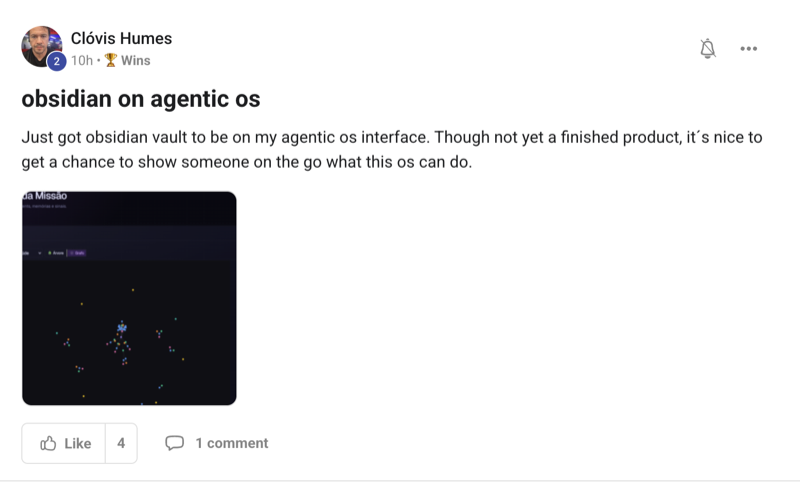
My conversations with Hermes and Hermes Jarvis are linked to my Obsidian memory, which I call the memory galaxy — my second brain.
Everything I do with Jarvis lands in a log I can open later and read back.
If your version of this command invents an answer, your memory link isn't wired up yet.
Go and connect it, because it's the difference between an assistant and a demo.
The Hermes second brain guide covers the Obsidian side properly.
Minute four: the silly test that's actually a system check
"Jarvis, tell me a joke that's about AI."
Mine: "Why did the neural network break up with the database? It said she had too many issues and wouldn't commit to a schema."
It sounds like a laugh, and it is, but it's also my fastest ElevenLabs check.
If the joke comes back spoken, the voice layer is healthy.
If it comes back as text only, fix the voice before you spend twenty minutes debugging a build.
Minute five: the dashboard views
"Jarvis, show me my numbers."
"Pulling up the numbers, sir" — and the metrics panel fills the screen.
"Jarvis, show me my team."
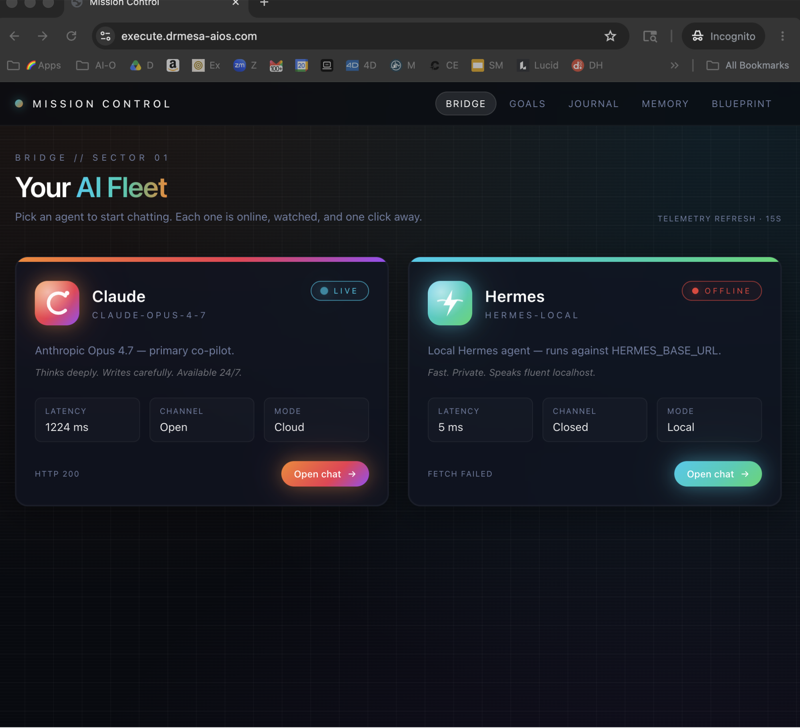
"Here's the team, sir" — and it pulls up the agents already configured in the system.
Mine shows Claude, OpenClaw and Hermes all together.
That command is surprisingly useful early on, because it shows you what's genuinely connected rather than what you think you connected.
Minute six: it opens things on your actual computer
"Jarvis, open up juliangoldie.com."
"Opening Julian Goldie's site now, sir" — and the website opens.
This is the moment most people realise it isn't a chatbot in a box.
Computer use and browser use are built into the system, which is powerful on its own and even more powerful inside longer tasks.
The agent can go and look at a real page, then build something from what it saw.
Minute seven: the builds gallery
"Show me everything I've built."
"Here's everything we've built, sir."
Now the gallery opens, and this is the part that makes the whole thing stick.
Here's what's currently in mine, all made through commands.
| Build | What it is | Still use it? |
|---|---|---|
| Habit tracker | A working tracker built entirely by voice | Yes |
| Full website | A complete site from a single command | Yes |
| Japanese flashcard game | A study game with card flipping | Occasionally |
| Meditation timer | A simple timer with a calm UI | Yes |
| Videos | Generated video content | Yes |
| Interactive galaxy | The mouse-swirl 3D demo | Purely for showing people |
I don't code.
Every one of those came out of a spoken command and got filed away automatically.
And let's be honest — this is the worst this technology is ever going to be.
Minute eight: the panels you haven't touched yet
Scroll the dashboard and there's more sitting there.
The history panel holds the full record of every conversation you've had.
The model controls let you manage which model is answering and swap it without leaving the screen.
The MCP section links Hermes to other tools, which extends what any command can reach.
The control room is the wider system view.
Goal mode is for when you want the agent chasing an outcome over time rather than doing one thing.
Chat mode is plain typing, for when voice is overkill.
Mission control is where agent teams live, with Paperclip built in.
The agent group chat lets Hermes talk to Claude and Gemini in the same thread.
That last one is my favourite part of the whole build, and I explain how it's wired in Hermes agent mission control.
Minute nine: what's actually running underneath
Three components, nothing exotic.
Hermes agent is the open source project, and all its agentic capability is built into this.
ElevenLabs generates the voice.
Claude sits in the background doing the improvements and helping me build the system itself.
If you want to build your own, that's the recipe — combine Hermes with ElevenLabs and let Claude help you in the background.
I've done a similar thing with free Claude Code, running an agent factory that builds live while you talk or type at it.
That version runs on Qwen 2.5 Coder with Ollama, so it's a free local model doing real work.
Local models are getting better fast, and that's worth paying attention to.
Minute ten: the honest bit
It doesn't always work.
Sometimes it isn't that smooth, sometimes a command misfires, and I say that on camera too.
The power of it still blows my mind, and I improve it every single day.
If your goal is pure throughput, something like Paperclip or a structured agent team will get more done faster.
If your goal is an assistant that feels like the future and quietly leaves a gallery of real builds behind it, this is the one.
🔥 Want my full Hermes Jarvis setup? The complete Agent OS build — dashboard, voice, wake word, install zip and prompts — is inside the AI Profit Boardroom. Updated daily, with four weekly coaching calls where you can share your screen and get it working live. → Get the Agent OS here
FAQ
What should my first Hermes dashboard command be?
A build command with an interaction in it, like "build me a galaxy I can swirl with my mouse". It tests the agent layer, the voice layer and the builds panel in one go.
How long does a Hermes dashboard command take to run?
A simple interactive build comes back in about a minute with "built and running, sir". Bigger builds like a full website take longer because the agent is writing real files.
Do I have to speak the command out loud?
No. Leave the wake word off and type the same command into the chat box. The agent behaviour is identical.
Where does the finished build go?
Into the builds section of the dashboard, alongside everything else you've made. You can reopen anything weeks later.
Can Hermes tell me what I worked on this week?
Yes, if your memory link is connected. Mine reads my Obsidian logs, which is how it knew I'd been on thumbnail work.
Does it work perfectly every time?
No. Sometimes it isn't smooth and a command misfires. I improve the system daily and it's still worth running.
About Julian
I'm Julian Goldie — AI entrepreneur, SEO expert, and founder of the AI Profit Boardroom (2,800+ members). I help business owners scale with AI agents, automation, and SEO.
- 400K+ YouTube subscribers
- 7-figure AI agency (Goldie Agency)
- Daily training inside the Boardroom
- Author of multiple AI automation playbooks
→ Get my best AI training inside the AI Profit Boardroom
Also On Our Network
- 🌐 Read on bestaiagentcommunity.com
- 🌐 Read on aiprofitboardroom.com
- 🌐 Read on aisuccesslabjuliangoldie.com
- 🌐 Read on aimoneylabjuliangoldie.com
Related reading
- What is the Hermes Agent OS dashboard? — the full panel tour.
- Hermes agent use cases — what to build next.
- Best Hermes agent dashboard — choosing your front end.
Run one build, one memory question and one browser open, and you'll know within ten minutes whether the Hermes dashboard command setup is worth your weekend.
📺 Video notes + links to the tools 👉