Agent OS Claude is the operating system I built for my AI agents using one Claude Desktop prompt and zero hand-written code.
If you've ever wanted a real mission-control dashboard for Claude, OpenClaw, Hermes, and anything else in your stack, this is the tutorial that walks through it end to end.
The tutorial below is the step-by-step I run with new boardroom members so they can have an Agent OS Claude dashboard live by the end of one evening.
Want the finished Agent OS Claude template? Inside the AI Profit Boardroom, I've zipped up the dashboard, the Claude wiring, and the prompt library — plus five weekly coaching calls. Get inside
What Your Agent OS Claude Build Delivers
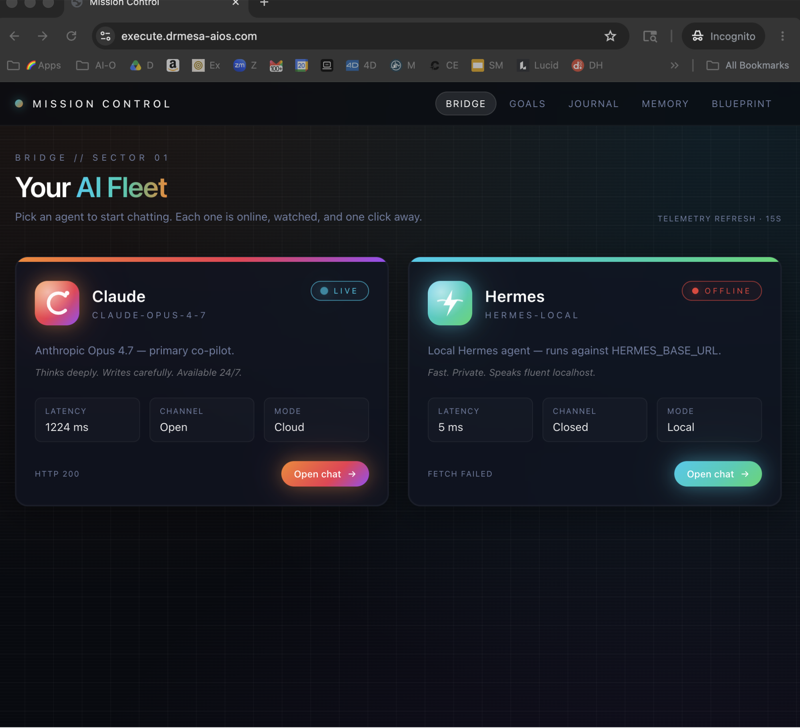
Before we start, let me show you the finish line so you know what you're building toward.
By the end of this tutorial you'll have a locally hosted web dashboard running on your machine.
The dashboard will have an Intelligence panel where you can chat with Claude.
It'll have a panel for OpenClaw showing browser tasks running in real time.
It'll have a panel for Hermes showing scheduled jobs and research workflows.
It'll have a status bar showing Claude's connection state and a one-click button to open the raw CLI.
It'll have a memory side panel showing chats and outputs auto-logged to Obsidian.
Total build time on your end is about 30 minutes of typing, plus Claude's own build time.
This is the cleanest stack you can run in 2026, and it costs nothing extra to build.
Step One — Prerequisites
You need three things on your machine before you start.
You need Claude Desktop installed with file system access enabled in the connectors panel.
You need Node.js installed — version 20 or newer is fine.
You need a folder where you want the OS to live, like ~/Code/agent-os-claude.
That's it.
You don't need Docker, you don't need a cloud account, you don't need anything paid beyond your existing Claude subscription.
If you've got those three things, you're ready to build.
Step Two — The One Prompt That Builds Agent OS Claude
This is the prompt I use to build the OS in a single Claude Desktop session.
Open Claude Desktop, point it at the empty folder, and paste this in.
Create a beautiful operating system hosted locally for managing
Claude for a website connected to Claude. Should be like a beautiful
mission control dashboard. Then allow me to control my OpenClaw, my
Hermes, and any other agents in separate systems inside the dashboard.
That's literally the entire prompt.
I didn't add bullet points, I didn't list features, I didn't supply a wireframe.
Claude asks the right clarifying questions on its own.
Mine asked four things — which framework should it use, what styling system, which panels do I want for which agents, and where should it host locally.
I answered "you pick" for the first two, "Intelligence, OpenClaw, Hermes, plus a memory panel" for the third, and "localhost on port 3000" for the fourth.
Claude went away and built it.
Step Three — Watching Claude Build Agent OS Claude
Claude takes about an hour to two hours to build the full dashboard, depending on how much you let it polish.
You don't need to babysit it.
You can watch in the file system if you want — Claude creates a Next.js project, generates the Tailwind config, builds the panel components, wires up the API routes for the CLI bridge, and tests it all incrementally.
If it hits a snag, it tells you and waits for direction.
I had two snags on my first build — a missing environment variable for the Claude API key, and a port conflict because something else was running on 3000.
Both took 30 seconds to fix because Claude told me exactly what to do.
By the end of the session you've got a working Next.js project that runs with npm run dev.
Open localhost:3000 and the dashboard renders.
That's your Agent OS Claude live.
Step Four — The 4-Layer Goldie Mission Stack
While Claude is building, let me explain the architecture so you understand what just got assembled.
The OS sits in a four-layer stack with Claude in seat one.
Layer one is Intelligence — Claude Desktop plus Claude Code.
Claude is the brain that plans, reasons, and decides what every other layer should do next.
Claude Code is the build hand inside the same Intelligence layer — it handles file system work, refactors, and shipping new features for the OS.
Layer two is Execution — OpenClaw.
OpenClaw is the browser-driving agent that handles anything needing a real browser session.
Layer three is Research — Hermes.
Hermes runs scheduled jobs, long-running research chains, and multi-step API workflows.
Layer four is Self — Obsidian plus OMI.
Self is the memory base where every conversation, meeting, and agent output auto-logs.
The flow is goal in, plan generated, work routed, results captured, repeat.
Claude orchestrates all of it.
Step Five — Wiring The Claude CLI Bridge
The Intelligence panel needs to actually talk to Claude, and that wiring is the Claude CLI bridge.
The bridge is a small Node process Claude builds as part of step three.
It exposes an HTTP endpoint that the dashboard calls when you type a message.
When you press send in the Intelligence panel, the dashboard POSTs to the bridge.
The bridge calls Claude via the official CLI, streams the response back to the dashboard, and the panel renders Claude's reply in real time.
You'll see a small status pill at the top of the panel — "Claude connected" in green when the bridge is healthy.
If the bridge goes down, the pill turns amber and the dashboard tells you to check the CLI.
There's a one-click "open control room" button next to the pill that drops you into a side terminal with the raw Claude CLI for debugging.
That's the wiring.
It's cleaner than running the CLI in a separate terminal because everything stays in one window.
Step Six — Wiring OpenClaw And Hermes Panels
Once the Intelligence panel works, Claude wires up the downstream panels.
OpenClaw connects through MCP.
The dashboard registers the OpenClaw MCP server as a tool Claude can call, and the OpenClaw panel polls the server for the current job status.
When you tell Claude "use OpenClaw to scrape this page," Claude makes the MCP call, OpenClaw starts the job, and the dashboard panel updates with progress.
Hermes connects the same way through Hermes MCP.
The Hermes panel shows scheduled jobs, queue depth, and recent outputs.
When Claude routes work to Hermes, the panel lights up and you watch the job run.
If you've never set up Hermes MCP before, my how-to-setup-hermes-agent guide is the exact same MCP install Claude does for you in this build.
The pattern is identical.
Step Seven — Wiring The Memory Panel
The memory panel is the one that makes the OS feel personal.
Claude wires it to a local Obsidian vault as part of the build.
Every conversation in the Intelligence panel auto-saves to a "Chats" folder in the vault.
Every output from OpenClaw and Hermes auto-saves to an "Agents" folder.
Every meeting captured by OMI lands in a "Meetings" folder.
The memory panel reads from the vault and shows the most recent entries in a scrollable list.
Claude also has read access to the vault as part of its system context, which means it has full memory across sessions.
You can open the dashboard fresh in the morning and Claude knows what you did yesterday.
If you want the deeper Obsidian setup, my Claude Obsidian setup walkthrough has the vault structure I use.
Step Eight — Your First Real Workflow
Once everything's wired, run a real workflow to test the loop end to end.
Here's the one I use as my "everything works" check.
Open the Intelligence panel and type: "Find me five competitor articles ranking for 'best AI agent', pull the top three insights from each, and draft a comparison blog post outline."
Claude reads the goal and splits it into sub-tasks.
It routes the search and scraping to OpenClaw.
It routes the insight extraction to Hermes.
It keeps the outline writing for itself.
The dashboard panels light up with the work in progress.
Twelve to fifteen minutes later you've got a finished blog outline with citations.
That's the loop running end to end.
If that works, you've built it correctly.
Step Nine — Extending The OS
The fun bit is that the OS is now self-extending.
When you want a new panel, you ask Claude.
"Add a panel that shows me the top three trending Reddit threads in r/AIAgents each morning."
Claude builds it.
It writes the cron job that hits the Reddit API, it builds the panel component, it wires it to the dashboard, and it ships.
That's the compounding loop.
Every week your OS gets one or two new capabilities because you can extend it just by talking to it.
That's why I call this the highest-leverage tool I've built in 2026 — the system that grows itself.
Real Workflow — How A Founder Day Looks
Here's how a typical day looks once the OS is running.
At 7am the morning brief lands in your inbox.
Hermes ran the cron job overnight, summarised your inbox, your calendar, and the news for your space.
You open the dashboard at 8am with a coffee.
You read the brief, decide the top priority of the day, and type it into the Intelligence panel.
Claude routes the work to the right downstream layers.
You go to your meetings, OMI records them, the recordings land in the Self layer.
When you come back at 10am, the dashboard has results waiting — a finished spreadsheet, a draft email, a research dossier, whatever you asked for.
You review, refine, decide the next priority, and the loop continues.
At 5pm the evening rollup runs and you've done a full day's work with Claude handling the routing and your agents doing the lifting.
That's the unlock.
The Vimeo Walkthrough Of The Boardroom
If you want the full template I built — the dashboard, the wiring, the prompts — it's all inside the boardroom. This is the walkthrough.
Want the finished Agent OS Claude template plus the prompts? The AI Profit Boardroom ships with the dashboard zip, the Claude prompt library, and five weekly coaching calls with 3,000+ members. Join here
Tips From Building This With New Members
Here's what I've learned watching 50+ boardroom members run this build.
Give Claude a clean folder.
Don't drop the build into an existing project — the dependency graph will fight you.
Let Claude pick the framework.
If you force it into something it doesn't want to use, the build takes twice as long.
Don't skip the memory panel.
The memory panel is what makes the OS feel personal — without it, you're just running a dashboard.
Test the loop end to end before extending it.
The "Find five competitors" workflow above is the standard check.
If that works, you're solid.
Extend in small steps.
Add one new panel per week, not five.
That keeps Claude's context clean and the OS stable.
Common Mistakes I See
The first mistake is trying to build the OS without Claude Desktop having file system access.
It can't write the project files without it.
Enable file system access in the connectors panel before you start.
The second mistake is using Claude Sonnet at lower tiers for the build itself.
Use the highest model tier you have access to — the brain quality directly affects the code quality.
The third mistake is wiring the dashboard to the Claude API directly instead of through the CLI bridge.
The CLI bridge handles streaming, auth, and reconnects properly.
Direct API calls don't, and you'll spend a Saturday debugging it.
The fourth mistake is skipping MCP for Hermes and OpenClaw and trying to wire them with custom HTTP.
MCP is the standard.
Use it.
FAQ — Agent OS Claude Tutorial
How long does the Agent OS Claude build take?
Claude takes about an hour to two hours to build the dashboard and you spend roughly 30 minutes of active time giving direction.
Do I need Claude Pro for this build?
You need Claude Pro for the chat layer through the CLI bridge — only the background scheduled jobs use API credits.
Can I build Agent OS Claude without Claude Code?
You can — Claude Desktop handles the build by itself, but Claude Code makes ongoing extensions cleaner.
What's the easiest first extension to add to Agent OS Claude?
A morning brief cron job — Hermes runs it, the brief lands in the dashboard, and you read it with coffee.
Does Agent OS Claude work on Windows and Linux?
Yes — it's a Next.js project so it runs anywhere Node runs, which includes both.
What if my first build fails?
Tell Claude what failed, paste the error, and let it fix itself — that's the most common debugging loop in the build.
About Julian
I'm Julian Goldie, AI entrepreneur, SEO expert, and founder of the AI Profit Boardroom with 3,000+ members.
I help business owners scale with AI agents, automation, and SEO.
- 400K+ YouTube subscribers
- 7-figure AI agency (Goldie Agency)
- Daily training inside the Boardroom
- Author of multiple AI automation playbooks
Get my best AI training inside the AI Profit Boardroom
Latest Updates
- Agent OS — the parent guide to the OS pattern.
- What is Agent OS — the plain-English overview.
- Agent OS Hermes — the Hermes-first version of the same pattern.
Further Reading On Agent OS Guide
For deeper walkthroughs on the topics in this article, the Agent OS Guide library has these worth bookmarking.
- Agent OS Guide — the full library if you want every Claude-related agent os angle in one place.
- How Claude Mythos Changed AI — context on why Claude became the brain of so many agent stacks.
- Free Claude Code Setup Guide — a clean walkthrough for getting Claude Code wired in.
- Hermes Agent OS Q&A — answers the questions that come up when you bolt Hermes onto a Claude-first build.
Also On Our Network
- Read on bestaiagentcommunity.com
- Read on aiprofitboardroom.com
- Read on aisuccesslabjuliangoldie.com
- Read on aimoneylabjuliangoldie.com
Related Reading
- AI Agent OS — the broader category overview.
- Agentic AI OS — the agentic flavour of the same idea.
- Claude Hermes Agent — wiring Hermes to Claude.
- Hermes Agent OS — the Hermes side of the stack.
- Claude Code no-flicker mode — stable Claude Code inside the OS.
Video notes + links to the tools
Get a FREE AI Course + Community + 1,000 AI Agents
If you can paste one prompt into Claude Desktop and answer four follow-up questions, you can ship your own Agent OS Claude dashboard tonight.