Agentic AI OS automation is what happens when you stop treating Hermes, Grok, Claude and OpenClaw as separate tools and start running them as a single pipeline. I build automations for a living, and the upgrade from disconnected agents to a coordinated Agent OS is the biggest leap in automation productivity I have hit since I started this work. The pipeline now runs jobs end to end without me touching the middle.
This post is the automation view of an Agentic AI OS. I will walk you through the pipeline architecture, the three commands that connect Grok to Hermes, the modalities you unlock, and the exact daily automations I run with the stack.
🔥 Get the full Agentic AI OS as an AIPB bonus AI Profit Boardroom members get the Agent OS zip file, 100 prompts, 30-day roadmap, plus Hermes Agent + Claude OS launch kit. → Get inside
Why Automation Needs An Agentic AI OS Now
Traditional automation tools move data between SaaS apps. They are good at simple flows but they do not think and they do not remember. An Agentic AI OS does both, which collapses the manual judgement calls in the middle of most pipelines.
If your automation needs a human to decide whether to send the email, choose the image, or rewrite the script, you are still trading time for money. The OS does those decisions for you because the Self layer knows your standards and the Intelligence layer applies them.
The other shift is multi-modal. Automation in 2026 is not just moving text between apps. It is producing images, videos and voice as part of the same pipeline. Without a coordinated stack you cannot run that end to end.
That is why the Agentic AI OS pattern is replacing the traditional Zapier-plus-AI stack for serious operators this year.
The Pipeline Architecture
The Agentic AI OS pipeline has four stages and each stage corresponds to a layer in the Goldie Mission Stack.
Stage one is Intake. The OS receives a signal from a webhook, a schedule, an X mention or a voice note captured by OMI. Whatever the trigger, it lands in the OS as a structured event.
Stage two is Decision. The Intelligence layer through Claude reads the event, checks the Self layer for your standards and decides what to do. Build a video. Draft a post. Reach out to a lead. Skip entirely.
Stage three is Execution. The Execution layer through OpenClaw plus the Research layer through Hermes and Grok produces the actual output. Text, image, video, voice or browser actions.
Stage four is Delivery. The OS pushes the finished output to wherever it needs to go — email, Slack, X, a Google Doc, or back into Obsidian for review.
Every stage hands off automatically. The pipeline runs without you in the loop unless something needs your approval.
Hermes Plus Grok Is The Pipeline Backbone
Hermes is the layer that hosts the pipeline and Grok is what supercharged it this month. Before Grok plugged in, Hermes was a strong text and code agent with no native eyes, ears or hands for visual work.
The new XAI integration changes that completely. Hermes now has X search for live signals, Grok Imagine for images, Grok video for short clips, and Grok TTS for voice — all inside one auth flow.
For a pipeline builder, that means you can run a single workflow that listens to X, decides on a content angle, generates the visuals and ships the final asset without ever leaving the OS.
That is the difference between automation that produces text and automation that produces a finished multi-modal deliverable.
Three Commands To Connect Grok
Setup takes three commands and one browser login. There is no separate Grok account to wire if you already have an X subscription.
hermes update pulls the build with the new XAI auth flow baked in. Skip this and the model picker does not show the Grok option.
hermes model opens the model picker. Scroll to XAI Grok Auth, select it, and a browser window opens for you to log in with your X account. Once authorised, the token is stored locally and Hermes can call Grok freely.
hermes tools opens the tools menu. Enable X search, image generation, video generation and text to speech. Tick all four for the full unlock.
That is the entire onboarding for the Research layer. Two minutes of terminal work, four modalities live.
Modalities In The Pipeline
X search is the live data feed. Pipelines can query trending topics, monitor specific accounts, or react to mentions in real time. No more stale training data running through your automations.
Image generation feeds the visual stages of any pipeline. Set quality to best, accept the slightly longer render, and you get hero images, social posts and thumbnails on demand.
Video generation produces clips of around 25 seconds that work for hooks, ads and B-roll. The cyberpunk Tokyo dragon test I ran came back usable in one render.
Text to speech turns any script the pipeline produces into a voice clip. Sales videos, podcast drafts and voice notes all become automation-native.
Together those four modalities turn a text pipeline into a full multi-modal production line.
The Goldie Mission Stack — Four Layers
The stack underneath every pipeline I build has four layers and each one matters.
Intelligence is Claude plus Claude Code. The brain that plans and writes.
Execution is OpenClaw. The hands that click, type and run jobs on the machine.
Research is Hermes plus Grok. The senses that gather signals and produce media.
Self is Obsidian plus OMI. The memory that holds your context, your standards and your voice.
Skip any one of those and the pipeline gets worse. Lose Intelligence and decisions are weak. Lose Execution and nothing actually happens. Lose Research and the pipeline runs blind. Lose Self and every output sounds generic.
The Self Layer Is The Reason Automations Sound Like You
The Self layer is the most under-rated piece of the OS. Without it your pipelines produce technically correct outputs that sound like every other AI-generated piece on the internet.
With Obsidian holding your offers, your SOPs and your transcripts — and OMI feeding fresh voice notes into the vault every day — your agents have constant access to your context. Every prompt is implicitly personalised.
When I ask Hermes how to use X search to build automations, the answer is shaped around Goldie Agency, AIPB and my Hermes work because the OS has read all of it. That is the unlock that turns a generic pipeline into a moat.
The Studio Section Inside The OS
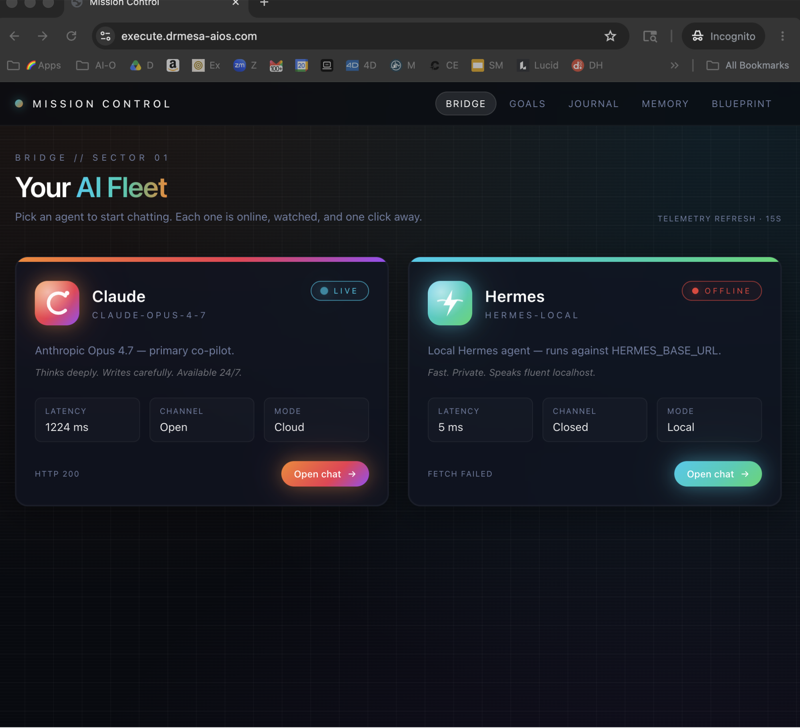
The newest addition to my Agent OS is a Studio section dedicated to multi-modal output. It was scaffolded by a single prompt to Claude Desktop and now sits as a permanent module inside the dashboard.
Studio runs image, video and speech generation in parallel. I can fire a video render on one tab while voice and image jobs run on the others, and the OS saves the history so I can grab any output again later.
For automation, Studio is the production end of the pipeline. Whatever the pipeline decides to ship, Studio renders it. The result is a pipeline that ends with a finished asset, not a draft.
Watch The Walkthrough
For the deeper Hermes context I recommend pairing this with my Hermes AI Agent Framework 2026 write-up so you can see how the framework layer underneath the OS works.
Why Local-First Wins For Automation
Automation that depends on third-party SaaS uptime is fragile. Every vendor pricing change, rate limit or terms tweak breaks your pipelines. Local-first removes that risk.
Privacy is the first reason. Your client data, your standards and your voice notes never leave your machine.
Speed is the second. Local reads and writes are instant. There is no round-trip lag in the middle of a 12-step pipeline.
Resilience is the third. If a model provider goes down, you swap the model and the pipeline keeps running because the OS is yours.
That is why I run the heavy logic locally and only call out to model APIs when needed.
Comparison Table — Traditional Automation Vs Agentic AI OS
| Capability | Zapier Plus AI Tabs | Agentic AI OS |
|---|---|---|
| Decision-making | Hard-coded | Claude reasoning |
| Memory of past runs | None | Shared Obsidian vault |
| Image generation | External API | Grok Imagine inside OS |
| Video generation | External API | Grok video inside OS |
| Voice | External API | Grok TTS inside OS |
| Real-time web | Limited | Grok X search |
| Multi-step parallelism | Sequential | Multi-agent fan-out |
| Personalisation | None | Trained on your vault |
If your pipelines feel like a bunch of glued-together steps, that is because they are. The OS replaces the glue with intelligence.
🚀 Need an AI agent stack for your agency? Book a free SEO + AI Strategy Session with Goldie Agency. → Book free session
Real Pipelines I Run Every Day
The first daily pipeline is the trend-to-content engine. Hermes runs X search every hour for my niche, Claude rates which trends are worth riding, and Studio produces a finished short with hero image, script and voice if a trend clears the bar.
The second is competitor monitoring. Hermes watches a fixed list of accounts and flags anything that mentions key topics. Claude decides if it deserves a response and drafts one for me to approve.
The third is the inbox triage pipeline. OpenClaw reads new emails, Claude classifies them against my rules, and either drafts a reply, schedules a calendar event or sends them to my Obsidian inbox.
The fourth is the overnight content pipeline. Before bed I queue a list of topics. The OS produces draft articles, hero images and voice-overs by the time I open the laptop in the morning.
Pipeline Mistakes To Avoid
Trying to do everything in one mega-pipeline is the first mistake. Smaller pipelines that hand off to each other are easier to debug and easier to swap.
Skipping the Self layer is the second mistake. Without your context the pipeline produces generic work and you end up rewriting it anyway, which defeats the purpose.
Not using version control on your prompts and configs is the third mistake. The OS is code-adjacent. Treat it like code.
Ignoring approvals on customer-facing output is the fourth. Build a review step into anything that goes to a customer until you trust the pipeline.
FAQs
Will this replace Zapier?
For most of my use cases, yes. Zapier is still useful for very simple data moves between SaaS apps, but anything involving decisions or multi-modal output is now better in the OS.
Can I trigger pipelines from outside the OS?
Yes. Webhooks, schedules, voice notes via OMI, and X mentions can all kick off pipelines.
Does the OS handle error retries?
Yes. Failed steps re-queue automatically and persistent failures get surfaced to you through the dashboard.
How many concurrent pipelines can it run?
In practice I run between five and ten in parallel on a modern Mac without issues. The bottleneck is usually model API rate limits, not the OS.
Is the launch kit worth joining AIPB for?
If you want the pre-built Agent OS zip, the 100 prompts and the 30-day automation roadmap, yes. The weekly live coaching is where most members say the real edge comes from.
When To Build A Pipeline Versus Run It Manually
If a task happens more than three times a week and takes more than ten minutes per run, automate it.
If a task requires judgement that depends on your context, the OS can still automate it because the Self layer provides the context. That used to be the line where automation stopped. It is not anymore.
If a task is purely creative and not yet repeatable, do not automate it. Build the muscle manually first, then convert it into a pipeline once the pattern is clear.
When Pipelines Are The Wrong Tool
If you are testing an offer for the first time, do it by hand. You will learn things automating it would hide.
If a task happens once a quarter, the setup time is more than the run time. Skip the pipeline.
If outputs vary wildly each time and have no underlying pattern, you do not have a pipeline candidate. You have a custom job.
FAQ — Agentic AI OS Automation
How long does it take to build a typical pipeline?
A simple two-step pipeline takes about 15 minutes. A multi-modal pipeline that ships finished content takes an hour or two the first time.
Can a non-technical operator maintain the OS?
Yes, once the launch kit is installed. Most day-to-day work is in the dashboard or in plain-text prompts.
Will the pipelines survive a model deprecation?
Yes. Swap the model in the config and the pipeline keeps running. The OS abstracts the model layer.
Is Grok essential for automation pipelines?
Not strictly, but X search, image, video and voice all live in Grok now. Skip it and you lose the four most useful modalities for content pipelines.
Can I run pipelines for clients?
Yes. Many AIPB members charge for Agent OS pipelines as a deliverable for their clients. The Self layer keeps the client brand consistent across runs.
Latest Updates
- Hermes MCP Server — how to expose Hermes capabilities to other tools in your pipelines.
- Hermes Computer Use — the Execution layer that handles real clicks and keystrokes.
- Hermes Agent Installation Guide 2026 — the install path I recommend for new pipeline builders.
Further Reading On Agent OS Guide
For deeper walkthroughs on the topics in this article, the Agent OS Guide library has these worth bookmarking.
- Agent OS Guide — the full library if you want every angle on the agentic ai os concept in one place.
- Hermes Agent OS Q&A — answers the wiring questions that come up when you actually build one.
- NotebookLM Agent OS — a worked example of one agent inside the agentic ai os pattern.
- Agent OS Member Testimonials — proof points from operators running this stack on real businesses.
Also On Our Network
- 🌐 Read on bestaiagentcommunity.com
- 🌐 Read on aiprofitboardroom.com
- 🌐 Read on aisuccesslabjuliangoldie.com
- 🌐 Read on aimoneylabjuliangoldie.com
Related Reading
- Hermes Agent OS — the full Agent OS breakdown that this post builds on.
- Hermes AI Agent Framework 2026 — the framework powering the Research layer.
- Claude Hermes Agent — the Claude plus Hermes pairing at the heart of the Intelligence layer.
- OMI Obsidian — the wearable plus vault combo that powers the Self layer.
- Hermes Agent HUD UI — the dashboard that ties the pipelines together.
📺 Video notes + links to the tools 👉
🎥 Learn how I make these videos 👉
🆓 Get a FREE AI Course + Community + 1,000 AI Agents 👉
Agentic AI OS automation is how a one-person automation shop ships agency-level pipelines in 2026 — wire Grok into Hermes, build your first multi-modal pipeline this week, and stop gluing tools together by hand.