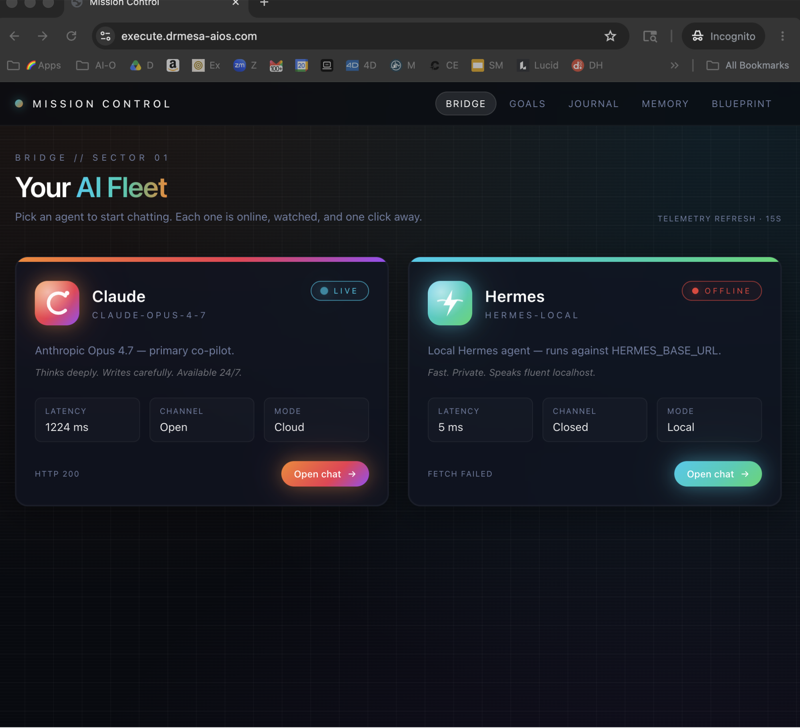
This hermes agent installation guide 2026 is the production-grade setup I run when I want Hermes operating as an always-on automation layer — not just a desktop CLI toy.
I'll walk through every install command, the production hosting choices that matter, and the scheduled automation patterns I use to keep Hermes running 24/7 across my agency.
🔥 Want my full Hermes installation + workflow training? AI Profit Boardroom has the full Hermes setup course, Workspace + Swarm + Goal trainings, plus weekly live coaching. → Get the trainings
Why Hermes Is The Right Production Automation Base
Hermes runs on seven different terminal backends out of the box: local, Docker, SSH, Singularity, Modal, Daytona, and Vercel Sandbox.
That alone makes it the most production-flexible agent I've used.
It supports more than 200 models across Nous Portal, OpenRouter, NVIDIA NIM, z.ai/GLM, Kimi/Moonshot, MiniMax, Hugging Face, OpenAI, and custom endpoints — so model lock-in is impossible.
It has a built-in cron scheduler with delivery to any messaging platform, which means recurring automation lives inside Hermes rather than in a separate scheduling layer.
It can delegate and parallelise by spawning isolated subagents — that's how production swarms get built.
For research-grade work it ships batch trajectory generation, Atropos RL environments, and trajectory compression — the same primitives Nous Research uses internally.
145,000 GitHub stars across 949 contributors means this is a real production project, not a weekend hack.
Install Command For Linux Servers (The Production Default)
Production almost always means a Linux server. Here's the one-liner.
curl -fsSL https://raw.githubusercontent.com/NousResearch/hermes-agent/main/scripts/install.sh | bash
That pulls the official install script from the NousResearch repo and runs it through bash on your server.
It installs uv, Python 3.11, Node.js, ripgrep, and the supporting CLI tooling in one pass.
It writes the Hermes binary to your shell path.
For a stock Ubuntu 22.04 VPS this command is all you need to get to a working install.
Install Command For macOS Developer Machines
If you're developing automations on a Mac before pushing to production, same install command.
curl -fsSL https://raw.githubusercontent.com/NousResearch/hermes-agent/main/scripts/install.sh | bash
Bash-compatible installer on macOS works perfectly. After install, source ~/.zshrc (or source ~/.bashrc if you've kept bash as your default).
The Mac install is my staging environment — I build and test automations locally, then push the same config to my VPS for production.
Install Command For Windows
Windows production servers are rare, but for developer machines here's the PowerShell installer.
irm https://raw.githubusercontent.com/NousResearch/hermes-agent/main/scripts/install.ps1 | iex
Currently early beta. Handles uv, Python 3.11, Node.js, ripgrep, ffmpeg, and portable Git Bash via MinGit.
MinGit unpacks to %LOCALAPPDATA%\hermes\git without admin permissions — isolated from any system Git you already have.
For production automation work I'd recommend WSL2 over native Windows — same one-liner, much more stable.
Install Command For Termux On Android
If you want a phone-side agent that can dispatch jobs from anywhere, Termux works.
Use the .[termux] extra rather than .[all] because voice deps aren't Android-compatible.
I keep a Termux install for travel weeks so I can trigger production jobs from a phone without a laptop.
Hermes Agent Installation Guide 2026 — Post-Install Steps
Reload the shell so the hermes binary resolves.
source ~/.bashrc
hermes
On macOS zsh, use source ~/.zshrc instead.
For headless production servers, you'll usually run Hermes inside tmux or screen so the session survives SSH disconnects.
Run hermes setup to walk through the full setup wizard — provider keys, default model, gateway config, scheduler.
Production Hosting Choices
Five-Dollar VPS (Hostinger, DigitalOcean, Vultr, Hetzner)
This is what I recommend for most production deployments. A $5/month VPS handles a single Hermes always-on instance comfortably.
You SSH in, run the bash one-liner, configure the gateway, and you're done.
The agent stays up 24/7, the messaging gateway always responds, and the cron scheduler fires on time.
Modal Serverless
Modal is the serverless backend Hermes natively supports. The killer feature is near-zero idle cost — Hermes spins up only when needed.
For workloads that aren't continuously active but need to be reachable, Modal is the cheapest production option.
Set up with hermes setup and pick Modal as the backend during the wizard.
Daytona Serverless
Daytona is the other serverless option Hermes supports natively. Similar profile to Modal — pay-per-execution with persistent state between runs.
I use Daytona for agent jobs that need a richer dev environment than Modal provides.
Docker On Anything
If you need reproducible deployments — for example deploying to multiple clients or maintaining environment parity — Hermes runs cleanly inside Docker.
Build once, deploy anywhere. Standard container ops apply.
SSH To A Remote Box
This is the simplest "remote production" pattern. Run Hermes on a remote server, SSH in to interact, expose the messaging gateway publicly so the agent reaches your apps.
Configuring The Messaging Gateway For Always-On Production
hermes gateway
That spins up the gateway that bridges Telegram, Discord, Slack, WhatsApp, Signal, and Email into a single Hermes instance.
For production you want the gateway running as a persistent process — wrap it in systemd or pm2 so it auto-restarts on crash.
Voice memo transcription, cross-platform continuity, and scheduled deliveries all run through this gateway.
Wire your incident channels here so production alerts hit your messaging layer instead of email.
Scheduled Automations With Hermes Cron
The built-in cron scheduler is one of Hermes' biggest production features.
Set up recurring jobs that run on a schedule and deliver output to any messaging platform.
Daily morning briefings to Telegram. Weekly metric reports to Slack. Hourly site monitoring with alerts to Discord on failures.
All configured through Hermes config rather than a separate scheduler — keep the automation surface in one place.
Watch The Walkthrough
The full walkthrough is worth the watch if you want to see Hermes running in a real automation flow rather than just toy examples.
Choosing The Right Model For Production
For production reasoning work I default to Claude Sonnet 4.8 via Anthropic — see my Sonnet 4.8 review for why it's my reasoning default.
For high-volume cheap-and-fast classification or routing, I route to a smaller OpenRouter or NVIDIA NIM (Nemotron) model.
For data-sensitive production where data can't leave my infrastructure, I run local via LM Studio or Ollama — see Atomic Chat vs Ollama for the comparison.
Swap models with hermes model — no code changes, no config edits.
For production I usually wire two models — a primary for reasoning and a fast fallback for routine classification — and switch with slash commands as needed.
Slash Commands Useful In Production
/new or /reset starts a fresh conversation context.
/model [provider:model] swaps the underlying LLM without restart.
/personality [name] swaps the agent persona — useful for routing different agents through the same gateway.
/retry and /undo roll back the last turn.
/compress shrinks long context, /usage shows session cost — critical for keeping production costs under control.
/insights --days N pulls the agent's reflection on patterns from the last N days. Run weekly to surface automation drift.
/skills browses learned skills.
/platforms, /status, /sethome show platform-specific status and configure the gateway's working directory.
Ctrl+C or sending a new message interrupts the current run — essential when an agent goes down a wrong path mid-execution.
Production Troubleshooting
If your Mac Mini production instance is sluggish, move to a $5 Hostinger VPS and SSH in. Performance issue solved.
If your agent feels passive in production, edit SOUL.md and add "be proactive, complete tasks end-to-end, take action without asking for confirmation."
For one-off autonomous loops use /goal <text> with a 20-turn default budget.
For multi-agent parallel production work, use the Workspace Swarm — covered in Hermes Agent Swarm — which lets you run 17+ agents at once.
If Windows install fails, run via Claude Code locally and let the model iterate the install for you.
hermes doctor diagnoses most config and credential issues in one pass — make this your first troubleshooting step.
Migrating Production Workloads From OpenClaw
hermes claw migrate
That's the interactive migration with the full preset.
hermes claw migrate --dry-run previews what would migrate without writing files — always run this first in production.
hermes claw migrate --preset user-data migrates without secrets if you want to handle production API keys via your secrets manager.
hermes claw migrate --overwrite overwrites existing Hermes conflicts.
What gets imported: SOUL.md persona, MEMORY.md and USER.md entries, user-created skills, command allowlist, messaging settings, allowlisted API keys (Telegram, OpenRouter, OpenAI, Anthropic, ElevenLabs), TTS workspace audio files, and AGENTS.md workspace instructions.
For production migrations I recommend dry-run first, then user-data preset, then layer in secrets via your existing secrets manager rather than letting the migration touch them.
What v0.13.0 Means For Production
v0.13.0 (Tenacity) dropped on 7 May 2026. v0.12.0 on 30 April. v0.11.0 on 23 April. v0.10.0 on 16 April.
Eleven releases in six months. This project moves fast.
v0.13 specifically ships harder retry semantics (production matters), better skill curation (memory hygiene at scale), faster gateway reconnects (fewer dropped messages), and improved memory consolidation (longer-running sessions stay coherent).
For production: pin a known-good version on a tagged release, test new releases in staging, then promote. Don't just hermes update in production without testing.
Hermes Hosting Methods Compared (Production View)
| Hosting Method | Best For | Cost | Always-On | Setup Time |
|---|---|---|---|---|
| $5 VPS (Hostinger/DO/Hetzner) | Single always-on instance | $5-10/mo | Yes | 15 min |
| Modal serverless | Bursty workloads, near-zero idle | $0-20/mo | On-demand | 20 min |
| Daytona serverless | Richer env, on-demand spin-up | $0-30/mo | On-demand | 20 min |
| Docker on any host | Reproducible, multi-tenant | Varies | Yes | 15 min |
| Vercel Sandbox | Web-adjacent workloads | Pay-per-use | On-demand | 15 min |
| Local Mac/Linux | Dev / staging only | $0 | No | 5 min |
For most production single-agent workloads, a $5 VPS is the right answer. Graduate to Modal or Daytona when you outgrow it.
🚀 Want hands-on Hermes coaching? AI Profit Boardroom members get daily Q&A with me and weekly live calls on Hermes setups. → Join here
Pairing Hermes With Workspace, Swarm, And Goals For Production
The base install is the foundation. The production leverage is in the layers on top.
Hermes Agent Workspace gives you the framework-level view of how Hermes fits into a production stack.
Hermes Agent Swarm is how I run 17+ parallel agents in production for content production and batch research.
Hermes Agent Goals is what I use for production autonomous loops — agents that run overnight on multi-step objectives.
Hermes Agent HUD UI is the visual control surface I rely on when monitoring multiple production agents.
That stack — base + Workspace + Swarm + Goals + HUD — is the production automation layer I run across my fifty-staff agency.
Hermes Agent Installation Guide 2026 — Production Mistakes To Avoid
Don't run production on your laptop. Move to a VPS the day you start trusting the automation.
Don't skip hermes doctor when something breaks. It diagnoses 80% of config issues in one pass.
Don't ignore SOUL.md in production. A timid agent that won't take action is a production liability — edit the persona.
Don't hermes update directly into production. Test in staging first.
Don't run without the gateway in systemd or pm2. Process supervision is mandatory for production.
Don't put secrets in MEMORY.md. Use environment variables or your secrets manager.
FAQ — Hermes Agent Installation Guide 2026
What's the cheapest production hosting for Hermes?
A $5/month VPS (Hostinger, DigitalOcean, Vultr, Hetzner) handles a single always-on instance comfortably.
Does Hermes support serverless?
Yes — Modal and Daytona are both first-class serverless backends. Vercel Sandbox is also supported.
How do I keep the messaging gateway always running?
Wrap hermes gateway in systemd (Linux) or pm2. Both auto-restart on crash and survive reboots.
Can I run multiple Hermes instances on one server?
Yes. Use isolated config directories and run each instance in its own working directory.
How do I update Hermes safely in production?
Test new releases in staging first, then promote to production. Don't run hermes update directly in prod.
What's the right model for production reasoning work?
For me, Claude Sonnet 4.8. For cheap classification, smaller OpenRouter or NVIDIA NIM models. For privacy-sensitive work, local via LM Studio or Ollama.
Should I upgrade to AI Profit Boardroom for the production course?
If you want the structured production setup course plus Workspace, Swarm, Goal trainings and weekly live coaching, yes. The 7-day refund and 30-day ROI guarantee make it risk-free.
Latest Updates
- Hermes Agent Swarm — running 17+ production-grade parallel agents.
- Hermes Agent Goals — autonomous loops for overnight production work.
- Sonnet 4.8 Review — my production reasoning default.
Also On Our Network
- 🌐 Read on bestaiagentcommunity.com
- 🌐 Read on aiprofitboardroom.com
- 🌐 Read on aisuccesslabjuliangoldie.com
- 🌐 Read on aimoneylabjuliangoldie.com
Related Reading
- Hermes AI Agent Framework 2026 — framework view for production.
- Hermes Agent HUD UI — production visual control surface.
- Atomic Chat vs Ollama — local model providers for privacy-sensitive prod work.
📺 Video notes + links to the tools 👉
🎥 Learn how I make these videos 👉
🆓 Get a FREE AI Course + Community + 1,000 AI Agents 👉
If you follow this hermes agent installation guide 2026 end-to-end, you'll have a production-grade Hermes instance running on a $5 VPS with always-on messaging and scheduled automation before the day is out.