For automation, the deepseek harness vs hermes decision comes down to one word: memory.
Hermes remembers what it worked out and gets faster next time.
DeepSeek Harness does not — but it builds things three times quicker and never times out on a big job.
Point each one at the right work and you get an automation stack that neither could give you alone.
The automation verdict
Recurring work that repeats every day or week goes to Hermes, because it gets faster each time it runs.
One-off building work goes to DeepSeek Harness, because it finishes and it does not stall.
That split is the entire article, and everything below is the reasoning.
The self-improvement loop is the real feature
Hermes launched from Nous Research on 25 February 2026 and now sits at roughly 226,000 GitHub stars.
The feature that actually matters for automation is not the star count.
It is that Hermes has a three-layer memory system and a self-improvement loop.
When it solves a problem, it can save what it learned as a skill.
Next time the same job comes round, it runs faster because it remembers how.
Almost no other agent does this.
For automation that is the difference between a script you maintain and a system that improves while you sleep.
Where it reaches you
The second Hermes advantage is channels.
It talks through Telegram, WhatsApp, Discord, Microsoft Teams and even iMessage without any custom work.
For an automation that needs to ping a human — approve this, review that, here is the daily brief — that matters more than raw speed.
What DeepSeek Harness brings instead
DeepSeek Harness is a local AI agent that runs on your computer while the model runs elsewhere.
It reads files, runs commands, changes code and searches the web.
It hit around 113,000 GitHub stars within two days of launch, now past 136,000, with 421 community plugins published one day after release.
The design is why.
Everything is a plugin: the model, the tools, memory, session locks, search, sub-agents, scheduling, and even the main loop that makes the agent think and act.
Any piece can be swapped without touching the core.
For an automation engineer that is the whole pitch — you are not accepting somebody else's architecture, you are assembling your own.
The plugin framework underneath, Cordis, has powered an open source chatbot project for years, which is why a v0.1 preview does not feel like one.
Building a workflow: hours versus minutes
Here is the practical difference I felt hardest.
In Hermes I have built custom workflows — Hermes Astra, Hermes Muse, Hermes Oracle. Oracle pulls the latest news from Twitter and tells me what is trending right now.
It works, and it took hours of coding.
In DeepSeek Harness you open a new session, pick creator mode, and describe what you want.
I asked for a panel in the corner with my three daily tasks and got it.
I asked for a daily task scheduler with times, days and repeat options, and watched it design the day semantics, plan the UI, validate the options and write the CSS in real time.
Same class of outcome, minutes instead of hours.
Hermes feels fixed once it is set up. Harness stays editable.
Scheduling on both
People assume scheduling is a Hermes-only thing. It is not.
DeepSeek Harness supports the same cron-style setup, and you can build the scheduler yourself through creator mode rather than waiting for a feature.
Likewise on mobile: Hermes connects natively, and there is already a community plugin pairing DeepSeek Harness with a paired mobile device.
That is what 421 plugins in a day means in practice — the gap closes fast.
| Automation need | Better choice | Why |
|---|---|---|
| Daily recurring research | Hermes | Memory + self-improvement loop |
| Big build or refactor | DeepSeek Harness | Does not time out, much faster |
| Human-in-the-loop alerts | Hermes | Native Telegram, WhatsApp, Discord, Teams, iMessage |
| Custom internal tooling | DeepSeek Harness | Creator mode rebuilds the UI live |
| Swapping models to cut cost | DeepSeek Harness | Model is a plugin |
| Long-running scheduled jobs | Either | Both support cron-style scheduling |
The failure mode to plan for
Hermes is powerful and fiddly, and it breaks more.
DeepSeek Harness breaks less but is a v0.1 developer preview, so it will change fast and it will break sometimes too.
For automation that means one rule: never let a single agent be the only thing standing between a job and a business outcome.
Route work through an orchestrator, log everything, and keep the fallback engine wired in.
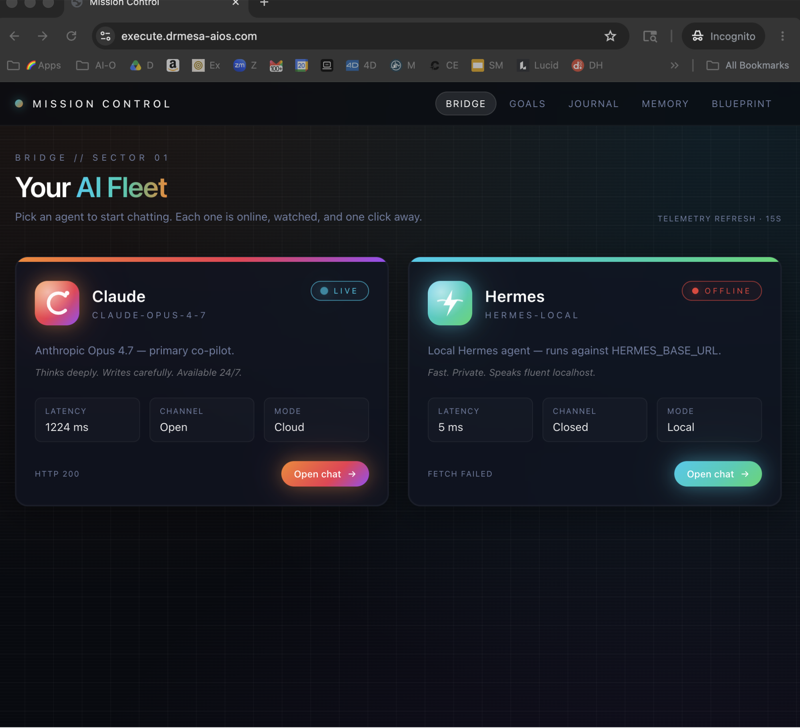
That is precisely why I run both inside one agent operating system rather than committing to either.
🔥 Want the whole automation stack in one dashboard?
Inside the AI Profit Boardroom I show the full Agent OS with Hermes and DeepSeek Harness working together — plus four coaching calls a week and 4,000+ members.
The free-brain angle
Both tools are free and open source.
The models can be free too — plug DeepSeek V4 Flash from OpenCode into either one and the running cost drops to nothing.
For automation that changes the maths completely, because the constraint stops being budget and becomes design.
Most people still automate as if every API call is expensive.
It is not, and that assumption is costing you more than the tokens ever did.
What I would build first
One. A daily research agent on Hermes, because repetition is where the memory pays.
Two. A build agent on DeepSeek Harness for anything code-shaped.
Three. An approval channel through Hermes messaging, so a human gets pinged where they already are.
Four. One orchestrator in front of both, so the routing is a rule rather than a decision.
Five. A free brain plugged in for volume work, and a frontier model reserved for the jobs that justify it.
FAQ
Which is better for automation, DeepSeek Harness or Hermes? Hermes for recurring scheduled work because it learns and remembers. DeepSeek Harness for building, because it is faster and does not time out.
What is Hermes's memory system? A three-layer memory plus a self-improvement loop that saves solved problems as reusable skills.
Can DeepSeek Harness run scheduled tasks? Yes, using the same cron-style approach. You can also build the scheduler yourself in creator mode.
Is DeepSeek Harness stable enough to automate on? It is a v0.1 developer preview built on the Cordis framework. Solid for its age, but keep a fallback.
Do I need to pay for either? No. Both are free and open source, and free models work inside both.
Two failure modes worth designing around
The silent stall. An agent that times out on a long job does not always tell you loudly. Hermes struggles on big coding tasks, and if that job was the first step in a chain, everything downstream just never happens. Design your chains so a stalled step raises a flag rather than a shrug.
The moving floor. DeepSeek Harness is a v0.1 developer preview. Things will change quickly and break occasionally. Anything automated on top of it needs to fail safe rather than fail silent, especially if it writes files or sends messages.
Neither of these is a reason to avoid either tool.
They are reasons to put logging and an orchestrator between the agents and anything that matters.
Why free changes the design, not just the bill
When both the tool and the brain can be free, the constraint on automation moves.
It stops being "can I afford to run this every hour" and becomes "is running this every hour actually useful".
Most automation stacks are still designed around the old constraint.
They batch things that should be continuous, and they skip checks that would cost pennies.
Go back through your workflows with a zero-cost assumption and you will find three or four places where a cheap agent could be watching something continuously instead of nothing watching it at all.
That is where the real automation gain is hiding, not in whichever agent won this month's comparison.
About Julian
I'm Julian Goldie — AI entrepreneur, SEO expert, and founder of the AI Profit Boardroom (4,000+ members). I help business owners scale with AI agents, automation, and SEO.
- 400K+ YouTube subscribers
- 7-figure AI agency (Goldie Agency)
- Daily training inside the Boardroom
- Author of multiple AI automation playbooks
→ Get my best AI training inside the AI Profit Boardroom
Related reading
For automation the deepseek harness vs hermes answer is not a winner — it is a routing table.