The agentic os command center is the answer to a problem I never thought I'd admit out loud — I'm tired of the terminal.
I came up the SEO and dev way, so I've spent more hours in a black-and-green CLI than I care to count.
But in 2026, running multiple AI agents from raw terminal is just slow, lossy and lonely.
This post is the honest case for why a proper dashboard beats CLI every time, and what an agentic os command center actually swaps in.
If you're still running everything from terminal in 2026, this one's for you.
Want the exact dashboard I use instead of terminal? Inside the AI Profit Boardroom you get the full command center zip, 100+ prompts and a 30-day build roadmap. Join AIPB for $59/mo
The terminal problem nobody admits
The terminal is incredible at what it's designed for.
But running 3-5 AI agents through it at the same time is genuinely painful.
You lose context the second a session ends.
You can't see at a glance which agent is doing what.
You can't search a chat from last Tuesday without grepping through log files.
And you can't show a client your "system" without them backing slowly out of the room.
I quoted this earlier on YouTube and I'll quote it again here: 99% of people don't want to use terminal.
That includes most of my Boardroom members, most of my clients and, increasingly, me.
The command center fixes that without giving up any of the power.
What a command center actually swaps in
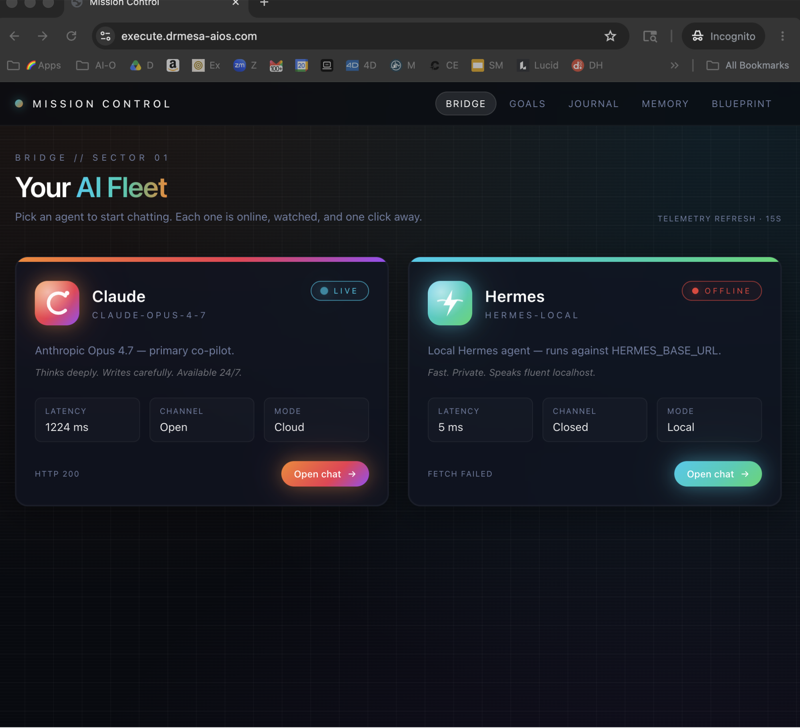
An agentic os command center is one screen that holds:
- Every agent (Claude, Hermes, OpenClaw, custom local) with a live status dot.
- An in-dashboard chat for each agent — no Cmd+Tab roulette.
- A goals tracker with progress bars.
- A daily journal that the agents read for context.
- A memory system that auto-saves every chat to Obsidian.
- A control room per agent with API keys, providers, session history, skills, plugins, Kanban and insights.
- Analytics for sessions, tool calls, tokens, models and peak hours.
- A persistent sidebar with mic input and session export.
If you've ever wanted "ChatGPT but for every agent and with memory", that's what it is.
For the broader "why agentic operating systems are a thing in 2026" frame, I wrote Agentic OS and Agentic OS Meaning — both are worth reading first.
Terminal vs command center — a side-by-side
This is the honest comparison.
| Job | Raw terminal | Agentic OS command center |
|---|---|---|
| See which agents are alive | Multiple panes + tmux | One status row, always visible |
| Switch between agents | Multiple windows | One click |
| Search past chats | grep through log files | One search bar, instant |
| Track goals | A markdown file you forget | Live panel with progress bars |
| See token spend | Stripe dashboards later | Built-in analytics panel |
| Show a client | Awkward | Looks like a Bloomberg terminal |
| Add a new agent | Write code, rebuild | Tell Claude in plain English |
The command center wins every single row, and it's not even close.
The only thing terminal still wins on is muscle memory for older devs.
That's a habit, not a feature.
The 4 panels that replace your terminal
Every command center I run, build for clients or teach in the Boardroom has the same four panels.
Panel 1 — Agent panel
This is where the agents live, side by side, with live status dots.
Click any of them and the chat opens in the same screen, with the agent's full history loaded.
Panel 2 — Memory panel
Every conversation auto-saves to Obsidian, and the memory panel reads from it in real time.
You search once, you get the right answer, regardless of which agent originally said it.
That's the thing terminal physically can't do without a load of duct tape.
Panel 3 — Goals + Journal panel
Goals get progress bars, journals get a daily entry box.
The agents read both before they respond, so prompts stop being generic and start being targeted at your actual targets.
Panel 4 — Analytics panel
Sessions, tool calls, tokens, models used and peak hours, all in proper charts.
This is the panel that converts the command center from a productivity toy into a business asset.
I broke each panel down in more depth in Hermes Agent Mission Control and OpenClaw Mission Control.
The agent control room — the bit terminal can't fake
Click into any agent and a control room opens.
That room has API keys, providers, session history, skills, plugins, Kanban and insights.
It's like opening the bonnet on a car and seeing every spec laid out and editable.
You can rewire that agent's defaults in seconds without leaving the dashboard.
Try doing that in tmux at 2am.
The 4-layer Goldie Mission Stack on top
Here's the stack I run on top of the command center.
| Layer | Tool | What it does |
|---|---|---|
| Intelligence | Claude | Plans, reasons, decides |
| Execution | OpenClaw | Clicks, ships, automates |
| Research | Hermes | Finds the inputs |
| Self | Obsidian + OMI | Holds the memory |
Each layer is a panel or a control room inside the command center.
The terminal can run any of these layers, but it can't show them together on one screen.
That's the whole pitch.
For the per-layer deep dives, see Agentic AI OS, Hermes Agent OS and Agentic OS Claude.
The hammer vs construction company analogy
Terminal is a hammer.
A great hammer, sure, but still a hammer.
The agentic os command center is the construction company — site office, foreman, project plan and materials list, all under one roof.
Hammers come and go.
The construction company is what keeps shipping.
Once you've worked in a construction company you don't go back to a shed with a single hammer.
That's how it feels going back to terminal after a week on the command center.
Why this works for non-coders too
Here's the part that flips most people.
You don't need to be a developer to run this.
You don't even need to know what Next.js is.
You tell Claude in plain English what you want, Claude builds the panel and it shows up in the dashboard.
That's how I built mine in one Claude Desktop session.
If a complete beginner asked me where to start, I'd point them at Agentic OS Claude Code and Agentic OS Download — that's the gentle ramp.
When terminal still wins
I'll be fair to terminal.
There are still moments when it wins:
- Quick one-off scripts where you just need a single shell command.
- Server-side work where there's no GUI to hand.
- Power-user dev workflows where you're already in vim or tmux all day.
But for running multiple AI agents day-in, day-out, with shared memory and visible analytics?
The command center wins.
Use the right tool for the job — and for running an agentic stack, that's the command center.
My honest terminal-to-dashboard switch story
I'll share the actual switch because it might mirror yours.
For years I had three tmux windows open at any time — one for Hermes logs, one for OpenClaw and one for general shell.
I'd lose track of which was which by lunch.
The breaking moment was when I shipped a feature, closed the terminal, and couldn't reconstruct what the agents had even done.
I lost an afternoon trying to piece it back together from scrollback.
That night I built the first version of the command center.
It was ugly, just an agent panel and a memory panel.
But it solved the "what just happened" problem on day one.
Within a week I added the goals panel and the journal panel.
Within a month the analytics panel was telling me where I was bleeding money.
The terminal is still on my Mac, of course.
But it's no longer where my agentic work lives — it's a tool I dip into when I need a shell, not a workplace.
That's the switch most operators are about to make in 2026.
Inside the AI Profit Boardroom
Here's what AIPB members get on this exact build:
- The complete command center zip.
- 100+ prompts to customise every panel.
- A 30-day roadmap from "I don't even know where to start" to a live dashboard.
- 5 weekly live coaching calls where I help debug.
- 3,000+ members already running their own versions.
- $59/mo locked, twin guarantee.
Stop fighting the terminal, get the dashboard. Join the AI Profit Boardroom for the zip, the roadmap, the prompts and weekly coaching.
If you want a free entry point first, the AI Money Lab community is open.
If you'd rather have a team build the whole stack for you, my agency at Goldie Agency handles bespoke builds.
FAQ — agentic os command center vs terminal
Is the agentic os command center actually faster than terminal?
For multi-agent workflows, yes — you save the time spent switching panes, grepping log files and rebuilding context after each session.
Do I have to give up terminal entirely?
No, I still use terminal for one-off scripts, but the command center handles all the multi-agent work that used to live in tmux.
Can I really build this without writing code?
Yes, I built mine by describing each panel to Claude in plain English inside a Claude Desktop session.
Does the command center work with my existing terminal tools?
Yes, you can wrap any CLI tool as a skill inside an agent's control room and call it from the dashboard.
Is the agentic os command center safer than running things in terminal?
It can be, because every action is logged in the analytics panel, so you can see exactly what happened, when and from which agent.
What's the learning curve compared to terminal?
Lighter for non-devs, similar for devs — most of the heavy lifting is already done by the underlying build, you're just describing what you want in plain English.
About Julian
I'm Julian Goldie — AI entrepreneur, SEO expert, and founder of the AI Profit Boardroom (3,000+ members). I help business owners scale with AI agents, automation and SEO.
- 400K+ YouTube subscribers
- 7-figure AI agency (Goldie Agency)
- Daily training inside the Boardroom
- Author of multiple AI automation playbooks
→ Get my best AI training inside the AI Profit Boardroom
Further Reading On Agent OS Guide
For deeper walkthroughs on the topics in this article, the Agent OS Guide library has these worth bookmarking.
- Agent OS Guide — the full library if you want every command-center angle on the agentic os in one place.
- Hermes Agent OS Q&A — answers the wiring questions that come up once your command center is live.
- NotebookLM Agent OS — one agent view that pairs cleanly with a command-center dashboard.
- Agent OS Member Testimonials — proof points from operators running this command center day-to-day.
Also On Our Network
- 🌐 Read on bestaiagentcommunity.com
- 🌐 Read on aiprofitboardroom.com
- 🌐 Read on aisuccesslabjuliangoldie.com
- 🌐 Read on aimoneylabjuliangoldie.com
Related reading
- Agentic OS
- Agentic OS Meaning
- Agentic OS Claude
- Agentic OS Claude Code
- Agentic OS Download
- Hermes Agent Mission Control
- OpenClaw Mission Control
📺 Video notes + links to the tools 👉
🎥 Learn how I make these videos 👉
🆓 Get a FREE AI Course + Community + 1,000 AI Agents 👉
That's why I'd take an agentic os command center over raw terminal every single time in 2026.