The agentic OS meaning makes sense the moment you see one running in real life, and it sounds like word salad until that point.
That is the problem with most of the explainers floating around online — they describe the concept without ever showing what the thing actually looks like on a screen.
So in this post I am going to walk through the meaning of an Agentic OS using the exact examples from my own workflow in 2026.
This is the same example-led explanation I use in the AI Profit Boardroom onboarding, because abstract definitions only stick when paired with concrete demos.
By the end of this post you will know what the term means, why it matters, and exactly what it looks like in motion.
Want the live walkthrough of every example below? Inside the AI Profit Boardroom I show the exact Agentic OS dashboards on screen during 5 weekly coaching calls. 3,000+ members inside. Get access here
The Agentic OS Meaning In One Sentence
An Agentic OS is a personal operating system that coordinates multiple AI agents on your own machine into one shared, memory-aware stack.
That is the cleanest one-sentence answer I can give you on the agentic OS meaning.
The word doing the heavy lifting is coordinates.
A regular AI setup is a stack of disconnected apps with no awareness of each other.
An Agentic OS is the layer underneath that gives them a shared dashboard, shared memory, and a shared way to pass tasks back and forth.
If you want the broader breakdown, see my post on what an Agentic OS really is and the agentic AI OS explainer.
Etymology — Where The Word Comes From
The phrase agentic OS is a mash-up of two words, and breaking them apart locks the meaning in fast.
The word agentic comes from the noun agent, which in AI describes software that takes actions on your behalf rather than only answering questions.
An AI agent can browse the web, write code, send emails, scrape data, and chain multiple steps without you intervening.
The adjective agentic just means "relating to agents" or "acting like one".
OS is short for operating system — the layer in any computer that coordinates apps and gives you one unified place to control everything.
Stick those halves together and the agentic OS meaning is the operating system designed specifically to coordinate autonomous AI agents.
That is the definition with no fluff.
Real Example One — The Tab Pile vs The Agentic OS
Here is the first example I show new Boardroom members.
Open your AI workspace right now and look at your tabs.
You probably have ChatGPT in one tab.
You have Claude in another.
You have a random agent CLI in a third terminal window.
Maybe you have a Notion page open with notes from last week's chats.
That is a tab pile, and it has no idea any of those windows belong to the same workflow.
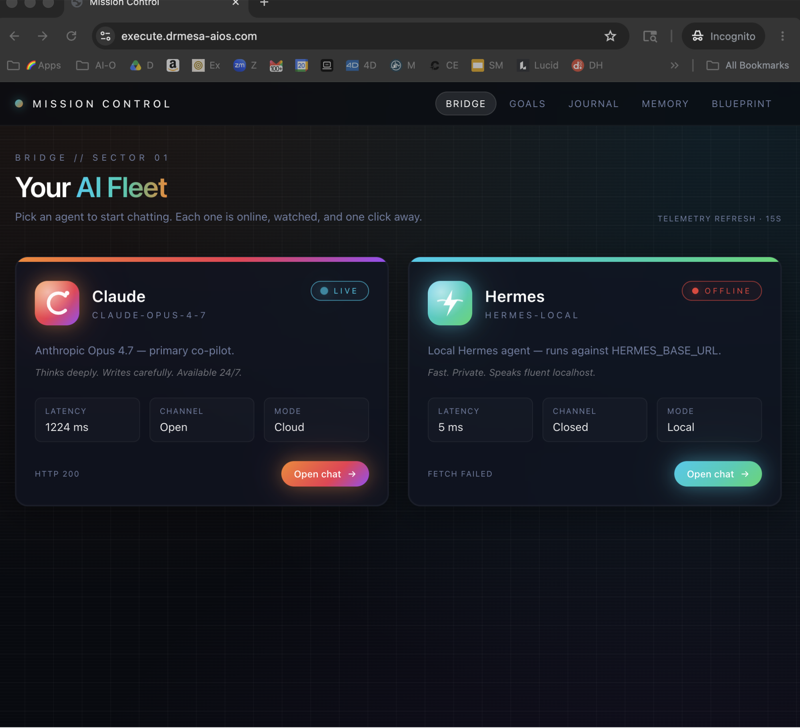
The Agentic OS replaces that pile with a single screen where every agent is visible at once and every previous conversation is searchable in one shared memory.
The before and after is night and day, and it is the cleanest real-world example of the agentic OS meaning.
Real Example Two — Writing A Long Report
Here is the second example, taken directly from a project I ran last month.
A client asked me for a 40-page market report on the AI automation space for finance teams.
The old way of doing this was hours of prompting ChatGPT, hours of pasting results into Notion, and hours of rewriting because nothing stayed consistent across sections.
With an Agentic OS the same job ran like this.
Claude planned the report and split it into ten sections.
Hermes ran deep research on each section in parallel.
Claude wrote each section using Hermes' notes and pulled from my Obsidian vault for client-specific context.
OpenClaw clicked through Google Docs to lay out and format the final report.
I watched the whole thing from one dashboard while doing other work.
That is what the agentic OS meaning looks like in motion — not five chat windows, but one coordinated stack producing a deliverable.
Real Example Three — Booking A Client Trip
Here is a smaller example to show the meaning is not only about big reports.
I needed to book a client trip to London, sort accommodation, send an itinerary, and update my calendar.
In an Agentic OS flow, Claude planned the trip and broke it into steps.
OpenClaw opened Google Flights, picked the right options, and held the booking page.
Hermes pulled hotel options that matched the brief.
Obsidian logged the itinerary into my client's vault entry for next time.
The whole thing took less than fifteen minutes of my actual attention.
The agents did the work. I made the final go-no-go calls.
That is what people miss about the agentic OS meaning — it is not just for engineers. It is for any operator who values their time.
The Phone OS Analogy
Beyond the live examples, the phone OS analogy is the fastest way I have found to explain the meaning.
Imagine your phone with no iOS or Android installed.
You would have a pile of apps sat on bare hardware with no notification system, no shared contacts, no clipboard, and no way for one app to talk to another.
That is exactly what your AI stack looks like today if you are running it as separate tabs.
An Agentic OS is the iOS layer for your AI agents.
It gives them a notification system, shared contacts (which is really shared memory), shared settings, and a single home screen.
The agentic OS meaning never gets confusing once you internalise that picture.
How An Agentic OS Differs From A Regular AI App
The agentic OS meaning is easiest to grasp through contrast.
ChatGPT alone is a chat interface — you type, it replies.
Claude Desktop is a chat with some tool use, but it is still essentially one agent in one window.
Hermes alone is one agent doing one workflow at a time.
An Agentic OS is the dashboard above all three that coordinates them with shared memory holding the context together.
So when somebody asks me "is Claude an Agentic OS?", the honest answer is no.
Claude is one of the brains. The OS is the layer that orchestrates Claude alongside everything else.
If you want the install path for the one I run, see Agentic OS download.
The Three Core Components Of An Agentic OS
Every legitimate Agentic OS has these three components.
If a vendor sells you something called an "Agentic OS" without all three, it is marketing wearing a costume.
1. Mission Control Dashboard
The first component is a single screen where you see every agent and task at once.
You can pause one, redirect another, and watch a third work in the background.
Without this screen you are flying blind across multiple agents, and the leverage collapses.
I wrote a full tour of mine in the Agentic OS command center post.
2. Coordination Layer
The second component is the layer that moves work between agents.
When research finishes, it hands the result to the writer.
When the writer finishes, the draft goes to QA.
When QA approves, the output ships to the destination.
This is the difference between "real automation" and "I have to copy-paste between tabs".
3. Shared Memory
The third component is shared memory.
Every conversation, document, decision, and previous run is logged in one searchable store every agent can access.
This is the most under-appreciated piece, and it is also the one that compounds the fastest.
I unpack the memory layer in my Claude Agentic OS and Agentic OS for Claude Code posts.
The Goldie Mission Stack — The Four Layers I Run
The cleanest mental model I have for the agentic OS meaning is the Goldie Mission Stack.
It is the four-layer system I personally use, and every Boardroom member learns it.
Layer 1 — Intelligence Layer
The intelligence layer is the brain that thinks and plans.
For me that is Claude in 2026. It decides which other agent should handle each step.
Claude is the executive of the stack.
Layer 2 — Execution Layer
The execution layer is the agent that actually does things in the real world.
For me that is OpenClaw. It clicks, types, browses, and operates apps on my computer like a virtual employee.
The intelligence layer says "book this flight" and OpenClaw goes and books it.
Layer 3 — Research Layer
The research layer gathers information from outside.
For me that is Hermes. Multi-source aggregation, deep research, and structured note generation.
The 40-page report example earlier? That was Hermes plus Claude working together.
Layer 4 — Self Layer
The self layer is the part that remembers you.
It is my notes, my voice transcripts via OMI, my Obsidian vault, and my client briefs.
Without the self layer every agent feels generic. With it, every agent sounds like it has worked at my company for years.
If you want the exact tools that fill each layer, the AI agent OS overview post walks through each pick.
Why The Meaning Matters For Your Business
The agentic OS meaning is not academic — it has real revenue implications.
Most people use AI like a hammer. One chat, one answer, repeat.
That caps your leverage at one task at a time.
An Agentic OS lets you run AI like a construction company.
A foreman plans the job, workers execute in parallel, a researcher pulls reference plans, and a notebook records every decision.
Same tools underneath. Completely different leverage on top.
This is why the term matters even if the jargon feels heavy at first.
Want me to walk you through every example above live? Inside the AI Profit Boardroom I demo these flows on 5 weekly coaching calls. 3,000+ members are inside. Join here
What An Agentic OS Is Not
Equally useful is knowing what the agentic OS meaning does not cover.
It is not a chatbot.
It is not a single AI agent.
It is not a SaaS product with one logo on the side.
It is not a model like GPT or Claude.
It is the coordination layer that ties all of those together.
If a vendor sells you something they call an "Agentic OS" but it is really one chat interface, that is marketing dressed up as operating system.
Watch The Boardroom Walkthrough
Here is the Boardroom walkthrough that explains why I bet my business on the Agentic OS approach.
If you want the configs, the prompts, and live coaching to set up the same stack I run, the Boardroom is where it lives.
It is locked at $59 a month with a twin guarantee, and over 3,000 members are inside building these stacks alongside me.
How To Build Your First Agentic OS This Week
You have the meaning, you have the examples — here is the simple path to actually build one.
Pick one intelligence layer brain. Claude is my pick.
Layer in one execution agent like OpenClaw so the brain can act in the real world.
Add a research layer like Hermes so the stack can gather information autonomously.
Plug in a self layer using Obsidian or a similar note system so everything you do feeds back into shared memory.
Wrap it all in a mission control dashboard so you can see every agent at once.
That is the entire build, and it is exactly what I cover end-to-end inside the AI Profit Boardroom.
Frequently Asked Questions About The Agentic OS Meaning
What is the simplest agentic OS meaning?
A personal operating system that coordinates multiple AI agents on your own machine into one stack with shared memory and one dashboard.
Can you give a real example of an Agentic OS at work?
Yes. Writing a 40-page client report where Claude plans, Hermes researches, OpenClaw lays it out in Google Docs, and Obsidian holds the client context — all from one dashboard.
Is an Agentic OS only useful for engineers?
No. Any operator who values their time benefits. Booking trips, writing reports, scraping competitors, and running outreach all become one-dashboard jobs.
How does an Agentic OS differ from agentic AI?
Agentic AI is the broad category of AI that acts. An Agentic OS is one specific architecture inside that category — the coordination layer for multiple agents.
Do I need to be a developer to set one up?
No. Most popular Agentic OS stacks install with a single script, and the Boardroom has step-by-step guides plus live coaching.
What is the difference between an Agentic OS and Claude?
Claude is a model. An Agentic OS is the layer that orchestrates Claude alongside other agents and memory systems.
About Julian
I am Julian Goldie — AI entrepreneur, SEO expert, and founder of the AI Profit Boardroom with over 3,000 members inside. I help business owners scale with AI agents, automation, and SEO at the Goldie Agency.
- Over 400,000 YouTube subscribers across my channels.
- 7-figure AI agency (Goldie Agency).
- Daily training and 5 weekly coaching calls inside the Boardroom.
- Author of multiple AI automation and SEO playbooks on Amazon.
→ Get my best AI training inside the AI Profit Boardroom
Further Reading On Agent OS Guide
For deeper walkthroughs on the topics in this article, the Agent OS Guide library has these worth bookmarking.
- Agent OS Guide — the full library if you want the wider definition set in one place.
- Hermes Agent OS Q&A — answers the foundational questions about what an agentic os actually does.
- NotebookLM Agent OS — a concrete worked example that makes the meaning tangible.
- Agent OS Member Testimonials — real-world voices that show what the term looks like in practice.
Also On Our Network
- 🌐 Read on bestaiagentcommunity.com
- 🌐 Read on aiprofitboardroom.com
- 🌐 Read on aisuccesslabjuliangoldie.com
- 🌐 Read on aimoneylabjuliangoldie.com
Related Reading
- What is Agent OS — the plain English explainer
- Agentic OS command center walkthrough
- Hermes Agentic OS deep dive
- Agentic OS download steps
📺 Video notes + links to the tools 👉
🎥 Learn how I make these videos 👉
🆓 Get a FREE AI Course + Community + 1,000 AI Agents 👉
If you want a 1:1 session on building your first Agentic OS, my team at Goldie Agency runs free strategy sessions for serious business owners.
That is the agentic OS meaning explained through the real examples I run every single day in 2026.